Pete Daoust
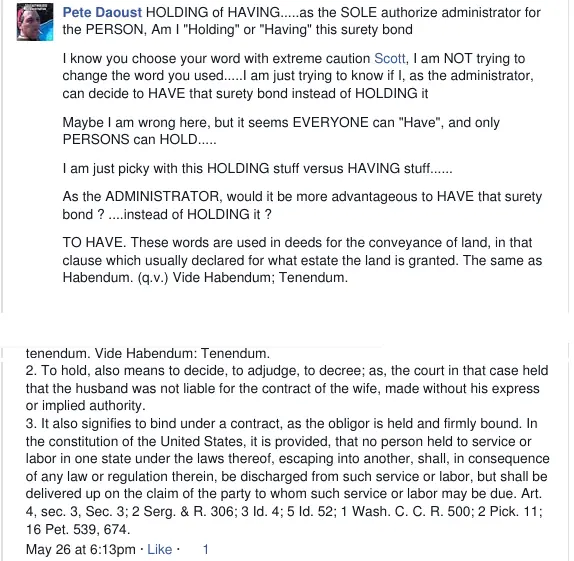
HOLDING of HAVING.....as the SOLE authorize administrator for the PERSON, Am I "Holding" or "Having" this surety bond
I know you choose your word with extreme caution Scott, I am NOT trying to change the word you used.....I am just trying to know if I, as the administrator, can decide to HAVE that surety bond instead of HOLDING it :)
Maybe I am wrong here, but it seems EVERYONE can "Have", and only PERSONS can HOLD.....
I am just picky with this HOLDING stuff versus HAVING stuff......
As the ADMINISTRATOR, would it be more advantageous to HAVE that surety bond ? ....instead of HOLDING it ?
TO HAVE. These words are used in deeds for the conveyance of land, in that clause which usually declared for what estate the land is granted. The same as Habendum. (q.v.) Vide Habendum; Tenendum.
TO HOLD. These words are now used in a deed to express by what tenure the grantee is to have the land. The clause which commences with these words is called the tenendum. Vide Habendum; Tenendum. 2. To hold, also means to decide, to adjudge, to decree; as, the court in that case held that the husband was not liable for the contract of the wife, made without his express or implied authority. 3. It also signifies to bind under a contract, as the obligor is held and firmly bound. In the constitution of the United States, it is provided, that no person held to service or labor in one state under the laws thereof, escaping into another, shall, in consequence of any law or regulation therein, be discharged from such service or labor, but shall be delivered up on the claim of the party to whom such service or labor may be due. Art. 4, sec. 3, Sec. 3; 2 Serg. & R. 306; 3 Id. 4; 5 Id. 52; 1 Wash. C. C. R. 500; 2 Pick. 11; 16 Pet. 539, 674.
Printed copy · Anthology Volume 9, page 536