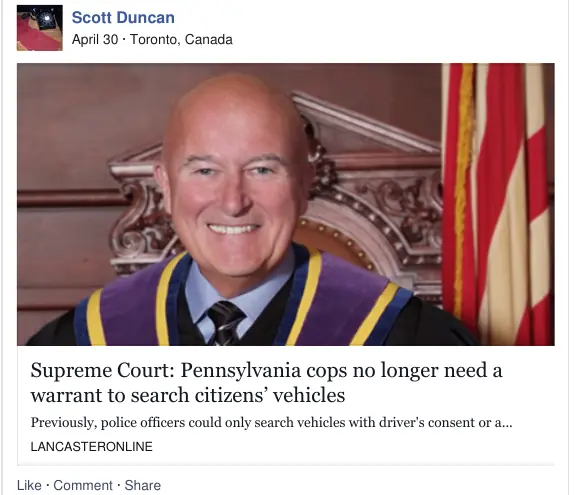
Previously, police officers could only search vehicles with driver's consent or a signed warrant.
Printed copy · Anthology Volume 8, page 327Printed copy from The Tender For Law Anthology, Volume 8, page 327 (printed 13 June 2014). Added by this site; not part of the Facebook export.Filter by poster
Read Comments 25
Pete Daoust
A 4-2 vote !! :-\
I wonder when Murickans will have enough of it :-(
Printed copy · Anthology Volume 8, page 327Printed copy from The Tender For Law Anthology, Volume 8, page 327 (printed 13 June 2014). Added by this site; not part of the Facebook export.
T?lis B?auns · Brauns Orig Libau Tālis
Police don't necessarily need a warrant to search a vehicle, but can do it based on REASONABLE probable cause.
"In her dissenting opinion, Justice Debra McCloskey Todd rightly noted the ruling “heedlessly contravenes over 225 years of unyielding protection against unreasonable search and seizure which our people have enjoyed as their birthright.”
www.pacourts.us/assets/opinions/Supreme/out/J-5-2013oajc%20-%201017924602181959.pdf?cb=1
Printed copy · Anthology Volume 8, page 328Printed copy from The Tender For Law Anthology, Volume 8, page 328 (printed 13 June 2014). Added by this site; not part of the Facebook export.
CJ ML · Jason Moreland
Sorry, not for hire.
Printed copy · Anthology Volume 8, page 328Printed copy from The Tender For Law Anthology, Volume 8, page 328 (printed 13 June 2014). Added by this site; not part of the Facebook export.
David Johansen
if the cop could smell it, it wasnt hidden.
"is that weed i smell? yes..." = dumb fuck.
Printed copy · Anthology Volume 8, page 328Printed copy from The Tender For Law Anthology, Volume 8, page 328 (printed 13 June 2014). Added by this site; not part of the Facebook export.
Stuart Stone
Hang on...do citizens exist???
Let me paraphrase Marc Stevens...citizens pledge their allegiance to the state in exchange for protection...However, the various supreme courts have ruled that the state does not owe a duty of protection to the public.
Ergo, if the state cannot/is not obligated to provide protection, then doesn't it follow that there now an invalid contract as one party is not fulfilling its obligations?
Consequently, isn't the concept of citizens/citizenship also invalid, thus removing the right to search the vehicle, in much the same way they can't search Santa Claus, the Easter bunny or Jeebus' vehicle?
If this is a shitstain pulled from the dictionary of my arse, please forgive me and delete the offending post
Printed copy · Anthology Volume 8, page 328Printed copy from The Tender For Law Anthology, Volume 8, page 328 (printed 13 June 2014). Added by this site; not part of the Facebook export.
Chris Evan
FFS...how fucking docile can one population be? But then on the other hand....how fucking manipulative can the other be???
Printed copy · Anthology Volume 8, page 328Printed copy from The Tender For Law Anthology, Volume 8, page 328 (printed 13 June 2014). Added by this site; not part of the Facebook export.
Scott Duncan
You are exactly correct, Stuart Stone. YOU have spotted the one thing every "citizen" hasn't. It is not a shit-stain. It is reality.
Printed copy · Anthology Volume 8, page 328 · cut by a page breakPrinted copy from The Tender For Law Anthology, Volume 8, page 328 (printed 13 June 2014). Added by this site; not part of the Facebook export. A page break in the printout swallowed this comment: only its date was printed.
Chris Evan
:-D Nice!!! I saw that before Scott said that!!! 2 more fuckin weeks until I think right!
Printed copy · Anthology Volume 8, page 329Printed copy from The Tender For Law Anthology, Volume 8, page 329 (printed 13 June 2014). Added by this site; not part of the Facebook export.
Scott Duncan
It shouldn't take that long. These things are self-evident.
Printed copy · Anthology Volume 8, page 329Printed copy from The Tender For Law Anthology, Volume 8, page 329 (printed 13 June 2014). Added by this site; not part of the Facebook export.
Chris Evan
It was a play on another joke from 2 weeks ago....
Printed copy · Anthology Volume 8, page 329Printed copy from The Tender For Law Anthology, Volume 8, page 329 (printed 13 June 2014). Added by this site; not part of the Facebook export.
Scott Duncan
That's what you get for focusing on the past. :P
Printed copy · Anthology Volume 8, page 329Printed copy from The Tender For Law Anthology, Volume 8, page 329 (printed 13 June 2014). Added by this site; not part of the Facebook export.
Mike Lamb · Michael Lamb II
Makes sense since most REGISTER their private property with the DMV/STATE fictions, hence do not have lawful allodial ownership. THEY can pretty much do whatever THEY want with THEIR property, but most don't even know the difference between driving and traveling, let alone the truth of the REGISTRATION CONTRACT.
Printed copy · Anthology Volume 8, page 329Printed copy from The Tender For Law Anthology, Volume 8, page 329 (printed 13 June 2014). Added by this site; not part of the Facebook export.
Chris Evan
Oh boy....
Printed copy · Anthology Volume 8, page 329Printed copy from The Tender For Law Anthology, Volume 8, page 329 (printed 13 June 2014). Added by this site; not part of the Facebook export.
Pete Daoust
:-o
Printed copy · Anthology Volume 8, page 329Printed copy from The Tender For Law Anthology, Volume 8, page 329 (printed 13 June 2014). Added by this site; not part of the Facebook export.
Eamonn O Brien
This old chestnut... Covered numerous times in the group... :p
Printed copy · Anthology Volume 8, page 329Printed copy from The Tender For Law Anthology, Volume 8, page 329 (printed 13 June 2014). Added by this site; not part of the Facebook export.
Chip Douglas
This ruling applies to a "citizen," but; the Second Amendment applies to a "people".....hmmmm
Printed copy · Anthology Volume 8, page 329Printed copy from The Tender For Law Anthology, Volume 8, page 329 (printed 13 June 2014). Added by this site; not part of the Facebook export.
Pete Daoust
And what's the LEGAL definition of PEOPLE ?
Printed copy · Anthology Volume 8, page 329Printed copy from The Tender For Law Anthology, Volume 8, page 329 (printed 13 June 2014). Added by this site; not part of the Facebook export.
Pete Daoust
People
The aggregate of the individuals who comprise a state or a nation.
In a more restricted sense, as generally used in Constitutional Law, the entire body of those citizens of a state or a nation who are invested with political power for political purposes (the qualified voters).
Printed copy · Anthology Volume 8, page 329Printed copy from The Tender For Law Anthology, Volume 8, page 329 (printed 13 June 2014). Added by this site; not part of the Facebook export.
Scott Duncan
Listen to mt evil apprentice. He knows of what he speaks. :D
Printed copy · Anthology Volume 8, page 330Printed copy from The Tender For Law Anthology, Volume 8, page 330 (printed 13 June 2014). Added by this site; not part of the Facebook export.
Pete Daoust
Now, try to find in one of there "club house stuff", the word MAN or WOMAN.
So far, the closest thing I have found is.
EVERY "HUMAN BEING" HAS THE RIGHT TO THE LIFE, SURETY, INTEGRITY AND LIBERTY OF "HIS" PERSON.
:-P
Printed copy · Anthology Volume 8, page 330Printed copy from The Tender For Law Anthology, Volume 8, page 330 (printed 13 June 2014). Added by this site; not part of the Facebook export.
Pete Daoust
Fuck, that makes me think that I might have the right to be the SOLE AUTHORIZED ADMINISTRATOR of the person I "happen" to have in my pocket :-D
muhahahaha !
Printed copy · Anthology Volume 8, page 330Printed copy from The Tender For Law Anthology, Volume 8, page 330 (printed 13 June 2014). Added by this site; not part of the Facebook export.
Pete Daoust
Top ten reasons why Rob Ford is taking a leave of absence :-P
Printed copy · Anthology Volume 8, page 330Printed copy from The Tender For Law Anthology, Volume 8, page 330 (printed 13 June 2014). Added by this site; not part of the Facebook export.
T?lis B?auns · Brauns Orig Libau Tālis
In Canada is this incorrect? "We the People" is not, and never has been, us individually, it is us as a whole, a collective, as represented by a parliament. That is why it is said the parliament is sovereign, the parliament is "We the People", and gains it's authority from the electoral consent of the governed, not by individual consent, or royal decree, or the will of god. We have a "Sovereign", but she doesn't represent any authority or any sovereign power here. In an independant nation, the authority behind government in Canada comes from majority rule, same as in every other democratic system.
The monarch has merely been a ceremonial provision since the magna charter and the subsequent creation of parliament. The notion of royal sovereignty was removed with a sword to the kings throat, and given to a parliament of the people. This was where the notion of parliamentary sovereignty was born. Assent from the monarch today is merely a formality, not some sort of nessessary permission or something. The parliament of this sovereign independant nation still holds the sword to her throat, and it is this parliament of the people that holds the sovereignty.
Printed copy · Anthology Volume 8, page 330 · cut by a page breakPrinted copy from The Tender For Law Anthology, Volume 8, page 330 (printed 13 June 2014). Added by this site; not part of the Facebook export. A page break in the printout cut off the end of this comment.
T?lis B?auns
Printed copy from The Tender For Law Anthology, Volume 8, page 331 (printed 13 June 2014). Added by this site; not part of the Facebook export. A page break in the printout cut off the beginning of this comment, with its name.
Chip Douglas
Brauns' post makes me wonder Scott, based on this section of the Criminal Code...who then is in the DE JURE possession of the sovereign power?
Obedience to de facto law
15. No person shall be convicted of an offence in respect of an act or omission in obedience to the laws for the time being made and enforced by persons in de facto possession of the sovereign power in and over the place where the act or omission occurs.
Printed copy · Anthology Volume 8, page 331Printed copy from The Tender For Law Anthology, Volume 8, page 331 (printed 13 June 2014). Added by this site; not part of the Facebook export.
Filter by poster
Read Comments 25
Pete Daoust
Printed copy · Anthology Volume 8, page 327
T?lis B?auns · Brauns Orig Libau Tālis
Printed copy · Anthology Volume 8, page 328
CJ ML · Jason Moreland
Printed copy · Anthology Volume 8, page 328
David Johansen
Printed copy · Anthology Volume 8, page 328
Stuart Stone
Printed copy · Anthology Volume 8, page 328
Chris Evan
Printed copy · Anthology Volume 8, page 328
Scott Duncan
Printed copy · Anthology Volume 8, page 328 · cut by a page break
Chris Evan
Printed copy · Anthology Volume 8, page 329
Scott Duncan
Printed copy · Anthology Volume 8, page 329
Chris Evan
Printed copy · Anthology Volume 8, page 329
Scott Duncan
Printed copy · Anthology Volume 8, page 329
Mike Lamb · Michael Lamb II
Printed copy · Anthology Volume 8, page 329
Chris Evan
Printed copy · Anthology Volume 8, page 329
Pete Daoust
Printed copy · Anthology Volume 8, page 329
Eamonn O Brien
Printed copy · Anthology Volume 8, page 329
Chip Douglas
Printed copy · Anthology Volume 8, page 329
Pete Daoust
Printed copy · Anthology Volume 8, page 329
Pete Daoust
Printed copy · Anthology Volume 8, page 329
Scott Duncan
Printed copy · Anthology Volume 8, page 330
Pete Daoust
Printed copy · Anthology Volume 8, page 330
Pete Daoust
Printed copy · Anthology Volume 8, page 330
Pete Daoust
Printed copy · Anthology Volume 8, page 330
T?lis B?auns · Brauns Orig Libau Tālis
Printed copy · Anthology Volume 8, page 330 · cut by a page break
T?lis B?auns
Chip Douglas
Printed copy · Anthology Volume 8, page 331