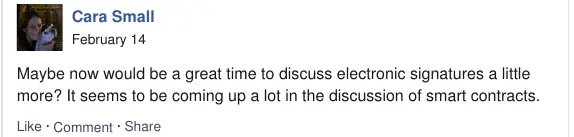
Maybe now would be a great time to discuss electronic signatures a little more? It seems to be coming up a lot in the discussion of smart contracts.
Printed copy · Anthology Volume 7, page 708Printed copy from The Tender For Law Anthology, Volume 7, page 708 (printed 13 June 2014). Added by this site; not part of the Facebook export.Filter by poster
Read Comments 63
Pete Daoust
What's an electronic signature ? :/
Printed copy · Anthology Volume 7, page 708Printed copy from The Tender For Law Anthology, Volume 7, page 708 (printed 13 June 2014). Added by this site; not part of the Facebook export.
Pete Daoust
Digital Signatures
The computer and Telecommunications have changed how work is done and how it is exchanged. Both business and the legal system have begun to explore ways of using the Internet and other forms of electronic communication to transact work. Court systems cannot permit the electronic filing of legal documents, however, unless the documents have been authenticated as coming from the sender. Similarly, businesses will not enter into contracts using the Internet or E-Mail unless they can authenticate that the other contracting party actually made the agreement. Computers and digital scanners can reproduce handwritten signatures, but they are susceptible to forgery.
A solution has been the legal recognition of "digital signatures." The majority of states have enacted statutes that allow digital signatures in intrastate transactions. In 2000, President bill clinton signed into law the Electronic Signatures in Global and National Commerce Act, Pub. L. No. 106-229, 114 Stat. 464, also called the E-Sign Act, which essentially validates electronic contracts in interstate and foreign commerce. The act does not apply to certain types of documents, including wills, Divorce notices, and documents that are associated with court proceedings.
A digital signature is based on cryptography, which uses mathematical formulas, or algorithms, to scramble messages. Using encryption and decryption software, the sender can scramble the message and the recipient can unscramble it. To affix a digital signature to an electronic document, a signer must obtain electronic "keys." The keys are assigned in pairs: a private key and a public key.
A person creates his keys using a software program. The digital signature is affixed to the electronic document using the private key. The "signer" types in a password, similar to a personal identification number for an automatic teller machine. The private key then generates a long string of numbers and letters that represent the digital signature, or public key. The recipient of the message runs a software program using this public key to authenticate that the document was signed by the private key and that the document has not been altered during transmission.
It is mathematically infeasible for a person to derive another person's private key. The only way to compromise a digital signature is to give another person access to the signature software and the password to the private key.
Printed copy · Anthology Volume 7, page 708Printed copy from The Tender For Law Anthology, Volume 7, page 708 (printed 13 June 2014). Added by this site; not part of the Facebook export.
Cara Small
We can call it a digital signature if you think that is more accurate. I am wondering HOW a digital signature is witnessed to be from the party that the other party is intending to contract with. Scott did say that a digital signature is not the same as a wet ink signature and I am wanting to discuss the difference and where the line is between whether or not a digital signature is substantial. I see that in the definition you posted- The "act" does not apply to wills, divorce, notices, and documents that are associated with court proceedings. I want to know why.
Printed copy · Anthology Volume 7, page 709Printed copy from The Tender For Law Anthology, Volume 7, page 709 (printed 13 June 2014). Added by this site; not part of the Facebook export.
Pete Daoust
Because FUCK OFF, that's why :D
Printed copy · Anthology Volume 7, page 709Printed copy from The Tender For Law Anthology, Volume 7, page 709 (printed 13 June 2014). Added by this site; not part of the Facebook export.
Maximus Legis
Cara Small Are you referring to a facsimile of a signature?
Printed copy · Anthology Volume 7, page 709Printed copy from The Tender For Law Anthology, Volume 7, page 709 (printed 13 June 2014). Added by this site; not part of the Facebook export.
Cara Small
Not accepting your explanation. I may not get the explanation from you, but I will get an explanation.
Printed copy · Anthology Volume 7, page 709 · cut by a page breakPrinted copy from The Tender For Law Anthology, Volume 7, page 709 (printed 13 June 2014). Added by this site; not part of the Facebook export. A page break in the printout swallowed this comment: only its date was printed.
Maximus Legis
My research has lead me to understand that a SIGNATURE is the mark made by a living man/woman. Apparently the word is derived/composed from the phrase SIGN(OF)NATURE. A facsimile of a signature suggests fraud to me. I may be wrong but my research leads to my opinion.
Printed copy · Anthology Volume 7, page 710Printed copy from The Tender For Law Anthology, Volume 7, page 710 (printed 13 June 2014). Added by this site; not part of the Facebook export.
Cara Small
No. I was speaking of digital signatures way back when we were discussing how birth certificates are formed. I was looking through the .gov site and saw that you could now register babies "online" and I know I signed the registration forms and sent them in. It then occurred to me that they must be accepting a signature online somehow. Then I thought how could they know it is the mother?
Printed copy · Anthology Volume 7, page 710Printed copy from The Tender For Law Anthology, Volume 7, page 710 (printed 13 June 2014). Added by this site; not part of the Facebook export.
Maximus Legis
I would say no because anyone could be at the keyboard, but that's my opinion only .
Printed copy · Anthology Volume 7, page 710Printed copy from The Tender For Law Anthology, Volume 7, page 710 (printed 13 June 2014). Added by this site; not part of the Facebook export.
Cara Small
Yes. That is how I felt about it. They are definitely not the same thing and I want to know where/how it can be applied. Where IS a digital signature acceptable and where isn't it? To better understand, I want to know why.
Printed copy · Anthology Volume 7, page 710Printed copy from The Tender For Law Anthology, Volume 7, page 710 (printed 13 June 2014). Added by this site; not part of the Facebook export.
Maximus Legis
How can anything but a signature be a SIGN(OF)NATURE ?
Printed copy · Anthology Volume 7, page 710Printed copy from The Tender For Law Anthology, Volume 7, page 710 (printed 13 June 2014). Added by this site; not part of the Facebook export.
Maximus Legis
Cara "Where IS a digital signature acceptable and where isn't it?" Easy answer, WHEN BOTH PARTIES AGREE IT IS ACCEPTABLE :-)
Printed copy · Anthology Volume 7, page 710Printed copy from The Tender For Law Anthology, Volume 7, page 710 (printed 13 June 2014). Added by this site; not part of the Facebook export.
Cara Small
That is how I see Ethereum. But I can't wrap my brain around it being acceptable in any other circumstance.
Printed copy · Anthology Volume 7, page 710Printed copy from The Tender For Law Anthology, Volume 7, page 710 (printed 13 June 2014). Added by this site; not part of the Facebook export.
Maximus Legis
No No No, Ethereum totally different.
Printed copy · Anthology Volume 7, page 710Printed copy from The Tender For Law Anthology, Volume 7, page 710 (printed 13 June 2014). Added by this site; not part of the Facebook export.
Cara Small
Ok. Why?
Printed copy · Anthology Volume 7, page 710 · cut by a page breakPrinted copy from The Tender For Law Anthology, Volume 7, page 710 (printed 13 June 2014). Added by this site; not part of the Facebook export. A page break in the printout cut off the end of this comment.
Maximus Legis
Because of the Math involved and the verification process.
Printed copy · Anthology Volume 7, page 711 · cut by a page breakPrinted copy from The Tender For Law Anthology, Volume 7, page 711 (printed 13 June 2014). Added by this site; not part of the Facebook export. A page break in the printout swallowed this comment: only its date was printed.
Pete Daoust
The thing is, with crypto currency and crypto contract, there is no need of government club house rules... :) you just can't fuck around with it.... :D
Printed copy · Anthology Volume 7, page 711Printed copy from The Tender For Law Anthology, Volume 7, page 711 (printed 13 June 2014). Added by this site; not part of the Facebook export.
Cara Small
How do you know you are contracting with the party you are intending to contract with?
Printed copy · Anthology Volume 7, page 711Printed copy from The Tender For Law Anthology, Volume 7, page 711 (printed 13 June 2014). Added by this site; not part of the Facebook export.
Maximus Legis
The digital signatures you are thinking about are a mouse click from an i.p address. Ethereum is a whole other ball of wax which I'm not qualified to explain in detail but I do comprehend the difference. The Admiral would be the one to elaborate.
Printed copy · Anthology Volume 7, page 711Printed copy from The Tender For Law Anthology, Volume 7, page 711 (printed 13 June 2014). Added by this site; not part of the Facebook export.
Pete Daoust
You look at the screen on your computer :D
Printed copy · Anthology Volume 7, page 711Printed copy from The Tender For Law Anthology, Volume 7, page 711 (printed 13 June 2014). Added by this site; not part of the Facebook export.
Pete Daoust
Are you blonde Cara Small ? :D ?
Printed copy · Anthology Volume 7, page 711Printed copy from The Tender For Law Anthology, Volume 7, page 711 (printed 13 June 2014). Added by this site; not part of the Facebook export.
Cara Small
Ok. So then CAN Ethereum be used for wills, divorce, notices and etc.?
Printed copy · Anthology Volume 7, page 711Printed copy from The Tender For Law Anthology, Volume 7, page 711 (printed 13 June 2014). Added by this site; not part of the Facebook export.
Maximus Legis
yes yes yes , anything !
Printed copy · Anthology Volume 7, page 711Printed copy from The Tender For Law Anthology, Volume 7, page 711 (printed 13 June 2014). Added by this site; not part of the Facebook export.
Cara Small
The one time I tried to "go blond" we were dirt poor and I used too much H2O2.
Printed copy · Anthology Volume 7, page 711Printed copy from The Tender For Law Anthology, Volume 7, page 711 (printed 13 June 2014). Added by this site; not part of the Facebook export.
Printed copy · Anthology Volume 7, page 711Printed copy from The Tender For Law Anthology, Volume 7, page 711 (printed 13 June 2014). Added by this site; not part of the Facebook export.
Cara Small
I have read and reread that.
Printed copy · Anthology Volume 7, page 711Printed copy from The Tender For Law Anthology, Volume 7, page 711 (printed 13 June 2014). Added by this site; not part of the Facebook export.
Maximus Legis
^^^ tHE DECENTRALISED VERIFICATION ELEMENT CAN BE APPLIED TO ANYTHING OF VALUE, WILLS , CONTRACTS ETC. tHE VERIFICATION IS IN THE BLOCK CHAIN. :-)
Printed copy · Anthology Volume 7, page 711 · cut by a page breakPrinted copy from The Tender For Law Anthology, Volume 7, page 711 (printed 13 June 2014). Added by this site; not part of the Facebook export. A page break in the printout cut off the end of this comment.
Maximus Legis
Excuse typos too much single malt, heading for bed now :-)
Printed copy · Anthology Volume 7, page 712Printed copy from The Tender For Law Anthology, Volume 7, page 712 (printed 13 June 2014). Added by this site; not part of the Facebook export.
Maximus Legis
Cara Small well, read it again :-)
Printed copy · Anthology Volume 7, page 712Printed copy from The Tender For Law Anthology, Volume 7, page 712 (printed 13 June 2014). Added by this site; not part of the Facebook export.
Pete Daoust
Create decentralized companies or organizations that operate entirely on the blockchain
Printed copy · Anthology Volume 7, page 712Printed copy from The Tender For Law Anthology, Volume 7, page 712 (printed 13 June 2014). Added by this site; not part of the Facebook export.
Pete Daoust
ENTIRELY :D
Printed copy · Anthology Volume 7, page 712Printed copy from The Tender For Law Anthology, Volume 7, page 712 (printed 13 June 2014). Added by this site; not part of the Facebook export.
Cara Small
I understand that. I don't understand how you can know who it is you are dealing with. I suppose that could BE the point.
Printed copy · Anthology Volume 7, page 712Printed copy from The Tender For Law Anthology, Volume 7, page 712 (printed 13 June 2014). Added by this site; not part of the Facebook export.
Maximus Legis
No signature required just solid mega-multiple verification !
Printed copy · Anthology Volume 7, page 712Printed copy from The Tender For Law Anthology, Volume 7, page 712 (printed 13 June 2014). Added by this site; not part of the Facebook export.
Pete Daoust
I hope these guys choose their words the same as Scott choose his... :/
Printed copy · Anthology Volume 7, page 712Printed copy from The Tender For Law Anthology, Volume 7, page 712 (printed 13 June 2014). Added by this site; not part of the Facebook export.
Maximus Legis
If you don't know who you're dealing with you shouldn't be dealing with them. I think you're getting confused between currency transactions and contracts. Contracts "know with whom you are dealing" Currency transactions = WHO GIVES A FUCK AS LONG AS THE TRADE GOES THROUGH !
Printed copy · Anthology Volume 7, page 712Printed copy from The Tender For Law Anthology, Volume 7, page 712 (printed 13 June 2014). Added by this site; not part of the Facebook export.
Pete Daoust
WHO cares, who is who, when EVERYONE knows what is ? :D
Printed copy · Anthology Volume 7, page 712Printed copy from The Tender For Law Anthology, Volume 7, page 712 (printed 13 June 2014). Added by this site; not part of the Facebook export.
Pete Daoust
Is that makes sense ? :/
Printed copy · Anthology Volume 7, page 712Printed copy from The Tender For Law Anthology, Volume 7, page 712 (printed 13 June 2014). Added by this site; not part of the Facebook export.
Maximus Legis
^ aYE !
Printed copy · Anthology Volume 7, page 712Printed copy from The Tender For Law Anthology, Volume 7, page 712 (printed 13 June 2014). Added by this site; not part of the Facebook export.
Cara Small
It makes total sense. I just LIKE knowing who I am dealing with.
Printed copy · Anthology Volume 7, page 712Printed copy from The Tender For Law Anthology, Volume 7, page 712 (printed 13 June 2014). Added by this site; not part of the Facebook export.
Maximus Legis
^ sTOP OVERTHINKING IT ffs !!!!
Pete Daoust
:D
Printed copy · Anthology Volume 7, page 712Printed copy from The Tender For Law Anthology, Volume 7, page 712 (printed 13 June 2014). Added by this site; not part of the Facebook export.
Maximus Legis
There goes the Malt again lol :-)
Printed copy · Anthology Volume 7, page 713Printed copy from The Tender For Law Anthology, Volume 7, page 713 (printed 13 June 2014). Added by this site; not part of the Facebook export.
Cara Small
No such thing. WRONG thinking, yes. TOO much thinking, no.
Printed copy · Anthology Volume 7, page 713Printed copy from The Tender For Law Anthology, Volume 7, page 713 (printed 13 June 2014). Added by this site; not part of the Facebook export.
Maximus Legis
Okay, I'm off now I have to get up early and wake the neighbourhood up at 6am with my bagpipes .
Printed copy · Anthology Volume 7, page 713Printed copy from The Tender For Law Anthology, Volume 7, page 713 (printed 13 June 2014). Added by this site; not part of the Facebook export.
Cara Small
HAHA!
Printed copy · Anthology Volume 7, page 713Printed copy from The Tender For Law Anthology, Volume 7, page 713 (printed 13 June 2014). Added by this site; not part of the Facebook export.
Printed copy · Anthology Volume 7, page 713Printed copy from The Tender For Law Anthology, Volume 7, page 713 (printed 13 June 2014). Added by this site; not part of the Facebook export.
Cara Small
I loved the post Pete put on his page a while back of the "Thunderstruck" bagpiper. It gave me a different view on bagpipes. They can be BADASS.
Printed copy · Anthology Volume 7, page 713Printed copy from The Tender For Law Anthology, Volume 7, page 713 (printed 13 June 2014). Added by this site; not part of the Facebook export.
Maximus Legis
I have them growing out my ass lol. I live five miles from loch ness the home of Nessie !
Printed copy · Anthology Volume 7, page 713Printed copy from The Tender For Law Anthology, Volume 7, page 713 (printed 13 June 2014). Added by this site; not part of the Facebook export.
Maximus Legis
Google Red Hot Chilli Pipers .
Printed copy · Anthology Volume 7, page 713Printed copy from The Tender For Law Anthology, Volume 7, page 713 (printed 13 June 2014). Added by this site; not part of the Facebook export.
Cara Small
There is just something so engrossing watching a large group of people play music in such perfect form together. I played flute in highschool and loved every minute of it.
Printed copy · Anthology Volume 7, page 713Printed copy from The Tender For Law Anthology, Volume 7, page 713 (printed 13 June 2014). Added by this site; not part of the Facebook export.
Cara Small
My band teacher was great so that helped.
Printed copy · Anthology Volume 7, page 713Printed copy from The Tender For Law Anthology, Volume 7, page 713 (printed 13 June 2014). Added by this site; not part of the Facebook export.
Maximus Legis
Goodnight folks, sleep well when your bedtime comes around :-)
Printed copy · Anthology Volume 7, page 713Printed copy from The Tender For Law Anthology, Volume 7, page 713 (printed 13 June 2014). Added by this site; not part of the Facebook export.
August le Blanc
Ah, Band Camp” :-)
This one of the private electronic signatures, held in trust, and used as er wines of the shareholder = King, administered by the board of Directors ( Admiral), enforced by the Officer = Vice President, as The CEO Office is the ultimate surety Issuing orders = General.
Kings = We Wish.= Shareholder
Admirals Command = The Board of Directors.
General's Order =Vice President.
This is notice that accompanies some business:
Jason Le Blanc
Media Producer
This e-mail (and attachment(s)) is confidential, proprietary, may be subject to copyright and legal privilege and no related rights are waived. If you are not the intended recipient or its agent, any review, dissemination, distribution or copying of this e-mail or any of its content is strictly prohibited and may be unlawful. All messages may be monitored as permitted by applicable law and regulations and our policies to protect our business. E-mails are not secure and you are deemed to have accepted any risk if you communicate with us by e-mail. If received in error, please notify us immediately and delete the e-mail (and any attachments) from any computer or any storage medium without printing a copy.
Printed copy · Anthology Volume 7, page 713 · cut by a page breakPrinted copy from The Tender For Law Anthology, Volume 7, page 713 (printed 13 June 2014). Added by this site; not part of the Facebook export. A page break in the printout cut off the beginning of this comment, with its name.
August le Blanc · Bobis Youruncle
Fill in the appropriate titles and it is PRIVATE, a historical record, printable and attached to a affidavit as a exhibit,
Printed copy · Anthology Volume 7, page 714Printed copy from The Tender For Law Anthology, Volume 7, page 714 (printed 13 June 2014). Added by this site; not part of the Facebook export.
August le Blanc · Bobis Youruncle
Private law.
Printed copy · Anthology Volume 7, page 714Printed copy from The Tender For Law Anthology, Volume 7, page 714 (printed 13 June 2014). Added by this site; not part of the Facebook export.
August le Blanc · Bobis Youruncle
ouch.
Printed copy · Anthology Volume 7, page 714Printed copy from The Tender For Law Anthology, Volume 7, page 714 (printed 13 June 2014). Added by this site; not part of the Facebook export.
Tommy Atherton
She gets the "band camp" thing around here all the time, I cant resist.
Printed copy · Anthology Volume 7, page 714Printed copy from The Tender For Law Anthology, Volume 7, page 714 (printed 13 June 2014). Added by this site; not part of the Facebook export.
August le Blanc · Bobis Youruncle
Well if the flute fits :-D
All due respect”
Printed copy · Anthology Volume 7, page 714Printed copy from The Tender For Law Anthology, Volume 7, page 714 (printed 13 June 2014). Added by this site; not part of the Facebook export.
T?lis B?auns · Brauns Orig Libau Tālis
"Any mark made with the intent of recording assent to a proposition is a signature. ..intent and assent are elements distinguishing a signature froman ordinary writing."
Journal of Criminal Law and Criminology - Volume 27
Issue 3 September-October / Article 5 / Fall 1936
Fingerprint Signatures (A Word of Caution Concerning Their Use)
_George Tyler Mairs
Printed copy · Anthology Volume 7, page 714Printed copy from The Tender For Law Anthology, Volume 7, page 714 (printed 13 June 2014). Added by this site; not part of the Facebook export.
Cara Small
:p
Printed copy · Anthology Volume 7, page 715Printed copy from The Tender For Law Anthology, Volume 7, page 715 (printed 13 June 2014). Added by this site; not part of the Facebook export.
Printed copy · Anthology Volume 7, page 715Printed copy from The Tender For Law Anthology, Volume 7, page 715 (printed 13 June 2014). Added by this site; not part of the Facebook export.
August le Blanc · Bobis Youruncle
Signed: All My Love, Bob :-D
( brotherly type of thing, we at bob uncle, do not cut anyone else's grass)
Printed copy · Anthology Volume 7, page 715Printed copy from The Tender For Law Anthology, Volume 7, page 715 (printed 13 June 2014). Added by this site; not part of the Facebook export.
August le Blanc · Bobis Youruncle
and not the church kind of brotherly love :-P
Printed copy · Anthology Volume 7, page 715Printed copy from The Tender For Law Anthology, Volume 7, page 715 (printed 13 June 2014). Added by this site; not part of the Facebook export.
Filter by poster
Read Comments 63
Pete Daoust
Printed copy · Anthology Volume 7, page 708
Pete Daoust
Printed copy · Anthology Volume 7, page 708
Cara Small
Printed copy · Anthology Volume 7, page 709
Pete Daoust
Printed copy · Anthology Volume 7, page 709
Maximus Legis
Printed copy · Anthology Volume 7, page 709
Cara Small
Printed copy · Anthology Volume 7, page 709 · cut by a page break
Maximus Legis
Printed copy · Anthology Volume 7, page 710
Cara Small
Printed copy · Anthology Volume 7, page 710
Maximus Legis
Printed copy · Anthology Volume 7, page 710
Cara Small
Printed copy · Anthology Volume 7, page 710
Maximus Legis
Printed copy · Anthology Volume 7, page 710
Maximus Legis
Printed copy · Anthology Volume 7, page 710
Cara Small
Printed copy · Anthology Volume 7, page 710
Maximus Legis
Printed copy · Anthology Volume 7, page 710
Cara Small
Printed copy · Anthology Volume 7, page 710 · cut by a page break
Maximus Legis
Printed copy · Anthology Volume 7, page 711 · cut by a page break
Pete Daoust
Printed copy · Anthology Volume 7, page 711
Cara Small
Printed copy · Anthology Volume 7, page 711
Maximus Legis
Printed copy · Anthology Volume 7, page 711
Pete Daoust
Printed copy · Anthology Volume 7, page 711
Pete Daoust
Printed copy · Anthology Volume 7, page 711
Cara Small
Printed copy · Anthology Volume 7, page 711
Maximus Legis
Printed copy · Anthology Volume 7, page 711
Cara Small
Printed copy · Anthology Volume 7, page 711
Maximus Legis
Printed copy · Anthology Volume 7, page 711
Cara Small
Printed copy · Anthology Volume 7, page 711
Maximus Legis
Printed copy · Anthology Volume 7, page 711 · cut by a page break
Maximus Legis
Printed copy · Anthology Volume 7, page 712
Maximus Legis
Printed copy · Anthology Volume 7, page 712
Pete Daoust
Printed copy · Anthology Volume 7, page 712
Pete Daoust
Printed copy · Anthology Volume 7, page 712
Cara Small
Printed copy · Anthology Volume 7, page 712
Maximus Legis
Printed copy · Anthology Volume 7, page 712
Pete Daoust
Printed copy · Anthology Volume 7, page 712
Maximus Legis
Printed copy · Anthology Volume 7, page 712
Pete Daoust
Printed copy · Anthology Volume 7, page 712
Pete Daoust
Printed copy · Anthology Volume 7, page 712
Maximus Legis
Printed copy · Anthology Volume 7, page 712
Cara Small
Printed copy · Anthology Volume 7, page 712
Maximus Legis
Pete Daoust
Printed copy · Anthology Volume 7, page 712
Maximus Legis
Printed copy · Anthology Volume 7, page 713
Cara Small
Printed copy · Anthology Volume 7, page 713
Maximus Legis
Printed copy · Anthology Volume 7, page 713
Cara Small
Printed copy · Anthology Volume 7, page 713
Maximus Legis
Printed copy · Anthology Volume 7, page 713
Cara Small
Printed copy · Anthology Volume 7, page 713
Maximus Legis
Printed copy · Anthology Volume 7, page 713
Maximus Legis
Printed copy · Anthology Volume 7, page 713
Cara Small
Printed copy · Anthology Volume 7, page 713
Cara Small
Printed copy · Anthology Volume 7, page 713
Maximus Legis
Printed copy · Anthology Volume 7, page 713
August le Blanc
Printed copy · Anthology Volume 7, page 713 · cut by a page break
August le Blanc · Bobis Youruncle
Printed copy · Anthology Volume 7, page 714
August le Blanc · Bobis Youruncle
Printed copy · Anthology Volume 7, page 714
August le Blanc · Bobis Youruncle
Printed copy · Anthology Volume 7, page 714
Tommy Atherton
Printed copy · Anthology Volume 7, page 714
August le Blanc · Bobis Youruncle
Printed copy · Anthology Volume 7, page 714
T?lis B?auns · Brauns Orig Libau Tālis
Printed copy · Anthology Volume 7, page 714
Cara Small
Printed copy · Anthology Volume 7, page 715
August le Blanc · Bobis Youruncle
Printed copy · Anthology Volume 7, page 715
August le Blanc · Bobis Youruncle
Printed copy · Anthology Volume 7, page 715
August le Blanc · Bobis Youruncle
Printed copy · Anthology Volume 7, page 715