The Tender For Law

English Only

ENGLISH is the international language of law and commerce. Knowing FRENCH is useful for understanding LEGAL ENGLISH, but FRENCH is not the international language of law and commerce, so we will ignore French speakers who speak to us in the language of a conquered people.

Non.

I understand that you are a proud Québécois, but the people here have nothing but contempt for you because of decades of transfer payments and NONE OF YOU understanding what Quebec sovereignty means. None of you know who Russell Rogers Smith is, and you're too proud and arrogant to teach. Just go away and be Retardier somewhere else.

Volume 4

Nov 21, 2013 12:48 AM

Scott Duncan

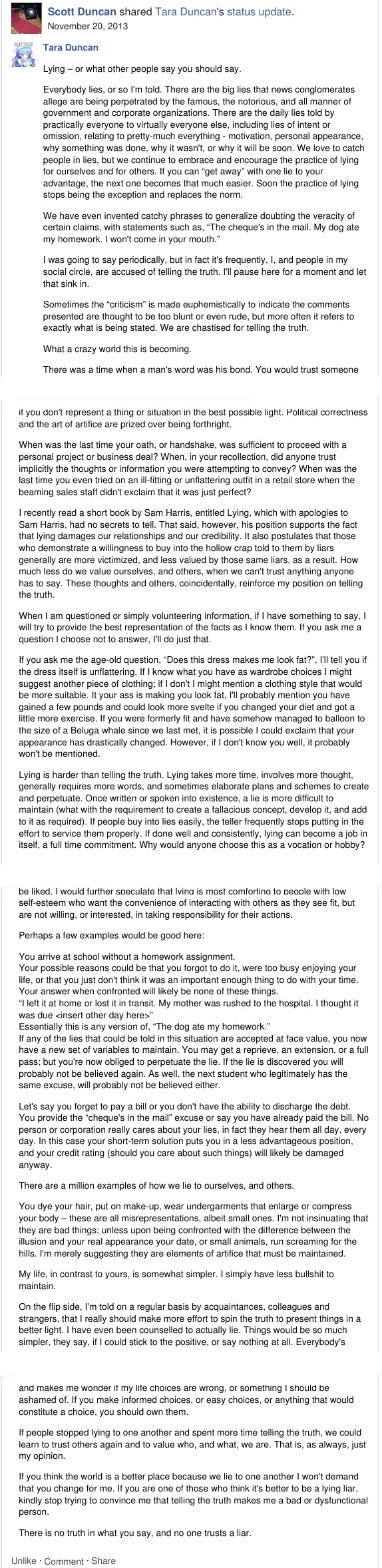
Tara Duncan Lying – or what other people say you should say. Everybody lies, or so I'm told. There are the big lies that news conglomerates allege are being perpetrated by the famous, the notorious, and all manner of government and corporate organizations. There are the daily lies told by practically everyone to virtually everyone else, including lies of intent or omission, relating to pretty-much everything - motivation, personal appearance, why something was done, why it wasn't, or why it will be soon. We love to catch people in lies, but we continue to embrace and encourage the practice of lying for ourselves and for others. If you can “get away” with one lie to your advantage, the next one becomes that much easier. Soon the practice of lying stops being the exception and replaces the norm. We have even invented catchy phrases to generalize doubting the veracity of certain claims, with statements such as, “The cheque's in the mail. My dog ate my homework. I won't come in your mouth.” I was going to say periodically, but in fact it's frequently, I, and people in my social circle, are accused of telling the truth. I'll pause here for a moment and let that sink in. Sometimes the “criticism” is made euphemistically to indicate the comments presented are thought to be too blunt or even rude, but more often it refers to exactly what is being stated. We are chastised for telling the truth. What a crazy world this is becoming. There was a time when a man's word was his bond. You would trust someone if you don't represent a thing or situation in the best possible light. Political correctness and the art of artifice are prized over being forthright. When was the last time your oath, or handshake, was sufficient to proceed with a personal project or business deal? When, in your recollection, did anyone trust implicitly the thoughts or information you were attempting to convey? When was the last time you even tried on an ill-fitting or unflattering outfit in a retail store when the beaming sales staff didn't exclaim that it was just perfect? I recently read a short book by Sam Harris, entitled Lying, which with apologies to Sam Harris, had no secrets to tell. That said, however, his position supports the fact that lying damages our relationships and our credibility. It also postulates that those who demonstrate a willingness to buy into the hollow crap told to them by liars generally are more victimized, and less valued by those same liars, as a result. How much less do we value ourselves, and others, when we can't trust anything anyone has to say. These thoughts and others, coincidentally, reinforce my position on telling the truth. When I am questioned or simply volunteering information, if I have something to say, I will try to provide the best representation of the facts as I know them. If you ask me a question I choose not to answer, I'll do just that. If you ask me the age-old question, “Does this dress makes me look fat?”, I'll tell you if the dress itself is unflattering. If I know what you have as wardrobe choices I might suggest another piece of clothing; if I don't I might mention a clothing style that would be more suitable. It your ass is making you look fat, I'll probably mention you have gained a few pounds and could look more svelte if you changed your diet and got a little more exercise. If you were formerly fit and have somehow managed to balloon to the size of a Beluga whale since we last met, it is possible I could exclaim that your appearance has drastically changed. However, if I don't know you well, it probably won't be mentioned. Lying is harder than telling the truth. Lying takes more time, involves more thought, generally requires more words, and sometimes elaborate plans and schemes to create and perpetuate. Once written or spoken into existence, a lie is more difficult to maintain (what with the requirement to create a fallacious concept, develop it, and add to it as required). If people buy into lies easily, the teller frequently stops putting in the effort to service them properly. If done well and consistently, lying can become a job in itself, a full time commitment. Why would anyone choose this as a vocation or hobby? be liked. I would further speculate that lying is most comforting to people with low self-esteem who want the convenience of interacting with others as they see fit, but are not willing, or interested, in taking responsibility for their actions. Perhaps a few examples would be good here: You arrive at school without a homework assignment. Your possible reasons could be that you forgot to do it, were too busy enjoying your life, or that you just don't think it was an important enough thing to do with your time. Your answer when confronted will likely be none of these things. “I left it at home or lost it in transit. My mother was rushed to the hospital. I thought it was due <insert other day here>” Essentially this is any version of, “The dog ate my homework.” If any of the lies that could be told in this situation are accepted at face value, you now have a new set of variables to maintain. You may get a reprieve, an extension, or a full pass; but you're now obliged to perpetuate the lie. If the lie is discovered you will probably not be believed again. As well, the next student who legitimately has the same excuse, will probably not be believed either. Let's say you forget to pay a bill or you don't have the ability to discharge the debt. You provide the “cheque's in the mail” excuse or say you have already paid the bill. No person or corporation really cares about your lies, in fact they hear them all day, every day. In this case your short-term solution puts you in a less advantageous position, and your credit rating (should you care about such things) will likely be damaged anyway. There are a million examples of how we lie to ourselves, and others. You dye your hair, put on make-up, wear undergarments that enlarge or compress your body – these are all misrepresentations, albeit small ones. I'm not insinuating that they are bad things; unless upon being confronted with the difference between the illusion and your real appearance your date, or small animals, run screaming for the hills. I'm merely suggesting they are elements of artifice that must be maintained. My life, in contrast to yours, is somewhat simpler. I simply have less bullshit to maintain. On the flip side, I'm told on a regular basis by acquaintances, colleagues and strangers, that I really should make more effort to spin the truth to present things in a better light. I have even been counselled to actually lie. Things would be so much simpler, they say, if I could stick to the positive, or say nothing at all. Everybody's and makes me wonder if my life choices are wrong, or something I should be ashamed of. If you make informed choices, or easy choices, or anything that would constitute a choice, you should own them. If people stopped lying to one another and spent more time telling the truth, we could learn to trust others again and to value who, and what, we are. That is, as always, just my opinion. If you think the world is a better place because we lie to one another I won't demand that you change for me. If you are one of those who think it's better to be a lying liar, kindly stop trying to convince me that telling the truth makes me a bad or dysfunctional person. There is no truth in what you say, and no one trusts a liar.
Printed copy from The Tender For Law Anthology, Volume 5, page 1101 (printed 13 June 2014). Added by this site; not part of the Facebook export.
Read Comments 2

Back to top