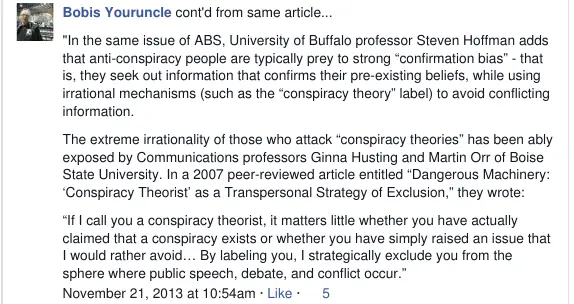
"In the same issue of ABS, University of Buffalo professor Steven Hoffman adds that anti-conspiracy people are typically prey to strong “confirmation bias” - that is, they seek out information that confirms their pre-existing beliefs, while using irrational mechanisms (such as the “conspiracy theory” label) to avoid conflicting information.
The extreme irrationality of those who attack “conspiracy theories” has been ably exposed by Communications professors Ginna Husting and Martin Orr of Boise State University. In a 2007 peer-reviewed article entitled “Dangerous Machinery: “Conspiracy Theorist” as a Transpersonal Strategy of Exclusion,” they wrote:
“If I call you a conspiracy theorist, it matters little whether you have actually claimed that a conspiracy exists or whether you have simply raised an issue that I would rather avoid” By labeling you, I strategically exclude you from the sphere where public speech, debate, and conflict occur.”
Printed copy · Anthology Volume 8, page 485Printed copy from The Tender For Law Anthology, Volume 8, page 485 (printed 13 June 2014). Added by this site; not part of the Facebook export.