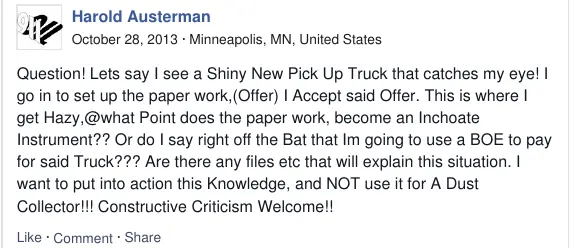
Question! Lets say I see a Shiny New Pick Up Truck that catches my eye! I go in to set up the paper work,(Offer) I Accept said Offer. This is where I get Hazy,@what Point does the paper work, become an Inchoate Instrument?? Or do I say right off the Bat that Im going to use a BOE to pay for said Truck??? Are there any files etc that will explain this situation. I want to put into action this Knowledge, and NOT use it for A Dust Collector!!! Constructive Criticism Welcome!!
Printed copy · Anthology Volume 4, page 1081Printed copy from The Tender For Law Anthology, Volume 4, page 1081 (printed 13 June 2014). Added by this site; not part of the Facebook export.Filter by poster
Read Comments 113
Pete Daoust
Funny INTENT you have there !! :/
Printed copy · Anthology Volume 4, page 1081Printed copy from The Tender For Law Anthology, Volume 4, page 1081 (printed 13 June 2014). Added by this site; not part of the Facebook export.
Pete Daoust
Here is my suggestion: CLOSE YOUR EYES when you pass by this TOY :D
Printed copy · Anthology Volume 4, page 1081Printed copy from The Tender For Law Anthology, Volume 4, page 1081 (printed 13 June 2014). Added by this site; not part of the Facebook export.
Pete Daoust
I hope you don't consider this suggestion as DUST :P
Printed copy · Anthology Volume 4, page 1081Printed copy from The Tender For Law Anthology, Volume 4, page 1081 (printed 13 June 2014). Added by this site; not part of the Facebook export.
Beverly Berta Braakschmack
When you sign the front for the loan, sign the back too and take a picture of it with your phone. Or have them give you a copy.
Printed copy · Anthology Volume 4, page 1081Printed copy from The Tender For Law Anthology, Volume 4, page 1081 (printed 13 June 2014). Added by this site; not part of the Facebook export.
Pete Daoust
Why ? :/
Printed copy · Anthology Volume 4, page 1081Printed copy from The Tender For Law Anthology, Volume 4, page 1081 (printed 13 June 2014). Added by this site; not part of the Facebook export.
Beverly Berta Braakschmack
You endorse the private side... same as your BILLS OF EXCHANGE, ****HELLOS*****
Printed copy · Anthology Volume 4, page 1081Printed copy from The Tender For Law Anthology, Volume 4, page 1081 (printed 13 June 2014). Added by this site; not part of the Facebook export.
Pete Daoust
OK, but for WHAT purpose ?
Beverly Berta Braakschmack
:p
Printed copy · Anthology Volume 4, page 1081Printed copy from The Tender For Law Anthology, Volume 4, page 1081 (printed 13 June 2014). Added by this site; not part of the Facebook export.
Pete Daoust
Stealing a truck ? :D
Printed copy · Anthology Volume 4, page 1082Printed copy from The Tender For Law Anthology, Volume 4, page 1082 (printed 13 June 2014). Added by this site; not part of the Facebook export.
Beverly Berta Braakschmack
to pay for it
Printed copy · Anthology Volume 4, page 1082Printed copy from The Tender For Law Anthology, Volume 4, page 1082 (printed 13 June 2014). Added by this site; not part of the Facebook export.
Beverly Berta Braakschmack
The loan papers... they do want your SIGNATURE, correct? To create the loan?
Printed copy · Anthology Volume 4, page 1082Printed copy from The Tender For Law Anthology, Volume 4, page 1082 (printed 13 June 2014). Added by this site; not part of the Facebook export.
Pete Daoust
OK, but WHO will REALLY pay for that brand spanking new pick-up truck for which I can't even afford in the first place :D
Bank of Canada will create a brand spanking new debt for that piece of metal, and then on WHO's books that debt will end up on ?
I am against EXTORTION......both ways :P
Debt creation for greed works on both ways....and my INTENT is to stay away from it ALL THE WAYS.... :D
Anyway........ Think about what Scott Duncan says about Robert Menard.....
If I am thinking wrong, PLEASE tell me .....please, please please (seriously :( )
Printed copy · Anthology Volume 4, page 1082Printed copy from The Tender For Law Anthology, Volume 4, page 1082 (printed 13 June 2014). Added by this site; not part of the Facebook export.
Beverly Berta Braakschmack
You create the debt by signing the loan... negotiable instruments includes "promissory notes"
Printed copy · Anthology Volume 4, page 1082Printed copy from The Tender For Law Anthology, Volume 4, page 1082 (printed 13 June 2014). Added by this site; not part of the Facebook export.
Pete Daoust
That's what I am saying Beverly Girl-Brain Braaksma, you create a DEBT, by signing a LOAN, for some shit you can't afford in the first place, and your INTENT is to end up with a PIECE of crap and get FREE ride.....which has NOTHING to do with Respect, Honor, integrity and Dignity :P
Printed copy · Anthology Volume 4, page 1082Printed copy from The Tender For Law Anthology, Volume 4, page 1082 (printed 13 June 2014). Added by this site; not part of the Facebook export.
Beverly Berta Braakschmack
Sure but what if you need a decent vehicle to get to work, instead of the piece of shit that is falling apart that you drive already?
Printed copy · Anthology Volume 4, page 1082Printed copy from The Tender For Law Anthology, Volume 4, page 1082 (printed 13 June 2014). Added by this site; not part of the Facebook export.
Beverly Berta Braakschmack
and you give them $5000 down?
Pete Daoust
if you need a decent vehicle to get to work and you can't afford one, I suggest to quit your "JOB" :D
Printed copy · Anthology Volume 4, page 1083Printed copy from The Tender For Law Anthology, Volume 4, page 1083 (printed 13 June 2014). Added by this site; not part of the Facebook export.
Beverly Berta Braakschmack
Oh HELL... That sure helps Pete... :/
Printed copy · Anthology Volume 4, page 1083Printed copy from The Tender For Law Anthology, Volume 4, page 1083 (printed 13 June 2014). Added by this site; not part of the Facebook export.
Pete Daoust
And you can find decent vehicule these days for $199.00 a month....
Printed copy · Anthology Volume 4, page 1083Printed copy from The Tender For Law Anthology, Volume 4, page 1083 (printed 13 June 2014). Added by this site; not part of the Facebook export.
Beverly Berta Braakschmack
Sure.. and you would get the bill and "administrate" it anyways...
Printed copy · Anthology Volume 4, page 1083Printed copy from The Tender For Law Anthology, Volume 4, page 1083 (printed 13 June 2014). Added by this site; not part of the Facebook export.
Pete Daoust
Of course it helps Beverly Girl-Brain Braaksma.....THINK ABOUT IT :D
Printed copy · Anthology Volume 4, page 1083Printed copy from The Tender For Law Anthology, Volume 4, page 1083 (printed 13 June 2014). Added by this site; not part of the Facebook export.
Beverly Berta Braakschmack
I prefer to pay cash... hate payments
Printed copy · Anthology Volume 4, page 1083Printed copy from The Tender For Law Anthology, Volume 4, page 1083 (printed 13 June 2014). Added by this site; not part of the Facebook export.
Beverly Berta Braakschmack
Pete, you are getting really "photoshop happy" :D
Printed copy · Anthology Volume 4, page 1083Printed copy from The Tender For Law Anthology, Volume 4, page 1083 (printed 13 June 2014). Added by this site; not part of the Facebook export.
Pete Daoust
Fuck do I love this meme creation shit :D
Beverly Berta Braakschmack
Obviously YOUR JOB... is kinda boring (fugggsa petite chien)
Printed copy · Anthology Volume 4, page 1083Printed copy from The Tender For Law Anthology, Volume 4, page 1083 (printed 13 June 2014). Added by this site; not part of the Facebook export.
Pete Daoust
It's "petite chienne" just saying, and I don't HAVE a "JOB" :P
Printed copy · Anthology Volume 4, page 1084Printed copy from The Tender For Law Anthology, Volume 4, page 1084 (printed 13 June 2014). Added by this site; not part of the Facebook export.
Beverly Berta Braakschmack
gotcha
Printed copy · Anthology Volume 4, page 1084Printed copy from The Tender For Law Anthology, Volume 4, page 1084 (printed 13 June 2014). Added by this site; not part of the Facebook export.
Pete Daoust
Just to conclude :D
You discharged UNwanted debts
You KILL wanted debts
Not the opposite, If you want a brand spanking new pick up truck, and don't want to pay for it :P , learn Adam Thomas method.
Printed copy · Anthology Volume 4, page 1084Printed copy from The Tender For Law Anthology, Volume 4, page 1084 (printed 13 June 2014). Added by this site; not part of the Facebook export.
Beverly Berta Braakschmack
its no different
Printed copy · Anthology Volume 4, page 1084Printed copy from The Tender For Law Anthology, Volume 4, page 1084 (printed 13 June 2014). Added by this site; not part of the Facebook export.
Pete Daoust
Oh fuck YES it is.......
Printed copy · Anthology Volume 4, page 1084Printed copy from The Tender For Law Anthology, Volume 4, page 1084 (printed 13 June 2014). Added by this site; not part of the Facebook export.
Beverly Berta Braakschmack
You're on your own here
Printed copy · Anthology Volume 4, page 1084Printed copy from The Tender For Law Anthology, Volume 4, page 1084 (printed 13 June 2014). Added by this site; not part of the Facebook export.
Pete Daoust
How's that ? :/
Printed copy · Anthology Volume 4, page 1084Printed copy from The Tender For Law Anthology, Volume 4, page 1084 (printed 13 June 2014). Added by this site; not part of the Facebook export.
Pete Daoust
What do you mean Beverly Girl-Brain Braaksma ? :/
Printed copy · Anthology Volume 4, page 1084Printed copy from The Tender For Law Anthology, Volume 4, page 1084 (printed 13 June 2014). Added by this site; not part of the Facebook export.
Beverly Berta Braakschmack
I am not going to argue with you...
Printed copy · Anthology Volume 4, page 1084Printed copy from The Tender For Law Anthology, Volume 4, page 1084 (printed 13 June 2014). Added by this site; not part of the Facebook export.
Pete Daoust
Why do you ALWAYS think I am ARGUING with you ? :/
Printed copy · Anthology Volume 4, page 1084Printed copy from The Tender For Law Anthology, Volume 4, page 1084 (printed 13 June 2014). Added by this site; not part of the Facebook export.
Pete Daoust
OK, so let's be it, I am on my own,
Printed copy · Anthology Volume 4, page 1084Printed copy from The Tender For Law Anthology, Volume 4, page 1084 (printed 13 June 2014). Added by this site; not part of the Facebook export.
Pete Daoust
Blocked :P
Pete Daoust
I will be REALLY on my own if I keep blocking members at this pace :D
Printed copy · Anthology Volume 4, page 1084Printed copy from The Tender For Law Anthology, Volume 4, page 1084 (printed 13 June 2014). Added by this site; not part of the Facebook export.
Pete Daoust
In the deep deep deep MINORITY :D
Printed copy · Anthology Volume 4, page 1085Printed copy from The Tender For Law Anthology, Volume 4, page 1085 (printed 13 June 2014). Added by this site; not part of the Facebook export.
Sky Kittycat
Why are you blocking members Pete Daoust
Pete Daoust
Because they want me to be ON MY OWN :(
Printed copy · Anthology Volume 4, page 1085Printed copy from The Tender For Law Anthology, Volume 4, page 1085 (printed 13 June 2014). Added by this site; not part of the Facebook export.
Sky Kittycat
Hmmm...I think that was a figure of speech? Meaning...the discussion is over....
Pete Daoust
I speak French and English, I have not learned Figure of Speech language so far.....and EVERYONE knows that :)
Printed copy · Anthology Volume 4, page 1085Printed copy from The Tender For Law Anthology, Volume 4, page 1085 (printed 13 June 2014). Added by this site; not part of the Facebook export.
No, she just don't want to go further when she knows I am right and she is wrong, it seems to offend her, like it should not happen or something like that......so I figure, blocking her would be the best thing to do, for her..... :D
Printed copy · Anthology Volume 4, page 1085Printed copy from The Tender For Law Anthology, Volume 4, page 1085 (printed 13 June 2014). Added by this site; not part of the Facebook export.
Geoffrey Sandor Walker, I can fix that easy for you if you want :D
Printed copy · Anthology Volume 4, page 1085Printed copy from The Tender For Law Anthology, Volume 4, page 1085 (printed 13 June 2014). Added by this site; not part of the Facebook export.
It's been like that for several months Geoffrey Sandor Walker, it's a done deal now, too late :(
Printed copy · Anthology Volume 4, page 1085Printed copy from The Tender For Law Anthology, Volume 4, page 1085 (printed 13 June 2014). Added by this site; not part of the Facebook export.
Pete Daoust
Why you say that Sky Kittycat, I can't see her and she can't see me, thats all :/
Printed copy · Anthology Volume 4, page 1086Printed copy from The Tender For Law Anthology, Volume 4, page 1086 (printed 13 June 2014). Added by this site; not part of the Facebook export.
Sky Kittycat
Oh okay Pierre...wasn't sure. I don't spend much time on fb.
It's NOTHING personal, I am just fed up with it, and can't spend more time on it......no big deal :/
Printed copy · Anthology Volume 4, page 1086Printed copy from The Tender For Law Anthology, Volume 4, page 1086 (printed 13 June 2014). Added by this site; not part of the Facebook export.
Pete Daoust
I was NOT given this as a duty in here.....that is NOT my duty to do this....
Printed copy · Anthology Volume 4, page 1086Printed copy from The Tender For Law Anthology, Volume 4, page 1086 (printed 13 June 2014). Added by this site; not part of the Facebook export.
Oh, and Beverly is at the level where she still REPRESENT the person she happen to have in her pocket :D
Printed copy · Anthology Volume 4, page 1086Printed copy from The Tender For Law Anthology, Volume 4, page 1086 (printed 13 June 2014). Added by this site; not part of the Facebook export.
Pete Daoust
So we just CAN'T think the same... :D
Printed copy · Anthology Volume 4, page 1086Printed copy from The Tender For Law Anthology, Volume 4, page 1086 (printed 13 June 2014). Added by this site; not part of the Facebook export.
Pete Daoust
And it's NOT MY FAULT :P
Printed copy · Anthology Volume 4, page 1086Printed copy from The Tender For Law Anthology, Volume 4, page 1086 (printed 13 June 2014). Added by this site; not part of the Facebook export.
Pete Daoust
Only EMPLOYEE represents.... :P
Printed copy · Anthology Volume 4, page 1086Printed copy from The Tender For Law Anthology, Volume 4, page 1086 (printed 13 June 2014). Added by this site; not part of the Facebook export.
Pete Daoust
But when I tried to explaine that to her, she went away, and left me on my own, like if I was a sort of a TOKEN or something :D
Printed copy · Anthology Volume 4, page 1086Printed copy from The Tender For Law Anthology, Volume 4, page 1086 (printed 13 June 2014). Added by this site; not part of the Facebook export.
Pete Daoust
So fuck her, with her NOBILITY syndrom :D
HAHAHAHAHAHA!!!!!!!!!!
Printed copy · Anthology Volume 4, page 1086 · cut by a page breakPrinted copy from The Tender For Law Anthology, Volume 4, page 1086 (printed 13 June 2014). Added by this site; not part of the Facebook export. A page break in the printout cut off the end of this comment.
Pete Daoust
oh fuck that one is deep :D
Printed copy · Anthology Volume 4, page 1087Printed copy from The Tender For Law Anthology, Volume 4, page 1087 (printed 13 June 2014). Added by this site; not part of the Facebook export.
Printed copy · Anthology Volume 4, page 1087Printed copy from The Tender For Law Anthology, Volume 4, page 1087 (printed 13 June 2014). Added by this site; not part of the Facebook export.
Pete Daoust
even smell like it :D
Printed copy · Anthology Volume 4, page 1087Printed copy from The Tender For Law Anthology, Volume 4, page 1087 (printed 13 June 2014). Added by this site; not part of the Facebook export.
Pete Daoust
I have a beautiful wife, and 4 daughters Geoffrey Sandor Walker, I don't NEED love from ANY other woman, and I don't CARE about them, I am not even LOOKING at them, I just don't give a shit :P
Printed copy · Anthology Volume 4, page 1087Printed copy from The Tender For Law Anthology, Volume 4, page 1087 (printed 13 June 2014). Added by this site; not part of the Facebook export.
Printed copy · Anthology Volume 4, page 1087Printed copy from The Tender For Law Anthology, Volume 4, page 1087 (printed 13 June 2014). Added by this site; not part of the Facebook export.
Pete Daoust
can't be poor with 4 daughters :P
Printed copy · Anthology Volume 4, page 1087Printed copy from The Tender For Law Anthology, Volume 4, page 1087 (printed 13 June 2014). Added by this site; not part of the Facebook export.
Printed copy · Anthology Volume 4, page 1087Printed copy from The Tender For Law Anthology, Volume 4, page 1087 (printed 13 June 2014). Added by this site; not part of the Facebook export.
Pete Daoust
Why STRESSED ? :/
Printed copy · Anthology Volume 4, page 1087Printed copy from The Tender For Law Anthology, Volume 4, page 1087 (printed 13 June 2014). Added by this site; not part of the Facebook export.
Geoffrey Sandor Walker
Recovered from The Tender For Law Anthology, Volume 4, page 1087 (printed 13 June 2014). Not in the Facebook export; added by this site. A page break in the printout cut off the end of this comment.
Printed copy · Anthology Volume 4, page 1087Printed copy from The Tender For Law Anthology, Volume 4, page 1087 (printed 13 June 2014). Added by this site; not part of the Facebook export.
Pete Daoust
It's because you did not get the right tools, I have the right tools, and I am an EXCELLENT administrator......don't ever think the opposite :D
Printed copy · Anthology Volume 4, page 1088Printed copy from The Tender For Law Anthology, Volume 4, page 1088 (printed 13 June 2014). Added by this site; not part of the Facebook export.
Pete Daoust
I may look stupid, but I am NOT an idiot :D
Printed copy · Anthology Volume 4, page 1088Printed copy from The Tender For Law Anthology, Volume 4, page 1088 (printed 13 June 2014). Added by this site; not part of the Facebook export.
Pete Daoust
Look how stupid I look :D
Printed copy · Anthology Volume 4, page 1088Printed copy from The Tender For Law Anthology, Volume 4, page 1088 (printed 13 June 2014). Added by this site; not part of the Facebook export.
Pete Daoust
Show me your face Geoffrey Sandor Walker, so I can see how stupid you may look :D
Printed copy · Anthology Volume 4, page 1088Printed copy from The Tender For Law Anthology, Volume 4, page 1088 (printed 13 June 2014). Added by this site; not part of the Facebook export.
Ha! That was easy... much less scrolling for me :D
Printed copy · Anthology Volume 4, page 1088 · cut by a page breakPrinted copy from The Tender For Law Anthology, Volume 4, page 1088 (printed 13 June 2014). Added by this site; not part of the Facebook export. A page break in the printout cut off the end of this comment.
Printed copy · Anthology Volume 4, page 1089Printed copy from The Tender For Law Anthology, Volume 4, page 1089 (printed 13 June 2014). Added by this site; not part of the Facebook export.
What did YOU do "WRONG" Beverly Girl-Brain Braaksma to deserve the wrath of Pete? Re: "less" scrolling...my scrolling finger is starting to heal. (Which is great, because i need it for other things) :P
Printed copy · Anthology Volume 4, page 1089Printed copy from The Tender For Law Anthology, Volume 4, page 1089 (printed 13 June 2014). Added by this site; not part of the Facebook export.
Maddog Wonfeyeve · King Matthew Benevolent
Don't give Pete such a hard time for blocking members... I am quite likely partially responsible for this methinks... But hey, if a man is not entitled to his temper; what is he really entitled to? ;)
Printed copy · Anthology Volume 4, page 1089Printed copy from The Tender For Law Anthology, Volume 4, page 1089 (printed 13 June 2014). Added by this site; not part of the Facebook export.
Stuart Stone
Pete Daoust, I respect how you're an honourable man...to your administrative affairs & to your family...that is a rare & special trait.
Re the difference(s) between Pete's best Administrator in town & the Buck-o-five method:
Pete discharges his obligations using a Bill of Exchange to wipe out any alleged debts, to zero & balance the accounts...like any good Administrator would...and according to Pete, he's the best Administrator in town...he acts with honourable intent & only wants the TRUTH.
Buck-o-five is different in that it uses lawful currency (the one dollar stamp) to lawfully pay/trump the use of debt & to invoke international law/treaties re the postal service...you can't pay a debt using debt notes (cheques, FRNs etc), so use lawful currency instead...one method is discharge, the other is payment.
I am currently reviewing the UPU's constitution docs & related Acts & treaties to get some tangible evidence as to how & why exactly the Buck-o-five method purportedly works, and how to defend it (when challenged) using the clubhouse rules of international treaty etc...if/when I find something useful, it will be posted here :D
Printed copy · Anthology Volume 4, page 1089Printed copy from The Tender For Law Anthology, Volume 4, page 1089 (printed 13 June 2014). Added by this site; not part of the Facebook export.
Harold Austerman, from what I understand (and the relevant legislation for the UK):
When you sign the credit agreement/promissory note/charge etc, you have created a specie of money...you deposit that as property/security in exchange for a loan...the fees and interest are the lender's compensation for acting as a currency exchange & converting your specie of currency into legal tender.
Once the 'loan' relationship is complete, you have the right to demand your promissory note back...problem is, it has often (meaning virtually ALWAYS) been on-sold to some third party, so it cannot be returned...therefore, you have the right to bill them for the agreed upon value of the promissory note (the principal amount of the loan)...
The Consumer Credit Act 1974, section 189 defines a security as follows:
“security —, in relation to an actual or prospective consumer credit agreement or consumer hire agreement, or any linked transaction, means a mortgage, charge, pledge, bond, debenture, indemnity, guarantee, bill, note or other right provided by the debtor or hirer, or at his request (express or implied), to secure the carrying out of the obligations of the debtor or hirer under the agreement;
The Administration of Justice Act 1970, Section 39 states:
“mortgage” includes a charge”
The Bill of Exchange Act 1882, Part 1(2) states:
“Bill” means bill of exchange, and “note” means promissory note.
Case Law:
“The principle is that a bill, cheque or note is given and taken in payment as so much cash”
(see Jackson v Murphy [1887] 4 T.L.R. 92).
"We have repeatedly said in this court that a bill of exchange or a promissory note is to be treated as cash. It is to be honoured unless there is some good reason to the contrary"
(see per Lord Denning M.R. in Fielding & Platt Ltd v Selim Najjar[1969] 1 W.L.R. 357 at 361; [1969] 2 All E.R. 150 at 152, CA)
The Bills of Exchange Act 1882, Section 30(1) states:
Every party whose signature appears on a bill is prima facie deemed to have become a party thereto for value.
You may need to dredge through the clubhouse rules where you are, to find the equivalent legislation in order to defend your claims.
...If, from this, you wish to (re)negotiate an early settlement & use the original promissory note to set off the loan amount, then that may be acceptable to the 'lender'. In that case, you'll need to use your own money of exchange to settle any fees for completing the relationship early, but hey, it's all contract & all down to offer/counter offer until you reach an agreeable solution :D
Printed copy · Anthology Volume 4, page 1090Printed copy from The Tender For Law Anthology, Volume 4, page 1090 (printed 13 June 2014). Added by this site; not part of the Facebook export.
Beverly Berta Braakschmack
Stuart, true payment is discharge. Both methods discharge a debt. Paying with legal tender is passing liability or paying a debt with a debt.
Printed copy · Anthology Volume 4, page 1091Printed copy from The Tender For Law Anthology, Volume 4, page 1091 (printed 13 June 2014). Added by this site; not part of the Facebook export.
Stuart Stone
two ways to skin the same cat
Printed copy · Anthology Volume 4, page 1091Printed copy from The Tender For Law Anthology, Volume 4, page 1091 (printed 13 June 2014). Added by this site; not part of the Facebook export.
Beverly Berta Braakschmack
Ultimately the result is the same...
Printed copy · Anthology Volume 4, page 1091Printed copy from The Tender For Law Anthology, Volume 4, page 1091 (printed 13 June 2014). Added by this site; not part of the Facebook export.
Beverly Berta Braakschmack
I don't get how the pre-auth payments go. Back in the day you would write a cheque for all utility bills, car payments, etc which creates more debt... Now everything is Pre-Authorized payments... How does that create more debt and why do they want everything done that way now?
Printed copy · Anthology Volume 4, page 1091Printed copy from The Tender For Law Anthology, Volume 4, page 1091 (printed 13 June 2014). Added by this site; not part of the Facebook export.
Pete Daoust
I don't skin cats, I feed them :(
Printed copy · Anthology Volume 4, page 1091Printed copy from The Tender For Law Anthology, Volume 4, page 1091 (printed 13 June 2014). Added by this site; not part of the Facebook export.
Harold Austerman
Stuart Stone awesome Insight!!!!!
Printed copy · Anthology Volume 4, page 1091Printed copy from The Tender For Law Anthology, Volume 4, page 1091 (printed 13 June 2014). Added by this site; not part of the Facebook export.
Harold Austerman
I read a post that Dean Clifford was talkin about Scott Duncan and himself teach the same principals, just using different methods as a means to an End!!! I heR what Stuart Stone and Beverly Girl-Brain Braaksma are sayin!!! and like Suil, says better to get skinned in here,than in the courts!!! Thanks for the input!
Printed copy · Anthology Volume 4, page 1091 · cut by a page breakPrinted copy from The Tender For Law Anthology, Volume 4, page 1091 (printed 13 June 2014). Added by this site; not part of the Facebook export. A page break in the printout cut off the end of this comment.
Beverly Berta Braakschmack
Robert, I didn't "do" anything... it was another TANTRUM moment... obviously...
Printed copy · Anthology Volume 4, page 1092 · cut by a page breakPrinted copy from The Tender For Law Anthology, Volume 4, page 1092 (printed 13 June 2014). Added by this site; not part of the Facebook export. A page break in the printout cut off the beginning of this comment, with its name.
Blake Gardner
In relation to discharge with the signature as Bev mentioned. Debt/Obligation is money in this system. The signature is obligation. When you indorse the back of a cheque/negotiable instrument what has happened?
Also a debt/account settled and closed in the private with value is a setoff. But a debt discharged with another debt instrument is an account still open but temporarily deactivated awaiting a future settlement.
Blake Gardner
It's good to not mix methods, but it's equally as good to be open for expanding ones repertoire:-)
Kirsten Carlstrom
I discharged my mortgage with an EFT on a closed checking account. Wells Fargo accepted the EFT, zero balanced my online banking statement, and then a couple of weeks later reversed my banking statement. They then sent me a letter stating that they weren't going to accept the payment and "would not speak about this matter again." I've asked for the instrument to be returned to me untouched, which of course they haven't, and they are refusing to answer any of my requests. They did however attempt to pass off a color copy of the promissory note as the original.
Printed copy · Anthology Volume 4, page 1092Printed copy from The Tender For Law Anthology, Volume 4, page 1092 (printed 13 June 2014). Added by this site; not part of the Facebook export.
Chris Evan
so....upon thinking about this more, I had this thought that Bills of Exchange were requests for loans! They are asking for NOTES! Meaning a liability. If we give Notes to them, we would, in FACT, be giving them a loan. By signing the BoE for account set off, wouldn't we be the Creditor authorizing the loan? This goes for checks as well...
Printed copy · Anthology Volume 4, page 1092Printed copy from The Tender For Law Anthology, Volume 4, page 1092 (printed 13 June 2014). Added by this site; not part of the Facebook export.
Harold Austerman
Pete Daoust Im saying this with respect so don't block me!!! I do respect your opinion! You speak of staying in Honor in a Corrupt Villanious system where Honors Light Never shown! Paper is paper, whether it be Fiat Notes, a napkin, or a BOE, It's their system-just usin it as they do, wheres the Honor in Debt Slavery????
Printed copy · Anthology Volume 4, page 1092Printed copy from The Tender For Law Anthology, Volume 4, page 1092 (printed 13 June 2014). Added by this site; not part of the Facebook export.
Pete Daoust
Why not applying on a "job" at the government with this thinking :-D ....
Printed copy · Anthology Volume 4, page 1092Printed copy from The Tender For Law Anthology, Volume 4, page 1092 (printed 13 June 2014). Added by this site; not part of the Facebook export.
Pete Daoust
And I never thought of blocking you Harold Austerman.....I only block those who don't give a shit about what I say, to help them avoiding my posts....
Printed copy · Anthology Volume 4, page 1092Printed copy from The Tender For Law Anthology, Volume 4, page 1092 (printed 13 June 2014). Added by this site; not part of the Facebook export.
Pete Daoust
They always do the same ...., they pretend being smarter, they pretend smelling better than you, they pretend being sharper than you, and when you show them that, in fact, they are not.....then they just don't want to talk to you no more, and they leave you on YOUR OWN....some of them will even try to harm you because of it.....I have seen this so many times.... :)
But it's my right to NOT tolerate this little daddy's girl attitude :D
Printed copy · Anthology Volume 4, page 1092Printed copy from The Tender For Law Anthology, Volume 4, page 1092 (printed 13 June 2014). Added by this site; not part of the Facebook export.
Filter by poster
Read Comments 113
Pete Daoust
Printed copy · Anthology Volume 4, page 1081
Pete Daoust
Printed copy · Anthology Volume 4, page 1081
Pete Daoust
Printed copy · Anthology Volume 4, page 1081
Beverly Berta Braakschmack
Printed copy · Anthology Volume 4, page 1081
Pete Daoust
Printed copy · Anthology Volume 4, page 1081
Beverly Berta Braakschmack
Printed copy · Anthology Volume 4, page 1081
Pete Daoust
Beverly Berta Braakschmack
Printed copy · Anthology Volume 4, page 1081
Pete Daoust
Printed copy · Anthology Volume 4, page 1082
Beverly Berta Braakschmack
Printed copy · Anthology Volume 4, page 1082
Beverly Berta Braakschmack
Printed copy · Anthology Volume 4, page 1082
Pete Daoust
Printed copy · Anthology Volume 4, page 1082
Beverly Berta Braakschmack
Printed copy · Anthology Volume 4, page 1082
Pete Daoust
Printed copy · Anthology Volume 4, page 1082
Beverly Berta Braakschmack
Printed copy · Anthology Volume 4, page 1082
Beverly Berta Braakschmack
Pete Daoust
Printed copy · Anthology Volume 4, page 1083
Beverly Berta Braakschmack
Printed copy · Anthology Volume 4, page 1083
Pete Daoust
Printed copy · Anthology Volume 4, page 1083
Beverly Berta Braakschmack
Printed copy · Anthology Volume 4, page 1083
Pete Daoust
Printed copy · Anthology Volume 4, page 1083
Beverly Berta Braakschmack
Printed copy · Anthology Volume 4, page 1083
Beverly Berta Braakschmack
Printed copy · Anthology Volume 4, page 1083
Pete Daoust
Beverly Berta Braakschmack
Printed copy · Anthology Volume 4, page 1083
Pete Daoust
Printed copy · Anthology Volume 4, page 1084
Beverly Berta Braakschmack
Printed copy · Anthology Volume 4, page 1084
Pete Daoust
Printed copy · Anthology Volume 4, page 1084
Beverly Berta Braakschmack
Printed copy · Anthology Volume 4, page 1084
Pete Daoust
Printed copy · Anthology Volume 4, page 1084
Beverly Berta Braakschmack
Printed copy · Anthology Volume 4, page 1084
Pete Daoust
Printed copy · Anthology Volume 4, page 1084
Pete Daoust
Printed copy · Anthology Volume 4, page 1084
Beverly Berta Braakschmack
Printed copy · Anthology Volume 4, page 1084
Pete Daoust
Printed copy · Anthology Volume 4, page 1084
Pete Daoust
Printed copy · Anthology Volume 4, page 1084
Pete Daoust
Pete Daoust
Printed copy · Anthology Volume 4, page 1084
Pete Daoust
Printed copy · Anthology Volume 4, page 1085
Sky Kittycat
Pete Daoust
Printed copy · Anthology Volume 4, page 1085
Sky Kittycat
Pete Daoust
Printed copy · Anthology Volume 4, page 1085
Geoffrey Sandor Walker
Sky Kittycat
Geoffrey Sandor Walker
Sky Kittycat
Pete Daoust
Printed copy · Anthology Volume 4, page 1085
Geoffrey Sandor Walker
Geoffrey Sandor Walker
Pete Daoust
Printed copy · Anthology Volume 4, page 1085
Sky Kittycat
Geoffrey Sandor Walker
Pete Daoust
Printed copy · Anthology Volume 4, page 1085
Pete Daoust
Printed copy · Anthology Volume 4, page 1086
Sky Kittycat
Geoffrey Sandor Walker
Pete Daoust
Printed copy · Anthology Volume 4, page 1086
Pete Daoust
Printed copy · Anthology Volume 4, page 1086
Geoffrey Sandor Walker
Pete Daoust
Printed copy · Anthology Volume 4, page 1086
Pete Daoust
Printed copy · Anthology Volume 4, page 1086
Pete Daoust
Printed copy · Anthology Volume 4, page 1086
Pete Daoust
Printed copy · Anthology Volume 4, page 1086
Pete Daoust
Printed copy · Anthology Volume 4, page 1086
Pete Daoust
Printed copy · Anthology Volume 4, page 1086 · cut by a page break
Pete Daoust
Printed copy · Anthology Volume 4, page 1087
Geoffrey Sandor Walker
Pete Daoust
Printed copy · Anthology Volume 4, page 1087
Pete Daoust
Printed copy · Anthology Volume 4, page 1087
Pete Daoust
Printed copy · Anthology Volume 4, page 1087
Geoffrey Sandor Walker
Geoffrey Sandor Walker
Pete Daoust
Printed copy · Anthology Volume 4, page 1087
Pete Daoust
Printed copy · Anthology Volume 4, page 1087
Geoffrey Sandor Walker
Pete Daoust
Printed copy · Anthology Volume 4, page 1087
Pete Daoust
Printed copy · Anthology Volume 4, page 1087
Geoffrey Sandor Walker
Geoffrey Sandor Walker
Pete Daoust
Printed copy · Anthology Volume 4, page 1087
Pete Daoust
Printed copy · Anthology Volume 4, page 1088
Pete Daoust
Printed copy · Anthology Volume 4, page 1088
Pete Daoust
Printed copy · Anthology Volume 4, page 1088
Pete Daoust
Printed copy · Anthology Volume 4, page 1088
Geoffrey Sandor Walker
Geoffrey Sandor Walker
Geoffrey Sandor Walker
Beverly Berta Braakschmack
Printed copy · Anthology Volume 4, page 1088 · cut by a page break
Geoffrey Sandor Walker
Beverly Berta Braakschmack
Printed copy · Anthology Volume 4, page 1089
Geoffrey Sandor Walker
Robert Cormier
Printed copy · Anthology Volume 4, page 1089
Maddog Wonfeyeve · King Matthew Benevolent
Printed copy · Anthology Volume 4, page 1089
Stuart Stone
Printed copy · Anthology Volume 4, page 1089
Geoffrey Sandor Walker
Stuart Stone
Printed copy · Anthology Volume 4, page 1090
Beverly Berta Braakschmack
Printed copy · Anthology Volume 4, page 1091
Stuart Stone
Printed copy · Anthology Volume 4, page 1091
Beverly Berta Braakschmack
Printed copy · Anthology Volume 4, page 1091
Beverly Berta Braakschmack
Printed copy · Anthology Volume 4, page 1091
Pete Daoust
Printed copy · Anthology Volume 4, page 1091
Harold Austerman
Printed copy · Anthology Volume 4, page 1091
Harold Austerman
Printed copy · Anthology Volume 4, page 1091 · cut by a page break
Beverly Berta Braakschmack
Printed copy · Anthology Volume 4, page 1092 · cut by a page break
Blake Gardner
Blake Gardner
Kirsten Carlstrom
Printed copy · Anthology Volume 4, page 1092
Chris Evan
Printed copy · Anthology Volume 4, page 1092
Harold Austerman
Printed copy · Anthology Volume 4, page 1092
Pete Daoust
Printed copy · Anthology Volume 4, page 1092
Pete Daoust
Printed copy · Anthology Volume 4, page 1092
Pete Daoust
Printed copy · Anthology Volume 4, page 1092