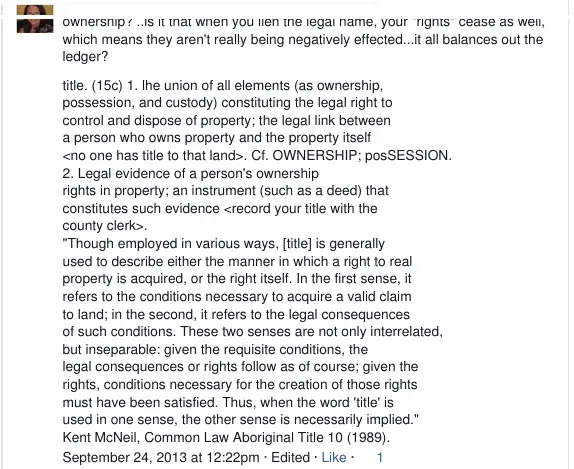
Does the govt not just have legal title ownership...which is 1/10 ownership? ..is it that when you lien the legal name, your "rights" cease as well, which means they aren't really being negatively effected...it all balances out the ledger?
title. (15c) 1. lhe union of all elements (as ownership,
possession, and custody) constituting the legal right to
control and dispose of property; the legal link between
a person who owns property and the property itself
<no one has title to that land>. Cf. OWNERSHIP; posSESSION.
2. Legal evidence of a person's ownership
rights in property; an instrument (such as a deed) that
constitutes such evidence <record your title with the
county clerk>.
"Though employed in various ways, [title] is generally
used to describe either the manner in which a right to real
property is acquired, or the right itself. In the first sense, it
refers to the conditions necessary to acquire a valid claim
to land; in the second, it refers to the legal consequences
of such conditions. These two senses are not only interrelated,
but inseparable: given the requisite conditions, the
legal consequences or rights follow as of course; given the
rights, conditions necessary for the creation of those rights
must have been satisfied. Thus, when the word 'title' is
used in one sense, the other sense is necessarily implied."
Kent McNeil, Common Law Aboriginal Title 10 (1989).
Printed copy · Anthology Volume 5, page 979 · cut by a page breakPrinted copy from The Tender For Law Anthology, Volume 5, page 979 (printed 13 June 2014). Added by this site; not part of the Facebook export. A page break in the printout cut off the beginning of this comment, with its name.