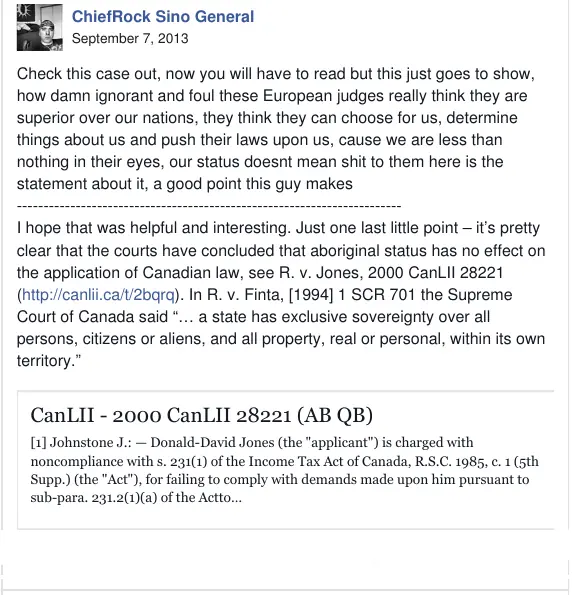
Check this case out, now you will have to read but this just goes to show, how damn ignorant and foul these European judges really think they are superior over our nations, they think they can choose for us, determine things about us and push their laws upon us, cause we are less than nothing in their eyes, our status doesnt mean shit to them here is the statement about it, a good point this guy makes
------------------------------------------------------------------------
I hope that was helpful and interesting. Just one last little point — it’s pretty clear that the courts have concluded that aboriginal status has no effect on the application of Canadian law, see R. v. Jones, 2000 CanLII 28221 (http://canlii.ca/t/2bqrq). In R. v. Finta, [1994] 1 SCR 701 the Supreme Court of Canada said … a state has exclusive sovereignty over all persons, citizens or aliens, and all property, real or personal, within its own territory.”
[1] Johnstone J.: — Donald-David Jones (the "applicant") is charged with noncompliance with s. 231(1) of the Income Tax Act of Canada, R.S.C. 1985, c. 1 (5th Supp.) (the "Act"), for failing to comply with demands made upon him pursuant to sub-para. 231.2(1)(a) of the Actto”
Printed copy · Anthology Volume 3, page 1153Printed copy from The Tender For Law Anthology, Volume 3, page 1153 (printed 13 June 2014). Added by this site; not part of the Facebook export.Filter by poster
Read Comments 14
John Quicktree Muellers
what about this http://www.un.org/en/documents/udhr/hr_law.shtml
Printed copy · Anthology Volume 3, page 1154Printed copy from The Tender For Law Anthology, Volume 3, page 1154 (printed 13 June 2014). Added by this site; not part of the Facebook export.
John Quicktree Muellers
and this http://www.un.org/en/documents/udhr/
Printed copy · Anthology Volume 3, page 1154Printed copy from The Tender For Law Anthology, Volume 3, page 1154 (printed 13 June 2014). Added by this site; not part of the Facebook export.
Pete Daoust
There is no HUMANS in court....Only applicants, persons and citizens... :(
Printed copy · Anthology Volume 3, page 1154Printed copy from The Tender For Law Anthology, Volume 3, page 1154 (printed 13 June 2014). Added by this site; not part of the Facebook export.
John Quicktree Muellers
of course as a corporation can only deal with a corporation,,,,
Printed copy · Anthology Volume 3, page 1154Printed copy from The Tender For Law Anthology, Volume 3, page 1154 (printed 13 June 2014). Added by this site; not part of the Facebook export.
Pete Daoust
No....APPLICANTS, PERSONS and CITIZENS.....and corporations....
Printed copy · Anthology Volume 3, page 1154Printed copy from The Tender For Law Anthology, Volume 3, page 1154 (printed 13 June 2014). Added by this site; not part of the Facebook export.
Pete Daoust
a state has exclusive sovereignty over all persons, citizens or aliens, and all property, real or personal, within its own territory.”
They deal with PERSONS, and these persons they deal with, has been created by the state, so therefor, these persons are considered INVENTORY sitting in the state's warehouse.....
Printed copy · Anthology Volume 3, page 1154Printed copy from The Tender For Law Anthology, Volume 3, page 1154 (printed 13 June 2014). Added by this site; not part of the Facebook export.
John Quicktree Muellers
so which definition of person and citizen are you using?
Printed copy · Anthology Volume 3, page 1154Printed copy from The Tender For Law Anthology, Volume 3, page 1154 (printed 13 June 2014). Added by this site; not part of the Facebook export.
John Quicktree Muellers
or should I say "they"
Printed copy · Anthology Volume 3, page 1154Printed copy from The Tender For Law Anthology, Volume 3, page 1154 (printed 13 June 2014). Added by this site; not part of the Facebook export.
Pete Daoust
In THEIR bunkers, I have to play by THEIR rules, if of course, I am the APPLICANT....because I have to APPLY with the person I have in my pocket if I want to go there.....and the person I have in my pocket seems to be a TRUSTEE to their view......they even make you swear an AFFIDAVIT on that when you apply....
Printed copy · Anthology Volume 3, page 1154Printed copy from The Tender For Law Anthology, Volume 3, page 1154 (printed 13 June 2014). Added by this site; not part of the Facebook export.
Pete Daoust
In that case, R. v. Jones was the APPLICANT, so he definitly admitted being a PERSON and/or a CITIZEN when he applied.....with or without knowing that a state has exclusive sovereignty over all persons, citizens or aliens, and all property, real or personal, within its own territory.”
Printed copy · Anthology Volume 3, page 1154 · cut by a page breakPrinted copy from The Tender For Law Anthology, Volume 3, page 1154 (printed 13 June 2014). Added by this site; not part of the Facebook export. A page break in the printout cut off the beginning of this comment, with its name.
Derek Moran
Operative-phrase- "...within its OWN territory".....theres a Maxim-of-law that says, all jurisdictions have their BOUNDARIES ;)
Printed copy · Anthology Volume 3, page 1155Printed copy from The Tender For Law Anthology, Volume 3, page 1155 (printed 13 June 2014). Added by this site; not part of the Facebook export.
Pete Daoust
And when you APPLY in THEIR jurisdiction, well you're right in it ;)
Printed copy · Anthology Volume 3, page 1155Printed copy from The Tender For Law Anthology, Volume 3, page 1155 (printed 13 June 2014). Added by this site; not part of the Facebook export.
Robert Cormier
I can't get my head around this. It leaped off the page at me as being so ludicrous as to be laughable. Am i missing something here? VI. Conclusion
[38] ..."The Royal Proclamation of George III contemplated licensing for purposes of CONDUCTING COMMERCE and DID NOT DEAL WITH the issues of sovereignty and JURISDICTION." Questions: Doesn't COMMERCE (by its very nature) itself dictate (deal with) the use of a specific JURISDICTION known as ADMIRALTY/COMMERCE? In other words, can commerce occur in any other jurisdiction other than admiralty? How can the court deny that it is engaging in commerce and that commerce does indeed "deal with" a (admiralty) JURISDICTION?
Printed copy · Anthology Volume 3, page 1155Printed copy from The Tender For Law Anthology, Volume 3, page 1155 (printed 13 June 2014). Added by this site; not part of the Facebook export.
Derek Moran
As Kate of Gaia drives home- "Until your ship-comes-to-shore, you are lost-at-sea"
Printed copy · Anthology Volume 3, page 1155Printed copy from The Tender For Law Anthology, Volume 3, page 1155 (printed 13 June 2014). Added by this site; not part of the Facebook export.
Filter by poster
Read Comments 14
John Quicktree Muellers
Printed copy · Anthology Volume 3, page 1154
John Quicktree Muellers
Printed copy · Anthology Volume 3, page 1154
Pete Daoust
Printed copy · Anthology Volume 3, page 1154
John Quicktree Muellers
Printed copy · Anthology Volume 3, page 1154
Pete Daoust
Printed copy · Anthology Volume 3, page 1154
Pete Daoust
Printed copy · Anthology Volume 3, page 1154
John Quicktree Muellers
Printed copy · Anthology Volume 3, page 1154
John Quicktree Muellers
Printed copy · Anthology Volume 3, page 1154
Pete Daoust
Printed copy · Anthology Volume 3, page 1154
Pete Daoust
Printed copy · Anthology Volume 3, page 1154 · cut by a page break
Derek Moran
Printed copy · Anthology Volume 3, page 1155
Pete Daoust
Printed copy · Anthology Volume 3, page 1155
Robert Cormier
Printed copy · Anthology Volume 3, page 1155
Derek Moran
Printed copy · Anthology Volume 3, page 1155