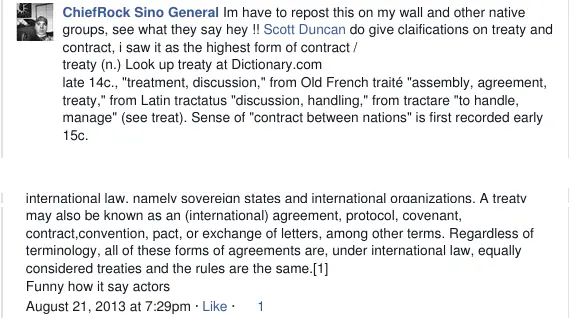
Im have to repost this on my wall and other native groups, see what they say hey !! Scott Duncan do give claifications on treaty and contract, i saw it as the highest form of contract /
treaty (n.) Look up treaty at Dictionary.com
late 14c., "treatment, discussion," from Old French trait” "assembly, agreement, treaty," from Latin tractatus "discussion, handling," from tractare "to handle, manage" (see treat). Sense of "contract between nations" is first recorded early 15c.
-------------------------------------------
A treaty is an express agreement under international law entered into by actors in international law, namely sovereign states and international organizations. A treaty may also be known as an (international) agreement, protocol, covenant, contract,convention, pact, or exchange of letters, among other terms. Regardless of terminology, all of these forms of agreements are, under international law, equally considered treaties and the rules are the same.[1]
Funny how it say actors :P
Printed copy · Anthology Volume 2, page 187Printed copy from The Tender For Law Anthology, Volume 2, page 187 (printed 14 June 2014). Added by this site; not part of the Facebook export.