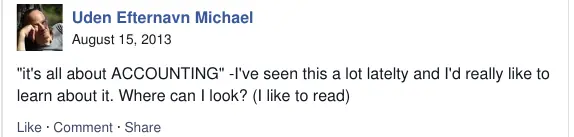
"it's all about ACCOUNTING" -I've seen this a lot latelty and I'd really like to learn about it. Where can I look? (I like to read)
Printed copy · Anthology Volume 2, page 247Printed copy from The Tender For Law Anthology, Volume 2, page 247 (printed 14 June 2014). Added by this site; not part of the Facebook export.Filter by poster
Read Comments 32
August le Blanc · Bobis Youruncle
Bills Of Exchange book in the files section above is a good place to begin...
Printed copy · Anthology Volume 2, page 247Printed copy from The Tender For Law Anthology, Volume 2, page 247 (printed 14 June 2014). Added by this site; not part of the Facebook export.
Beverly Berta Braakschmack
Financial Administration Act...
Printed copy · Anthology Volume 2, page 247Printed copy from The Tender For Law Anthology, Volume 2, page 247 (printed 14 June 2014). Added by this site; not part of the Facebook export.
August le Blanc · Bobis Youruncle
Interpretation Act...
Printed copy · Anthology Volume 2, page 247Printed copy from The Tender For Law Anthology, Volume 2, page 247 (printed 14 June 2014). Added by this site; not part of the Facebook export.
Beverly Berta Braakschmack
And have a law dictionary beside you :D
Printed copy · Anthology Volume 2, page 247Printed copy from The Tender For Law Anthology, Volume 2, page 247 (printed 14 June 2014). Added by this site; not part of the Facebook export.
August le Blanc · Bobis Youruncle
A current one..
Printed copy · Anthology Volume 2, page 247Printed copy from The Tender For Law Anthology, Volume 2, page 247 (printed 14 June 2014). Added by this site; not part of the Facebook export.
Beverly Berta Braakschmack
Like he said
Printed copy · Anthology Volume 2, page 247Printed copy from The Tender For Law Anthology, Volume 2, page 247 (printed 14 June 2014). Added by this site; not part of the Facebook export.
August le Blanc
and what she said...
Beverly Berta Braakschmack
See, we could say "Its all about SURETY and MONEY"... but what is money? Watch the Money as Debt series on Youtube as well...
Printed copy · Anthology Volume 2, page 248Printed copy from The Tender For Law Anthology, Volume 2, page 248 (printed 14 June 2014). Added by this site; not part of the Facebook export.
Dean Clifford
Has anyone found the gem in the Financial Admin Act yet? ;)
Printed copy · Anthology Volume 2, page 248Printed copy from The Tender For Law Anthology, Volume 2, page 248 (printed 14 June 2014). Added by this site; not part of the Facebook export.
Blake Gardner
The fact that's its burnable?:-)
Beverly Berta Braakschmack
There's many gems in that one! I'll get back to ya...
Printed copy · Anthology Volume 2, page 248Printed copy from The Tender For Law Anthology, Volume 2, page 248 (printed 14 June 2014). Added by this site; not part of the Facebook export.
David Johansen
Mik, that statement, made here, is speaking of civil court. all civil actions are merely a matter of accounting, so when you learn what they are doing, you can keep out of accepting responsibility for paying the bill.
Printed copy · Anthology Volume 2, page 248Printed copy from The Tender For Law Anthology, Volume 2, page 248 (printed 14 June 2014). Added by this site; not part of the Facebook export.
Michael Af Sjælland · Uden Efternavn Michael
From BoE: "A Promissory Note is an unconditional promise in writing made by one person to another, signed by the maker, engaging to pay on demand or at a fixed or determinable future time, a sum certain IN MONEY, to, or to the order of, a specified person, or to bearer." [My emphasis].
I am stuck here. If money (lik a $10 blll) is a promise to pay (representing somene's debt, and they promised they'd pay) then a promisary note can only get you another promise.
AmI missing the boat completly?
Printed copy · Anthology Volume 2, page 248Printed copy from The Tender For Law Anthology, Volume 2, page 248 (printed 14 June 2014). Added by this site; not part of the Facebook export.
Dennis FrmAccounts
In your public finance act, It should say something along the lines.. "The Crown must not get involved in Securities" except by Statute, Which implies you can pay by Statute. A note in the hands of a 3rd party is a Security, as you know they pool these notes and they become Securities/Bonds http://privateaudio.homestead.com/Exhibit_G_Securitization.pdf.
Printed copy · Anthology Volume 2, page 248Printed copy from The Tender For Law Anthology, Volume 2, page 248 (printed 14 June 2014). Added by this site; not part of the Facebook export.
David Johansen
nope, because what you call money has no value except to the bearer or exceptor provided they both agree to exchanging it as a representation of value. paper money is nothing more than a medium of exchange and it does not have to be accepted, however if it is it brings along with it an obligation, by tendering or accepting it you become bound to the color of law attached to it.
Printed copy · Anthology Volume 2, page 248Printed copy from The Tender For Law Anthology, Volume 2, page 248 (printed 14 June 2014). Added by this site; not part of the Facebook export.
Dennis FrmAccounts
Where there are obligations there are rights Where the are liabilities there are remedies.
Printed copy · Anthology Volume 2, page 249Printed copy from The Tender For Law Anthology, Volume 2, page 249 (printed 14 June 2014). Added by this site; not part of the Facebook export.
Beverly Berta Braakschmack
1. Marginal note:Debt due to Her Majesty
(3) Any interest or administrative charge payable pursuant to this section is a debt due to Her Majesty and may be recovered pursuant to section 155 or in any court of competent jurisdiction.
Printed copy · Anthology Volume 2, page 249Printed copy from The Tender For Law Anthology, Volume 2, page 249 (printed 14 June 2014). Added by this site; not part of the Facebook export.
Dennis FrmAccounts
Your the underwriter for the public debt. You pay with their note or your notes if your using your notes your paying twice.
Printed copy · Anthology Volume 2, page 249Printed copy from The Tender For Law Anthology, Volume 2, page 249 (printed 14 June 2014). Added by this site; not part of the Facebook export.
Derek Moran
Court-of-Competent Jurisdiction for us in this case = COURT OF EQUITY
Printed copy · Anthology Volume 2, page 249Printed copy from The Tender For Law Anthology, Volume 2, page 249 (printed 14 June 2014). Added by this site; not part of the Facebook export.
Dennis FrmAccounts
Your paperwork is the court.
Printed copy · Anthology Volume 2, page 249Printed copy from The Tender For Law Anthology, Volume 2, page 249 (printed 14 June 2014). Added by this site; not part of the Facebook export.
Beverly Berta Braakschmack
least Mik spells "a lot" properly...
Printed copy · Anthology Volume 2, page 249Printed copy from The Tender For Law Anthology, Volume 2, page 249 (printed 14 June 2014). Added by this site; not part of the Facebook export.
Blake Gardner
Money = debt /obligation but there are 2 sorts - money of account & money of exchange...the second variety is the one everyone is clamoring after and is under selective access control, but the first variety is in most cases just as useful when one transitions from accumulation to distribution. The real currency is consent/agreement:-)
Michael Af Sjælland · Uden Efternavn Michael
Blake, can you give an example of 'money of account'? I'm assuming you don't mean the stuff in your bank account that you can transfer by e.g. plstic card.
Printed copy · Anthology Volume 2, page 249Printed copy from The Tender For Law Anthology, Volume 2, page 249 (printed 14 June 2014). Added by this site; not part of the Facebook export.
Blake Gardner
Basically the difference between the two should be the difference between private and public, however with the introduction of fiat currency in 1933'ish there is no longer the ability to PAY a debt with substance - Public policy HJR 192. So you got funny money, paper debt instruments and digital digits on a screen all representing accounts, accounting, money of account. Then you got the mafia monopoly of legal tender as so-called money of exchange, however anything can be used as a medium of exchange if the bridge of consent/agreement is crossed/created:-)
Dennis FrmAccounts
Debts are assets, ABS - Asset Backed Securities it's pre 1933
Printed copy · Anthology Volume 2, page 249Printed copy from The Tender For Law Anthology, Volume 2, page 249 (printed 14 June 2014). Added by this site; not part of the Facebook export.
Blake Gardner
I guess a simple way to say it is money of account is obligation based (a contract) and money of exchange is a this for that affair. An immediate trade with no future obligation, or real gain other than the swap.
Dennis FrmAccounts
Tell'em you want recoupment under UCC 3-305, and claim under 3-306, watch how fast they discharge their debt
Printed copy · Anthology Volume 2, page 249Printed copy from The Tender For Law Anthology, Volume 2, page 249 (printed 14 June 2014). Added by this site; not part of the Facebook export.
Dennis FrmAccounts
Your askng for the proceeds from the investments.
Printed copy · Anthology Volume 2, page 249Printed copy from The Tender For Law Anthology, Volume 2, page 249 (printed 14 June 2014). Added by this site; not part of the Facebook export.
Blake Gardner
Or askem if they've paid the appropriate tax on said funds:)
Dennis FrmAccounts
See SEC vs CITY of MIAMI re; public & private mixing of money.
Printed copy · Anthology Volume 2, page 249 · cut by a page breakPrinted copy from The Tender For Law Anthology, Volume 2, page 249 (printed 14 June 2014). Added by this site; not part of the Facebook export. A page break in the printout cut off the end of this comment.
Pete Daoust
PUBLIC MONEY:
(b) money borrowed by Canada or received through the issue or sale of securities,
:D
Printed copy · Anthology Volume 2, page 250Printed copy from The Tender For Law Anthology, Volume 2, page 250 (printed 14 June 2014). Added by this site; not part of the Facebook export.
Pete Daoust
“security certificate”
— certificat de valeur — " Valuable Certificate
“security certificate” means a tangible certificate issued by or on behalf of Her Majesty representing part of the public debt of Canada;
Printed copy · Anthology Volume 2, page 250Printed copy from The Tender For Law Anthology, Volume 2, page 250 (printed 14 June 2014). Added by this site; not part of the Facebook export.
Filter by poster
Read Comments 32
August le Blanc · Bobis Youruncle
Printed copy · Anthology Volume 2, page 247
Beverly Berta Braakschmack
Printed copy · Anthology Volume 2, page 247
August le Blanc · Bobis Youruncle
Printed copy · Anthology Volume 2, page 247
Beverly Berta Braakschmack
Printed copy · Anthology Volume 2, page 247
August le Blanc · Bobis Youruncle
Printed copy · Anthology Volume 2, page 247
Beverly Berta Braakschmack
Printed copy · Anthology Volume 2, page 247
August le Blanc
Beverly Berta Braakschmack
Printed copy · Anthology Volume 2, page 248
Dean Clifford
Printed copy · Anthology Volume 2, page 248
Blake Gardner
Beverly Berta Braakschmack
Printed copy · Anthology Volume 2, page 248
David Johansen
Printed copy · Anthology Volume 2, page 248
Michael Af Sjælland · Uden Efternavn Michael
Printed copy · Anthology Volume 2, page 248
Dennis FrmAccounts
Printed copy · Anthology Volume 2, page 248
David Johansen
Printed copy · Anthology Volume 2, page 248
Dennis FrmAccounts
Printed copy · Anthology Volume 2, page 249
Beverly Berta Braakschmack
Printed copy · Anthology Volume 2, page 249
Dennis FrmAccounts
Printed copy · Anthology Volume 2, page 249
Derek Moran
Printed copy · Anthology Volume 2, page 249
Dennis FrmAccounts
Printed copy · Anthology Volume 2, page 249
Beverly Berta Braakschmack
Printed copy · Anthology Volume 2, page 249
Blake Gardner
Michael Af Sjælland · Uden Efternavn Michael
Printed copy · Anthology Volume 2, page 249
Blake Gardner
Dennis FrmAccounts
Printed copy · Anthology Volume 2, page 249
Blake Gardner
Dennis FrmAccounts
Printed copy · Anthology Volume 2, page 249
Dennis FrmAccounts
Printed copy · Anthology Volume 2, page 249
Blake Gardner
Dennis FrmAccounts
Printed copy · Anthology Volume 2, page 249 · cut by a page break
Pete Daoust
Printed copy · Anthology Volume 2, page 250
Pete Daoust
Printed copy · Anthology Volume 2, page 250