Sirwade Firsbey · Who-are You Frisbey
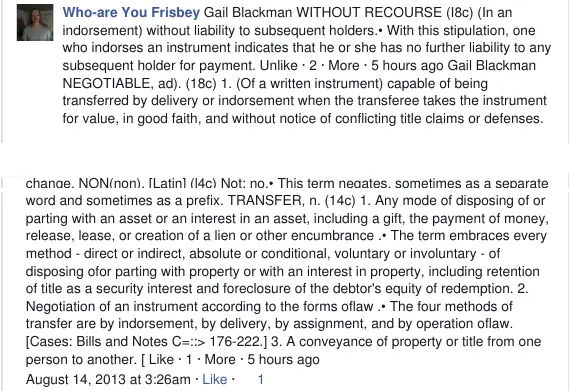
Gail Blackman WITHOUT RECOURSE (I8c) (In an indorsement) without liability to subsequent holders.” With this stipulation, one who indorses an instrument indicates that he or she has no further liability to any subsequent holder for payment. Unlike · 2 — More · 5 hours ago Gail Blackman NEGOTIABLE, ad). (18c) 1. (Of a written instrument) capable of being transferred by delivery or indorsement when the transferee takes the instrument for value, in good faith, and without notice of conflicting title claims or defenses. [Cases: Bills and Notes ~144.]2. (Of a deal, agreement, etc.) capable ofbeing accomplished. 3. (Of a price or deal) subject to further bargaining and possible change. NON(non). [Latin] (l4c) Not; no.” This term negates, sometimes as a separate word and sometimes as a prefix. TRANSFER, n. (14c) 1. Any mode of disposing of or parting with an asset or an interest in an asset, including a gift, the payment of money, release, lease, or creation of a lien or other encumbrance .” The term embraces every method - direct or indirect, absolute or conditional, voluntary or involuntary - of disposing ofor parting with property or with an interest in property, including retention of title as a security interest and foreclosure of the debtor's equity of redemption. 2. Negotiation of an instrument according to the forms oflaw .” The four methods of transfer are by indorsement, by delivery, by assignment, and by operation oflaw. [Cases: Bills and Notes C=::> 176-222.] 3. A conveyance of property or title from one person to another. [ Like · 1 — More · 5 hours ago
Printed copy · Anthology Volume 3, page 879