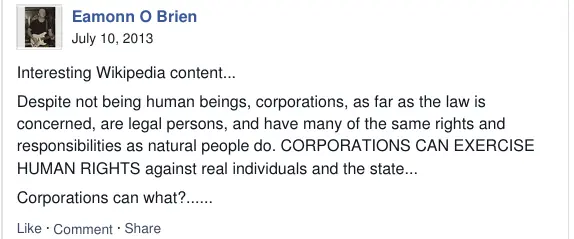
Despite not being human beings, corporations, as far as the law is concerned, are legal persons, and have many of the same rights and responsibilities as natural people do. CORPORATIONS CAN EXERCISE HUMAN RIGHTS against real individuals and the state...
Corporations can what?......
Printed copy · Anthology Volume 2, page 1214Printed copy from The Tender For Law Anthology, Volume 2, page 1214 (printed 14 June 2014). Added by this site; not part of the Facebook export.Filter by poster
Read Comments 34
Eamonn O Brien
If you read it enough times, all the words eventually turn into the word CLUBHOUSE...
Printed copy · Anthology Volume 2, page 1214Printed copy from The Tender For Law Anthology, Volume 2, page 1214 (printed 14 June 2014). Added by this site; not part of the Facebook export.
Mick Parker · Súil Eile
Hu-Man is colour of man, ( HUMAN RIGHTS), "people" is not the plural of person(natural persons) & if you check the interpretation act "individual" again refers back to their person... their creation, so the lesson i've learned is, dont allow yourself be defined by them "ARE YOU ADDRESSING ME" :)
Printed copy · Anthology Volume 2, page 1214Printed copy from The Tender For Law Anthology, Volume 2, page 1214 (printed 14 June 2014). Added by this site; not part of the Facebook export.
I know someone who saw an old dictionary that defined the prefix HU- as, "like unto; not quite the same as"
...HU - MAN
Signed,
"I-cant-BELIEVE-its-not-Butter!"
Printed copy · Anthology Volume 2, page 1214Printed copy from The Tender For Law Anthology, Volume 2, page 1214 (printed 14 June 2014). Added by this site; not part of the Facebook export.
Derek Moran
The Police Officers Manual 2000 says it right there, that effectively- "...the term Human Being is synonymous with Person..." (not MY words, Scott)
Printed copy · Anthology Volume 2, page 1215Printed copy from The Tender For Law Anthology, Volume 2, page 1215 (printed 14 June 2014). Added by this site; not part of the Facebook export.
Derek Moran
OH- and there is NO definition for HUMAN, in the Ontario Human Rights Code.....but there is one for PERSON ;) ;)
Printed copy · Anthology Volume 2, page 1215Printed copy from The Tender For Law Anthology, Volume 2, page 1215 (printed 14 June 2014). Added by this site; not part of the Facebook export.
Derek Moran
“person” in addition to the extended meaning given it by Part VI (Interpretation) of the Legislation Act, 2006, includes an employment agency, an employers’ organization, an unincorporated association, a trade or occupational association, a trade union, a partnership, a municipality, a board of police commissioners established under the Police Act, being chapter 381 of the Revised Statutes of Ontario, 1980, and a police services board established under the Police Services Act;
Printed copy · Anthology Volume 2, page 1215Printed copy from The Tender For Law Anthology, Volume 2, page 1215 (printed 14 June 2014). Added by this site; not part of the Facebook export.
Chad Brodgesell
Could that be construed as "a Human being a person"?
Printed copy · Anthology Volume 2, page 1215Printed copy from The Tender For Law Anthology, Volume 2, page 1215 (printed 14 June 2014). Added by this site; not part of the Facebook export.
Mick Parker · Súil Eile
murdochs Irish law dictionary "human rights commision ....in respect of the human rights of any person or class of persons"
Printed copy · Anthology Volume 2, page 1215Printed copy from The Tender For Law Anthology, Volume 2, page 1215 (printed 14 June 2014). Added by this site; not part of the Facebook export.
Derek Moran
*Province to Chad Brodgesell* "You are in VIOLATION of the Human Rights Code of Ontario..."
*Chad to Province* "Really?....so then you'll be able to tell me what your definition of a HUMAN is, right?"
*Province to Chad* "Get the fuck OUT of our quasi-Tribunal operating under the COLOR OF LAW!!"
Printed copy · Anthology Volume 2, page 1215Printed copy from The Tender For Law Anthology, Volume 2, page 1215 (printed 14 June 2014). Added by this site; not part of the Facebook export.
Maa Nathltaapaan
HUMAN = MONSTER = has no rights to own any thing, not even them selves = de facto has rights over you for you can not take care of you .. ballentines dictionary 1938 or that time ....
Printed copy · Anthology Volume 2, page 1216Printed copy from The Tender For Law Anthology, Volume 2, page 1216 (printed 14 June 2014). Added by this site; not part of the Facebook export.
Chad Brodgesell
Yes I know but they never do that. They talk and smile at you while your being dragged downstairs . :)
Printed copy · Anthology Volume 2, page 1216Printed copy from The Tender For Law Anthology, Volume 2, page 1216 (printed 14 June 2014). Added by this site; not part of the Facebook export.
Chad Brodgesell
In the end it is all still THEIR business not ours. Until there is a REAL claim from one of the parries.
Printed copy · Anthology Volume 2, page 1216Printed copy from The Tender For Law Anthology, Volume 2, page 1216 (printed 14 June 2014). Added by this site; not part of the Facebook export.
Chad Brodgesell
parties *
Printed copy · Anthology Volume 2, page 1216Printed copy from The Tender For Law Anthology, Volume 2, page 1216 (printed 14 June 2014). Added by this site; not part of the Facebook export.
Maximus Legis
Wiki(paedo) is not a reliable source of information ! I buy the part about corp's being persons but Human Rights? BULLSHIT !!!! AND WHAT IS THE ONLY "human right" ? THE RIGHT NOT TO CONTRACT !
Printed copy · Anthology Volume 2, page 1216Printed copy from The Tender For Law Anthology, Volume 2, page 1216 (printed 14 June 2014). Added by this site; not part of the Facebook export.
Ceit Butler
Ballentine's 3rd Defines "Human" as : "Of the form and characteristics of a man".
Printed copy · Anthology Volume 2, page 1216Printed copy from The Tender For Law Anthology, Volume 2, page 1216 (printed 14 June 2014). Added by this site; not part of the Facebook export.
Ceit Butler
and "Human Being" as: "a PERSON, male or female".
Printed copy · Anthology Volume 2, page 1216Printed copy from The Tender For Law Anthology, Volume 2, page 1216 (printed 14 June 2014). Added by this site; not part of the Facebook export.
Derek Moran
it'd be alot less ambiguous if it just said:
HUMAN: a man or woman, male or female
Printed copy · Anthology Volume 2, page 1216Printed copy from The Tender For Law Anthology, Volume 2, page 1216 (printed 14 June 2014). Added by this site; not part of the Facebook export.
Derek Moran
Christian Bale can be BATMAN, Michael Keaton can be BATMAN, Val Kilmer can be BATMAN
..but BATMAN is NOT Christian Bale, Michael Keaton, and/or Val Kilmer
Printed copy · Anthology Volume 2, page 1216Printed copy from The Tender For Law Anthology, Volume 2, page 1216 (printed 14 June 2014). Added by this site; not part of the Facebook export.
Ceit Butler
But that's the point...if "Human" meant "a man or woman", it would SAY that. "form and characteristics of a man" makes more sense when you pair that with the definition of "Hu".
Printed copy · Anthology Volume 2, page 1216Printed copy from The Tender For Law Anthology, Volume 2, page 1216 (printed 14 June 2014). Added by this site; not part of the Facebook export.
Pete Daoust
The way I see this is:
If I WANT to be a person, I will be a person (I'll bet ANYTHING that they will let me be a person :D )
If a person wants to be a human, well that is impossible
Does that makes sense ? :/
Printed copy · Anthology Volume 2, page 1217Printed copy from The Tender For Law Anthology, Volume 2, page 1217 (printed 14 June 2014). Added by this site; not part of the Facebook export.
Pete Daoust
We get to decide what we are, I was PIERRE DAOUST for so many years, and no one objected to it :D
Printed copy · Anthology Volume 2, page 1217Printed copy from The Tender For Law Anthology, Volume 2, page 1217 (printed 14 June 2014). Added by this site; not part of the Facebook export.
Pete Daoust
Now I am the Master of PIERRE DAOUST, and so far, no one objected to it
Printed copy · Anthology Volume 2, page 1217Printed copy from The Tender For Law Anthology, Volume 2, page 1217 (printed 14 June 2014). Added by this site; not part of the Facebook export.
Chad Brodgesell
Yup
Printed copy · Anthology Volume 2, page 1217Printed copy from The Tender For Law Anthology, Volume 2, page 1217 (printed 14 June 2014). Added by this site; not part of the Facebook export.
Maa Nathltaapaan
A LAW DICTIONARY — ADAPTED TO THE CONSTITUTION AND LAWS OF THE UNITED STATES OF AMERICA AND OF THE SEVERAL STATES OF THE AMERICAN UNION — by John Bouvier — Revised Sixth Edition, 1856
PERSON. This word is applied to men, women and children, who are called natural persons. In law, man and person are not exactly-synonymous terms. Any human being is a man, whether he be a member of society or not, whatever may be the rank he holds, or whatever may be his age, sex, &c. A person is a man considered according to the rank he holds in society, with all the rights to which the place he holds entitles him, and the duties which it imposes. 1 Bouv. Inst. n. 137.
2. It is also used to denote a corporation which is an artificial person. 1 Bl. Com. 123; 4 Bing. 669; C. 33 Eng. C. L R. 488; Wooddes. Lect. 116; Bac. Us. 57; 1 Mod. 164.
3. But when the word "Persons" is spoken of in legislative acts, natural persons will be intended, unless something appear in the context to show that it applies to artificial persons. 1 Scam. R. 178.
4. Natural persons are divided into males, or men; and females or women. Men are capable of all kinds of engagements and functions, unless by reasons applying to particular individuals. Women cannot be appointed to any public office, nor perform any civil functions, except those which the law specially declares them capable of exercising. Civ. Code of Louis. art. 25.
5. They are also sometimes divided into free persons and slaves. Freemen are those who have preserved their natural liberty, that is to say, who have the right of doing what is not forbidden by the law. A slave is one who is in the power of a master to whom he belongs. Slaves are sometimes ranked not with persons but things. But sometimes they are considered as persons for example, a negro is in contemplation of law a person, so as to be capable of committing a riot in conjunction with white men. 1 Bay, 358. Vide Man.
6. Persons are also divided into citizens, (q. v.) and aliens, (q. v.) when viewed with regard to their political rights. When they are considered in relation to their civil rights, they are living or civilly dead; vide Civil Death; outlaws; and infamous persons.
7. Persons are divided into legitimates and bastards, when examined as to their rights by birth.
8. When viewed in their domestic relations, they are divided into parents and children; husbands and wives; guardians and wards; and masters and servants son, as it is understood in law, see 1 Toull. n. 168; 1 Bouv. Inst. n. 1890, note
Printed copy · Anthology Volume 2, page 1217Printed copy from The Tender For Law Anthology, Volume 2, page 1217 (printed 14 June 2014). Added by this site; not part of the Facebook export.
Chad Brodgesell
That is why you need to ask them WHO are they referring to.
Printed copy · Anthology Volume 2, page 1218Printed copy from The Tender For Law Anthology, Volume 2, page 1218 (printed 14 June 2014). Added by this site; not part of the Facebook export.
Maa Nathltaapaan
THE 10 BIGGEST ERRORS MOST PEOPLE MAKE WHEN FACING THE PIRATES AND PRIVATEERS OF THE PRIVATE BAR GUILDS
Ucadia Blog - Wednesday, November 14, 2012
To be blunt — many people continue to make fundamental and silly errors when facing the pirates and privateers of the Private Bar Guilds — often with dire consequences. Some of these errors continue to be of such a basic level of competence, that it is surprising so many fail to consider common sense and avoid sabotaging the slimmest of margins in resolving matters with a kleptocratic guild that demands absolute loyalty by forcing its members to perpetually demonstrate perfidy, treachery and malfeasance.
[42] The sixth, most frequent error committed by those facing the Private Bar Guilds and their private commercial courts is when litigants confident in their own skills at oratory or documentation choose to fight and create conflict with the Pirates and Privateers; and
[43] This is a tragic cost- as many a brave soul have risen through experience to believe they can match in assertiveness and skill those registered members of the secret societies that practice pseudo-law, only to find the sharp fangs of procedural injustice at its worst; and
[44] The truth is that the system needs conflict, it demands controversy- it relishes and celebrates the belligerent litigant — as the poster character for supporting propaganda aligned at warning others, that such “anti-law”, “anti-establishment” and “anti-government” behavior will not be tolerated. Those that actively pursue the courts, sometimes with personal vendettas unfortunately created terrible injury against the law and the rest of society by enabling the system to re-set itself and parody genuine concerns as “extremists” and more recently as “paper terrorists”.
Printed copy · Anthology Volume 2, page 1218Printed copy from The Tender For Law Anthology, Volume 2, page 1218 (printed 14 June 2014). Added by this site; not part of the Facebook export.
Pete Daoust
paper terrorists ? :D
Printed copy · Anthology Volume 2, page 1219Printed copy from The Tender For Law Anthology, Volume 2, page 1219 (printed 14 June 2014). Added by this site; not part of the Facebook export.
Maa Nathltaapaan
The NAME GAME Explained
All adult humans are deceived into using the fiction name, as imprinted on the copy of the birth certificate you receive when ordering it from Provincial/State Vital Statistics, or to whatever
source you apply. Although the birth certificate is of somewhat recent origin and used to formally offer 'citizens' as chattel in bankruptcy to the Pope's Holy Roman Empire owned Rothschilds' Banking System, the false use of the family name goes back into the Middle Ages in England. Thus, it is with the family name made a primary, or surname, (example - Mister Jones), and the given names of the child (example - Peter) made a reference name to the primary name. This is the reverse or mirror image to reality. A 'family name' is NOT a man's name - it is a name of a clan - a blood relationship. [Replace the example names with your given and family name.]
We are then 'forced' or 'obliged' to use that name in all commercial and Government dealings and communications. So, when we do use it, as 99.99% of the human inhabitants of North America (and most of the world) do, we supposedly 'voluntarily' attach ourselves, the free will adult human, to the Crown/State owned property, called the 'legal identity name' as an accessory attached to property owned by Another party. Think of a ship under tow by another ship. Which
captain decides what route the ships will take? The “legal name/strawman” is the tow rope, and the towing ship is the corporate (make-believe ship at sea) Crown of the City of London. As an attachment to the legal name owned by the Crown, you are the towed ship, and your vessel captain, your free will mind, is now a subservient crew member to the captain of the Crown.
Printed copy · Anthology Volume 2, page 1219Printed copy from The Tender For Law Anthology, Volume 2, page 1219 (printed 14 June 2014). Added by this site; not part of the Facebook export.
Maa Nathltaapaan
In this country known as Canada we gradually came to accept being referred to as a person, especially after the famous Emily Murphy case. Whereas she concluded that women should have the status of a person and therefore be equal with men. The truth is that women always were equal and in the end as they have found out, have given up their god given inalienable rights for the rights of a dead corporation.
The key word here is dead, all formed in legal fiction PERSONS have attained the status of a dead in law corporation. All corporations are dead; they exist only on paper and in your mind. Now, under Roman civil law as we have in Canada, a dead corporation such as a government cannot deal with the living and as such can only deal with the dead. Hence the dead formed in legal fiction government can only deal/contract with another dead formed in legal fiction entity such as a “person”.
You, are aware aren’t you, that the living cannot communicate or contract with the dead? The proof is everywhere if you only look for it. Our forefathers knew this and that is why our so called constitution begins with “Canada is founded upon the principles that recognize the Supremacy of God and the rule of law”. According to our de jure head of state the living private woman Elizabeth Mary Alexandra: Windsor acting as the corporate Queen holds the King James Bible as the rule of law as stated in her coronation in 1953
Printed copy · Anthology Volume 2, page 1220Printed copy from The Tender For Law Anthology, Volume 2, page 1220 (printed 14 June 2014). Added by this site; not part of the Facebook export.
Chad Brodgesell
Yes Pete Daoust, paper terrorists. First saw that a couple years ago regarding a mining claim where the claimant went after every officer for every offence he could dig up. Over 400 claims he made in writing each separately.
Printed copy · Anthology Volume 2, page 1220Printed copy from The Tender For Law Anthology, Volume 2, page 1220 (printed 14 June 2014). Added by this site; not part of the Facebook export.
Maa Nathltaapaan
AMERICAN LAW AND PROCEDURE, Vol 13, page 137, 1910:
"This word `person' and its scope and bearing in the law, involving, as it does, legal fictions and also apparently natural beings, it is difficult to understand; but it is absolutely necessary to grasp, at whatever cost, a true and proper understanding to the word in all the phases of its proper use ...
A PERSON IS HERE NOT A PHYSICAL OR INDIVIDUAL PERSON, BUT THE STATUS OR CONDITION WITH WHICH HE IS INVESTED, NOT AN INDIVIDUAL OR PHYSICAL PERSON, BUT THE STATUS, CONDITION OR CHARACTER BORNE BY PHYSICAL PERSONS ... THE LAW OF PERSONS IS THE LAW OF STATUS OR CONDITION."
PEOPLE ARE NOT PERSONS.
As you will see, persons are defined as non-sovereigns.
A sovereign is someone who is not subject to statutes.
A person is someone who voluntarily submits himself to statutes.
In the United States the people are sovereign over their civil servants:
Romans 6:16 (NIV): "DON'T YOU KNOW THAT WHEN YOU OFFER YOURSELVES TO SOMEONE TO OBEY HIM AS SLAVES, YOU ARE SLAVES TO THE ONE WHOM YOU OBEY ..."
Printed copy · Anthology Volume 2, page 1220 · cut by a page breakPrinted copy from The Tender For Law Anthology, Volume 2, page 1220 (printed 14 June 2014). Added by this site; not part of the Facebook export. A page break in the printout cut off the beginning of this comment, with its name.
Maa Nathltaapaan
hope my posts have assisted in clearing up trick words that must be known .. now we can focus on how the are used against us, to maintain their slavery system, what happens to us is how we take care of Our Bodies, Minds to see and feel what has to be done to deal effectively with this PROGRAM OF FEAR ....
Printed copy · Anthology Volume 2, page 1221Printed copy from The Tender For Law Anthology, Volume 2, page 1221 (printed 14 June 2014). Added by this site; not part of the Facebook export.
Printed copy · Anthology Volume 2, page 1221Printed copy from The Tender For Law Anthology, Volume 2, page 1221 (printed 14 June 2014). Added by this site; not part of the Facebook export.
Filter by poster
Read Comments 34
Eamonn O Brien
Printed copy · Anthology Volume 2, page 1214
Mick Parker · Súil Eile
Printed copy · Anthology Volume 2, page 1214
J Mc Lawrence
Derek Moran
Printed copy · Anthology Volume 2, page 1214
Derek Moran
Printed copy · Anthology Volume 2, page 1215
Derek Moran
Printed copy · Anthology Volume 2, page 1215
Derek Moran
Printed copy · Anthology Volume 2, page 1215
Chad Brodgesell
Printed copy · Anthology Volume 2, page 1215
Mick Parker · Súil Eile
Printed copy · Anthology Volume 2, page 1215
Derek Moran
Printed copy · Anthology Volume 2, page 1215
Maa Nathltaapaan
Printed copy · Anthology Volume 2, page 1216
Chad Brodgesell
Printed copy · Anthology Volume 2, page 1216
Chad Brodgesell
Printed copy · Anthology Volume 2, page 1216
Chad Brodgesell
Printed copy · Anthology Volume 2, page 1216
Maximus Legis
Printed copy · Anthology Volume 2, page 1216
Ceit Butler
Printed copy · Anthology Volume 2, page 1216
Ceit Butler
Printed copy · Anthology Volume 2, page 1216
Derek Moran
Printed copy · Anthology Volume 2, page 1216
Derek Moran
Printed copy · Anthology Volume 2, page 1216
Ceit Butler
Printed copy · Anthology Volume 2, page 1216
Pete Daoust
Printed copy · Anthology Volume 2, page 1217
Pete Daoust
Printed copy · Anthology Volume 2, page 1217
Pete Daoust
Printed copy · Anthology Volume 2, page 1217
Chad Brodgesell
Printed copy · Anthology Volume 2, page 1217
Maa Nathltaapaan
Printed copy · Anthology Volume 2, page 1217
Chad Brodgesell
Printed copy · Anthology Volume 2, page 1218
Maa Nathltaapaan
Printed copy · Anthology Volume 2, page 1218
Pete Daoust
Printed copy · Anthology Volume 2, page 1219
Maa Nathltaapaan
Printed copy · Anthology Volume 2, page 1219
Maa Nathltaapaan
Printed copy · Anthology Volume 2, page 1220
Chad Brodgesell
Printed copy · Anthology Volume 2, page 1220
Maa Nathltaapaan
Printed copy · Anthology Volume 2, page 1220 · cut by a page break
Maa Nathltaapaan
Printed copy · Anthology Volume 2, page 1221
Maa Nathltaapaan
Printed copy · Anthology Volume 2, page 1221