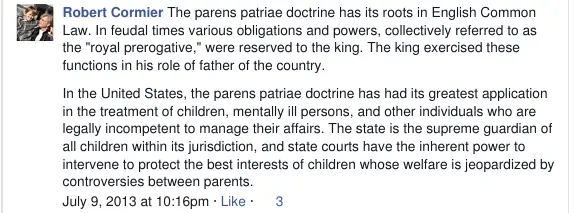
The parens patriae doctrine has its roots in English Common Law. In feudal times various obligations and powers, collectively referred to as the "royal prerogative," were reserved to the king. The king exercised these functions in his role of father of the country.
In the United States, the parens patriae doctrine has had its greatest application in the treatment of children, mentally ill persons, and other individuals who are legally incompetent to manage their affairs. The state is the supreme guardian of all children within its jurisdiction, and state courts have the inherent power to intervene to protect the best interests of children whose welfare is jeopardized by controversies between parents.
Printed copy · Anthology Volume 9, page 894Printed copy from The Tender For Law Anthology, Volume 9, page 894 (printed 13 June 2014). Added by this site; not part of the Facebook export.