The Tender For Law

English Only

ENGLISH is the international language of law and commerce. Knowing FRENCH is useful for understanding LEGAL ENGLISH, but FRENCH is not the international language of law and commerce, so we will ignore French speakers who speak to us in the language of a conquered people.

Non.

I understand that you are a proud Québécois, but the people here have nothing but contempt for you because of decades of transfer payments and NONE OF YOU understanding what Quebec sovereignty means. None of you know who Russell Rogers Smith is, and you're too proud and arrogant to teach. Just go away and be Retardier somewhere else.

Volume 2

Jun 13, 2013 12:52 AM

Chad Brodgesell

Basics for Idiots by an Idiot What 2 points best assist learning an Act (The core points)?

I have noticed that there are few main posters and many lurkers here. This is a good thing. To much crap floating around just stinks. From questions raised in every OP I see commenters stray from the basics of the OP. This is my method of approaching something I do not understand. Maybe others may post theirs as it may help others. I pick 2 points only, no matter how large the document. I have been going over the Bills of Exchange Act. POINT 1 ""Bills of Exchange Act"" (The title it self speaks volumes) many long hours have been invested into those 4 words. Fantastic learning! POINT 2 ""Section 30"" Perfecting bill

30. Where a simple signature on a blank paper is delivered by the signer in order that it may be converted into a bill, it operates, in the absence of evidence to the contrary, as an authority to fill it up as a complete bill for any amount, using the signature for that of the drawer or acceptor, or an endorser, and, in like manner, when a bill is wanting in any material particular, the person in possession of it has, in the absence of evidence to the contrary, the authority to fill up the omission in any way he thinks fit.

The point of a method such as this is that if the above is always used when reading this act there is always a base to referance to. To help stay on track so to speak. I use the above 2 points since I see the Entire act as having; 1) Everything is an Exchange of some nature and, 2) Every thing in this act starts from Just a signature and nothing else. So when ever studying portions of this act I always start with the above 2 items as a base.

Does anyone else use 'tricks' like this to help learn and what are they if you want to share. Ripping things apart is always fun as long as you have a referance.

Printed copy · Anthology Volume 1, page 324
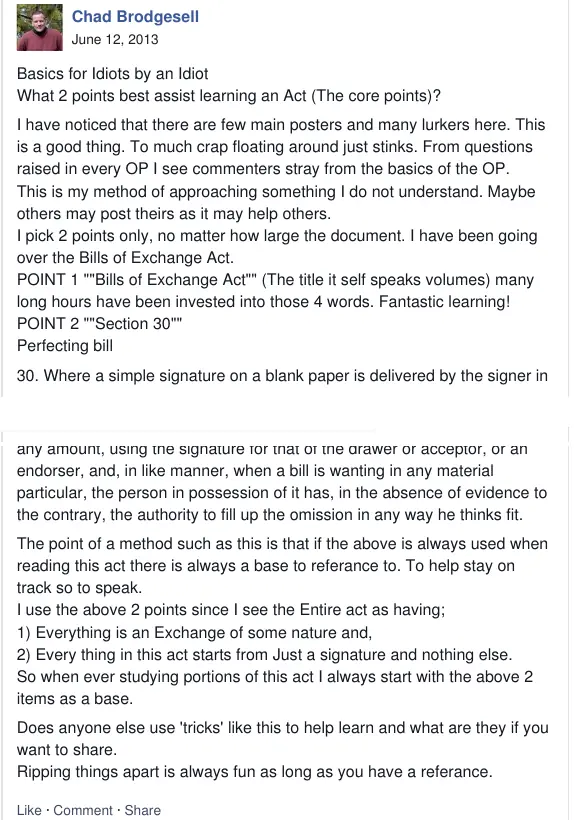
Printed copy of this post
Printed copy from The Tender For Law Anthology, Volume 1, page 324 (printed 14 June 2014). Added by this site; not part of the Facebook export.

Read Comments 5

Cara Small

So.....that's why you never leave an endorsement blank. Huh. Thanks Chad. If I am getting this garble de gook correctly, the other party has the chance to fill in whatever he/she wants and unless you rebut it, you have to "pay" or fulfill the "bill of exchange". So if one receives an endorsed piece of paper from some one, can they technically claim they have a bill of exchange if they sign and file their request on said paper? I am retarded in this area so please anyone jump all over me if I am wrong.

Printed copy · Anthology Volume 1, page 325
Printed copy of this comment
Printed copy from The Tender For Law Anthology, Volume 1, page 325 (printed 14 June 2014). Added by this site; not part of the Facebook export.

Cara Small

I sign as Mother and it means what I say it means because I SAID SO. My kids love it. All rights reserved.

Printed copy · Anthology Volume 1, page 325 · cut by a page break
Printed copy of this comment
Printed copy from The Tender For Law Anthology, Volume 1, page 325 (printed 14 June 2014). Added by this site; not part of the Facebook export. A page break in the printout cut off the end of this comment.

Chad Brodgesell

Cara Small Atherton, yes. If you always think "Exchange, Signature, (insert a portion of act here)" then it becomes easier to understand.

Another trick I use is to actually right on card stock what is being talked about and then I play all the people and follow the document. Writing it down like the real thing then follow it helps to tie their words to actions.

Printed copy · Anthology Volume 1, page 326 · cut by a page break
Printed copy of this comment
Printed copy from The Tender For Law Anthology, Volume 1, page 326 (printed 14 June 2014). Added by this site; not part of the Facebook export. A page break in the printout cut off the beginning of this comment, with its name.

Chad Brodgesell

No action? Here is another one. Open a document up do a word search for the most commonly used top 2 words of 5 letters or more. Point being, if the top 2words are used that much in the document they must be important. (Person is a great one)

Printed copy · Anthology Volume 1, page 326
Printed copy of this comment
Printed copy from The Tender For Law Anthology, Volume 1, page 326 (printed 14 June 2014). Added by this site; not part of the Facebook export.
Back to top