The Tender For Law

English Only

ENGLISH is the international language of law and commerce. Knowing FRENCH is useful for understanding LEGAL ENGLISH, but FRENCH is not the international language of law and commerce, so we will ignore French speakers who speak to us in the language of a conquered people.

Non.

I understand that you are a proud Québécois, but the people here have nothing but contempt for you because of decades of transfer payments and NONE OF YOU understanding what Quebec sovereignty means. None of you know who Russell Rogers Smith is, and you're too proud and arrogant to teach. Just go away and be Retardier somewhere else.

Volume 2

Jun 10, 2013 9:36 PM

Derek Moran

...i think i just figured-out what Scott Duncan is planning on "taking" from all of us hiding-in-plain-sight - SHITTY internet, and replacing it with, GOOD internet?? :)

Citizens Action Network

Non-profit ISP start up promises fully encrypted, private Internet By Rick Burgess Like us? www.facebook.com/Citizens.Action.Network

In an editorial piece by Cnet, Nicholas Merrill describes his upcoming Internet service, Calyx, as a "non-profit telecommunications provider dedicated to privacy, using ubiquitous encryption". According to Merrill, his goal is to fully encrypt Internet traffic at the ISP level in order to protect the privacy of his customers. In fact, he hopes to create a system that is so private, even the ISP itself is unable to snoop on its users. Such a system could conceivably make it impossible for the ISP to respond to privacy-infringing requests, even when compelled by big media conglomerates, public officials or authorities.

The legal viability of an all-encrypted ISP appears to hinge on a provision in a 1994 federal law called CALEA. The Communications Assistance for Law Enforcement Act ensures that ISPs are not held responsible for decrypting data if they don't have the necessary information to do so. If Merrill has his way, Calyx won't have a clue what's going on under the hood of its service. This means the ISP should be able to operate squarely under this premise.

After running his own ISP in New York, Merrill picked up a thing or two about the need for privacy in today's post-9/11 climate. In 2004, he enlisted the help of the ACLU to legally fight a request by the FBI to divulge customer details without a court order. To make this situation particularly menacing, the FBI required Merrill to never publicly disclose the request or the existence of the letter. After a lengthy six-year legal scuffle and having to remain anonymous throughout the course of the trial, Merrill won the case and a federal judge struck down a portion of the Patriot Act which made it illegal to defy an FBI gag order. United States District Judge Victor Marrero described the provision as an "unconstitutional prior restraint of speech in violation of the First Amendment."

After dealing with the FBI and the U.S. legal system for six years, the entrepreneur was inspired to design an ISP where privacy is integrated into its virtual DNA. As a result, Merrill has created the Calyx Institute and woven together an advisory board with the likes of former NSA technical director Brian Snow and TOR project leader Jacob Applebaum.

Merrill will be meeting up with potential West-coast investors in the next couple weeks as he attempts to raise $2 million before the service launches.

http://www.techspot.com/news/48141-non-profit-isp-start-up-promises-fully-encrypted-private-internet.html

Printed copy · Anthology Volume 4, page 111
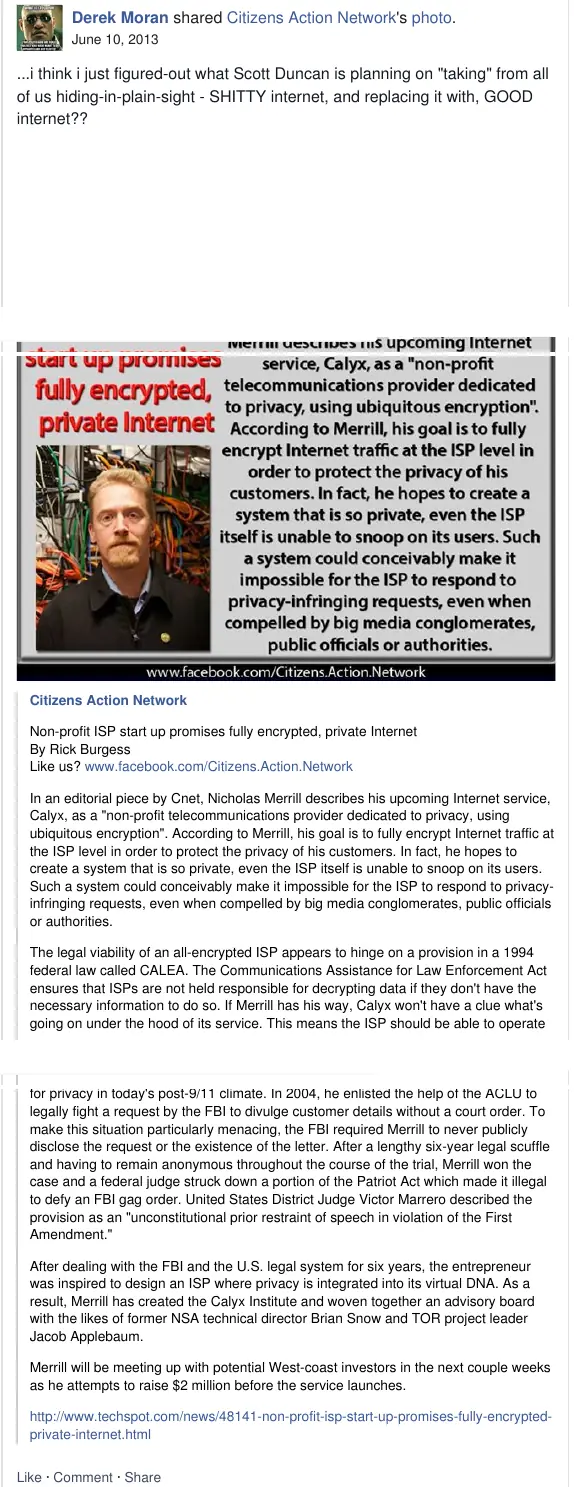
Printed copy of this post
Printed copy from The Tender For Law Anthology, Volume 4, page 111 (printed 13 June 2014). Added by this site; not part of the Facebook export.

Read Comments 19

Derek Moran

WRONG Eamonn O Brien- THIS is who built the internet!... http://www.youtube.com/watch?v=-NjgPDIeSXA

Printed copy · Anthology Volume 4, page 113 · cut by a page break
Printed copy of this comment
Printed copy from The Tender For Law Anthology, Volume 4, page 113 (printed 13 June 2014). Added by this site; not part of the Facebook export. A page break in the printout cut off the end of this comment.

Pete Daoust

Peer-to-peer networking involves data transfer from one user to another without using an intermediate server. Companies developing P2P applications have been involved in numerous legal cases, primarily in the United States. The two major cases are Grokster vs RIAA and MGM Studios, Inc. v. Grokster, Ltd..[23] In both of the cases the file sharing technology was ruled to be legal as long as the developers had no ability to prevent the sharing of the copyrighted material. JUST NEED TO HAVE NO ABILITY, and you are OK :D That souds a good spot on where to be... :D

Printed copy · Anthology Volume 4, page 114
Printed copy of this comment
Printed copy from The Tender For Law Anthology, Volume 4, page 114 (printed 13 June 2014). Added by this site; not part of the Facebook export.

Sirwade FirsbeyWho-are You Frisbey

Hypertext Transfer Protocol From Wikipedia, the free encyclopedia (Redirected from HTTP)

Internet protocol suite Application layer DHCP DHCPv6 DNS FTP HTTP IMAP IRC LDAP MGCP NNTP BGP NTP POP RPC RTP RTSP RIP SIP SMTP SNMP SOCKS SSH Telnet TLS/SSL XMPP (more) Transport layer TCP UDP DCCP SCTP RSVP (more) Internet layer IP IPv4 IPv6 ICMP ICMPv6 ECN IGMP IPsec (more) Link layer ARP/InARP NDP OSPF Tunnels L2TP PPP Media access control Ethernet DSL ISDN FDDI (more) v t e The Hypertext Transfer Protocol (HTTP) is an application protocol for distributed, collaborative, hypermedia information systems.[1] HTTP is the foundation of data communication for the World Wide Web. Hypertext is structured text that uses logical links (hyperlinks) between nodes containing text. HTTP is the protocol to exchange or transfer hypertext. The standards development of HTTP was coordinated by the Internet Engineering Task Force (IETF) and the World Wide Web Consortium (W3C), culminating in the publication of a series of Requests for Comments (RFCs), most notably RFC 2616 (June 1999), which defines HTTP/1.1, the version of HTTP in common use.

Printed copy · Anthology Volume 4, page 114
Printed copy of this comment
Printed copy from The Tender For Law Anthology, Volume 4, page 114 (printed 13 June 2014). Added by this site; not part of the Facebook export.

Sirwade FirsbeyWho-are You Frisbey

Technical overview[edit]

URI beginning with the HTTP scheme and the WWW domain name label. HTTP functions as a request-response protocol in the client-server computing model. A web browser, for example, may be the client and an application running on a computer hosting a web site may be the server. The client submits an HTTP request message to the server. The server, which provides resources such as HTML files and other content, or performs other functions on behalf of the client, returns a response message to the client. The response contains completion status information about the request and may also contain requested content in its message body. A web browser is an example of a user agent (UA). Other types of user agent include the indexing software used by search providers (web crawlers), voice browsers, mobile apps and other software that accesses, consumes or displays web content. HTTP is designed to permit intermediate network elements to improve or enable communications between clients and servers. High-traffic websites often benefit from web cache servers that deliver content on behalf of upstream servers to improve response time. Web browsers cache previously accessed web resources and reuse them when possible to reduce network traffic. HTTP proxy servers at private network boundaries can facilitate communication for clients without a globally routable address, by relaying messages with external servers. HTTP is an application layer protocol designed within the framework of the Internet Protocol Suite. Its definition presumes an underlying and reliable transport layer protocol,[2] and Transmission Control Protocol (TCP) is commonly used. However HTTP can use unreliable protocols such as the User Datagram Protocol (UDP), for example in Simple Service Discovery Protocol (SSDP). HTTP resources are identified and located on the network by Uniform Resource Identifiers (URIs)“or, more specifically, Uniform Resource Locators (URLs)“using the http or https URI schemes. URIs and hyperlinks in Hypertext Markup Language (HTML) documents form webs of inter-linked hypertext documents. HTTP/1.1 is a revision of the original HTTP (HTTP/1.0). In HTTP/1.0 a separate connection to the same server is made for every resource request. HTTP/1.1 can reuse a connection multiple times to download images, scripts, stylesheets et cetera after the page has been delivered. HTTP/1.1 communications therefore experience less latency as the establishment of TCP connections presents considerable overhead.

Printed copy · Anthology Volume 4, page 115 · cut by a page break
Printed copy of this comment
Printed copy from The Tender For Law Anthology, Volume 4, page 115 (printed 13 June 2014). Added by this site; not part of the Facebook export. A page break in the printout cut off the end of this comment.

Derek Moran

Scott Duncan: ...and I haven't even gone into "SCARY" mode yet. Better take a stiff drink, if you feel fear NOW. I haven't DONE anything.

I am about to publish the most horrifying legal process you have EVER seen.

I am going to use LIVE examples. I'm going to appear out of nowhere. I will launch a surprise legal action...

And rip my parent's lives apart in public. You can watch live prey go down, and learn in real-time, with LOTS of material to review.

None of you have seen "scary". Scary is coming.

Printed copy · Anthology Volume 4, page 116
Printed copy of this comment
Printed copy from The Tender For Law Anthology, Volume 4, page 116 (printed 13 June 2014). Added by this site; not part of the Facebook export.

Derek Moran

Scott Duncan: "You know, when we fought Scott, we did it to save ourselves from extinction. But we never answered the question "Why?" Why are we as a people worth saving? We still commit murder because of greed and spite, jealousy, and we still visit all of our sins upon our children. We refuse to accept the responsibility for anything that we've done, like we did with Scott. We decided to play God, create life. And when that life turned against us, we comforted ourselves in the knowledge that it really wasn't our fault, not really. You cannot play God then wash your hands of the things that you've created. Sooner or later, the day comes when you can't hide from the things that you've done anymore." - ADAMA (Paraphrased with Search & Replace)

Printed copy · Anthology Volume 4, page 116
Printed copy of this comment
Printed copy from The Tender For Law Anthology, Volume 4, page 116 (printed 13 June 2014). Added by this site; not part of the Facebook export.

Derek Moran

Scott Duncan: "How to crowd-source an online law center / school..."

http://www.turnkeylinux.org/mediawiki

Roll your own. MediaWiki - Wikipedia's Wiki Engine | TurnKey Linux Virtual Appliance Library www.turnkeylinux.org

Printed copy · Anthology Volume 4, page 117
Printed copy of this comment
Printed copy from The Tender For Law Anthology, Volume 4, page 117 (printed 13 June 2014). Added by this site; not part of the Facebook export.

Derek Moran

just practicing here for the City in the near future:

"EVERYBODY, obeys, THE LAW - DO YOU understand- do, YOU, under-stand?...EVERYONE, is to OBEY, the LAW, do you understand- answer the QUESTION...i dont CARE, i am directing THIS- answer the question - EVERYONE, including the government, OBEYS THE LAW- DO YOU under-stand?...OBEYS, the LAW- DO YOU UNDER-STAND?...you're listed in your OWN Charter as my SERVANT so what you have to say to me is IRRELEVANT, what you THINK does not COUNT, i am POSING the question to YOU- ALL of us, have to obey the law, do you understand? INCLUDING the City of Toronto which at this point, are just VIOLATING your OWN by-laws/City of Toronto Act and Charter, which you are BOUND to follow-and-abide to- DO YOU under-stand?...no there's no BUT AFTER, there's no QUALIFIER, there is no BUT...okay, then this conversation is over, carry-out, your INSTRUCTIONS"

Printed copy · Anthology Volume 4, page 117
Printed copy of this comment
Printed copy from The Tender For Law Anthology, Volume 4, page 117 (printed 13 June 2014). Added by this site; not part of the Facebook export.
Back to top