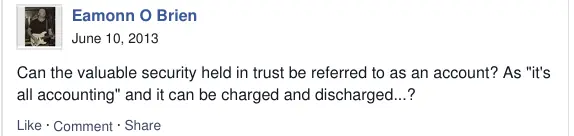
Can the valuable security held in trust be referred to as an account? As "it's all accounting" and it can be charged and discharged...?
Printed copy · Anthology Volume 1, page 422Printed copy from The Tender For Law Anthology, Volume 1, page 422 (printed 14 June 2014). Added by this site; not part of the Facebook export.Filter by poster
Read Comments 44
Sirwade Firsbey · Who-are You Frisbey
It is surety and can be used to discharge debt with oh and this is lawful not legal to pay is legal to discharge is lawful
Printed copy · Anthology Volume 1, page 422Printed copy from The Tender For Law Anthology, Volume 1, page 422 (printed 14 June 2014). Added by this site; not part of the Facebook export.
Eamonn O Brien
Not really answering the question Jon..
Printed copy · Anthology Volume 1, page 422Printed copy from The Tender For Law Anthology, Volume 1, page 422 (printed 14 June 2014). Added by this site; not part of the Facebook export.
Sirwade Firsbey · Who-are You Frisbey
the holding company has an account
Printed copy · Anthology Volume 1, page 422Printed copy from The Tender For Law Anthology, Volume 1, page 422 (printed 14 June 2014). Added by this site; not part of the Facebook export.
Eamonn O Brien
What holding company?
Printed copy · Anthology Volume 1, page 422Printed copy from The Tender For Law Anthology, Volume 1, page 422 (printed 14 June 2014). Added by this site; not part of the Facebook export.
Sirwade Firsbey · Who-are You Frisbey
ok you first set up a holding company. then you make a trust and place the surety into the trust
Printed copy · Anthology Volume 1, page 422Printed copy from The Tender For Law Anthology, Volume 1, page 422 (printed 14 June 2014). Added by this site; not part of the Facebook export.
Sirwade Firsbey · Who-are You Frisbey
and also you lien the surety first before you put into the trust
Printed copy · Anthology Volume 1, page 422Printed copy from The Tender For Law Anthology, Volume 1, page 422 (printed 14 June 2014). Added by this site; not part of the Facebook export.
Eamonn O Brien
That's not I was asking about though...
Printed copy · Anthology Volume 1, page 422Printed copy from The Tender For Law Anthology, Volume 1, page 422 (printed 14 June 2014). Added by this site; not part of the Facebook export.
Sirwade Firsbey · Who-are You Frisbey
the surety is not an account
Printed copy · Anthology Volume 1, page 422 · cut by a page breakPrinted copy from The Tender For Law Anthology, Volume 1, page 422 (printed 14 June 2014). Added by this site; not part of the Facebook export. A page break in the printout cut off the end of this comment.
Eamonn O Brien
You mean the PERSON is not... Surety is a form of promise/guarantee
Printed copy · Anthology Volume 1, page 423 · cut by a page breakPrinted copy from The Tender For Law Anthology, Volume 1, page 423 (printed 14 June 2014). Added by this site; not part of the Facebook export. A page break in the printout cut off the beginning of this comment, with its name.
Sirwade Firsbey · Who-are You Frisbey
in the fiat money system what backs it?
Printed copy · Anthology Volume 1, page 423Printed copy from The Tender For Law Anthology, Volume 1, page 423 (printed 14 June 2014). Added by this site; not part of the Facebook export.
Gail Marie
I would say yes, charged or discharged within the terms and agreement of the trust?
Printed copy · Anthology Volume 1, page 423Printed copy from The Tender For Law Anthology, Volume 1, page 423 (printed 14 June 2014). Added by this site; not part of the Facebook export.
Sirwade Firsbey · Who-are You Frisbey
the surety does. once you lien it you are removing it from their control into the holding company's control which you are a shear holder and gain liability coverage
Printed copy · Anthology Volume 1, page 423Printed copy from The Tender For Law Anthology, Volume 1, page 423 (printed 14 June 2014). Added by this site; not part of the Facebook export.
Eamonn O Brien
Jon, I'm not looking for info on companies or liens... It was a straight forward question I think...
Printed copy · Anthology Volume 1, page 423Printed copy from The Tender For Law Anthology, Volume 1, page 423 (printed 14 June 2014). Added by this site; not part of the Facebook export.
Sirwade Firsbey · Who-are You Frisbey
the surety is "NOT" an account
Printed copy · Anthology Volume 1, page 423Printed copy from The Tender For Law Anthology, Volume 1, page 423 (printed 14 June 2014). Added by this site; not part of the Facebook export.
Beverly Berta Braakschmack
Yes.
Printed copy · Anthology Volume 1, page 423Printed copy from The Tender For Law Anthology, Volume 1, page 423 (printed 14 June 2014). Added by this site; not part of the Facebook export.
Sirwade Firsbey · Who-are You Frisbey
thank you beverly
Printed copy · Anthology Volume 1, page 423Printed copy from The Tender For Law Anthology, Volume 1, page 423 (printed 14 June 2014). Added by this site; not part of the Facebook export.
Beverly Berta Braakschmack
to Eamonn's original question
Printed copy · Anthology Volume 1, page 423Printed copy from The Tender For Law Anthology, Volume 1, page 423 (printed 14 June 2014). Added by this site; not part of the Facebook export.
Sirwade Firsbey · Who-are You Frisbey
Okay how so?
Printed copy · Anthology Volume 1, page 423Printed copy from The Tender For Law Anthology, Volume 1, page 423 (printed 14 June 2014). Added by this site; not part of the Facebook export.
Beverly Berta Braakschmack
just as in his question
Printed copy · Anthology Volume 1, page 423Printed copy from The Tender For Law Anthology, Volume 1, page 423 (printed 14 June 2014). Added by this site; not part of the Facebook export.
Eamonn O Brien
How is it an account Jon's asking I think...
Printed copy · Anthology Volume 1, page 423Printed copy from The Tender For Law Anthology, Volume 1, page 423 (printed 14 June 2014). Added by this site; not part of the Facebook export.
Sirwade Firsbey · Who-are You Frisbey
and that is Mr jon lol
Printed copy · Anthology Volume 1, page 423Printed copy from The Tender For Law Anthology, Volume 1, page 423 (printed 14 June 2014). Added by this site; not part of the Facebook export.
Beverly Berta Braakschmack
it can be charged/discharged via its VALUE
Sirwade Firsbey · Who-are You Frisbey
How does that make it an account?
Printed copy · Anthology Volume 1, page 423Printed copy from The Tender For Law Anthology, Volume 1, page 423 (printed 14 June 2014). Added by this site; not part of the Facebook export.
Beverly Berta Braakschmack
I guess you don't have a credit card, huh?
Printed copy · Anthology Volume 1, page 424Printed copy from The Tender For Law Anthology, Volume 1, page 424 (printed 14 June 2014). Added by this site; not part of the Facebook export.
Sirwade Firsbey · Who-are You Frisbey
we know it has value
Printed copy · Anthology Volume 1, page 424Printed copy from The Tender For Law Anthology, Volume 1, page 424 (printed 14 June 2014). Added by this site; not part of the Facebook export.
Sirwade Firsbey · Who-are You Frisbey
the surety is the calatrial not the account
Printed copy · Anthology Volume 1, page 424Printed copy from The Tender For Law Anthology, Volume 1, page 424 (printed 14 June 2014). Added by this site; not part of the Facebook export.
Sirwade Firsbey · Who-are You Frisbey
we the men/women give it value
Printed copy · Anthology Volume 1, page 424Printed copy from The Tender For Law Anthology, Volume 1, page 424 (printed 14 June 2014). Added by this site; not part of the Facebook export.
Beverly Berta Braakschmack
Were you "charged" with something when you went to jail? And how was your preferred "payment" method?
Printed copy · Anthology Volume 1, page 424Printed copy from The Tender For Law Anthology, Volume 1, page 424 (printed 14 June 2014). Added by this site; not part of the Facebook export.
Sirwade Firsbey · Who-are You Frisbey
in payment is legal we are talking about discharge of debts
Printed copy · Anthology Volume 1, page 424Printed copy from The Tender For Law Anthology, Volume 1, page 424 (printed 14 June 2014). Added by this site; not part of the Facebook export.
Beverly Berta Braakschmack
I don't think that was the question.
Printed copy · Anthology Volume 1, page 424Printed copy from The Tender For Law Anthology, Volume 1, page 424 (printed 14 June 2014). Added by this site; not part of the Facebook export.
Sirwade Firsbey · Who-are You Frisbey
Can the valuable security held in trust be referred to as an account?
Printed copy · Anthology Volume 1, page 424Printed copy from The Tender For Law Anthology, Volume 1, page 424 (printed 14 June 2014). Added by this site; not part of the Facebook export.
Beverly Berta Braakschmack
Its the ASSETS that are held in trust, or VALUE
Printed copy · Anthology Volume 1, page 424Printed copy from The Tender For Law Anthology, Volume 1, page 424 (printed 14 June 2014). Added by this site; not part of the Facebook export.
Sirwade Firsbey · Who-are You Frisbey
no it can not be
Printed copy · Anthology Volume 1, page 424Printed copy from The Tender For Law Anthology, Volume 1, page 424 (printed 14 June 2014). Added by this site; not part of the Facebook export.
Sirwade Firsbey · Who-are You Frisbey
it is all done with accounting that is not saying all things are an account
Printed copy · Anthology Volume 1, page 424Printed copy from The Tender For Law Anthology, Volume 1, page 424 (printed 14 June 2014). Added by this site; not part of the Facebook export.
Sirwade Firsbey · Who-are You Frisbey
if I have a title to my house and I go to the bank and ask for a loan the title is surety for the loan it is not the account. the surety is just the surety.
Printed copy · Anthology Volume 1, page 424 · cut by a page breakPrinted copy from The Tender For Law Anthology, Volume 1, page 424 (printed 14 June 2014). Added by this site; not part of the Facebook export. A page break in the printout cut off the end of this comment.
Sirwade Firsbey · Who-are You Frisbey
Collateral (finance)
From Wikipedia, the free encyclopedia
In lending agreements, collateral is a borrower's pledge of specific property to a lender, to secure repayment of a loan.[1][2] The collateral serves as protection for a lender against a borrower's default - that is, any borrower failing to pay the principal and interest under the terms of a loan obligation. If a borrower does default on a loan (due to insolvency or other event), that borrower forfeits (gives up) the property pledged as collateral - and the lender then becomes the owner of the collateral. In a typical mortgage loan transaction, for instance, the real estate being acquired with the help of the loan serves as collateral. Should the buyer fail to pay the loan under the mortgage loan agreement, the ownership of the real estate is transferred to the bank. The bank uses a legal process called foreclosure to obtain real estate from a borrower who defaults on a mortgage loan obligation.
Concept of collateral [edit]
Collateral, especially within banking, traditionally refers to secured lending (also known as asset-based lending). More recently, complex collateralization arrangements are used to secure trade transactions (also known as capital market collateralization). The former often presents unilateral obligations, for secured in the form of property, surety, guarantee or other as collateral (originally denoted by the term security), whereas the latter often presents bilateral obligations secured by more liquid assets such as cash or securities, often known for margin. Another example might be to ask for collateral in exchange for holding something of value until it is returned. Some forms of lending are solely based on the strength of the collateral such as gold, jewelry and property. Certain non-conservative lending practices such as lending against antique items or art works are also known to exist.
In many developing countries, the use of collateral is the main way to secure bank financing.[citation needed] The ease of acquiring a loan depends on the ability to use assets such as real estate as collateral.
Printed copy · Anthology Volume 1, page 425Printed copy from The Tender For Law Anthology, Volume 1, page 425 (printed 14 June 2014). Added by this site; not part of the Facebook export.
Eamonn O Brien
If the bank takes legal action against you though they don't charge the bank account... What account are they charging then?
Printed copy · Anthology Volume 1, page 425Printed copy from The Tender For Law Anthology, Volume 1, page 425 (printed 14 June 2014). Added by this site; not part of the Facebook export.
Stuart Stone
Top of my head/out of the ass reasoning here...the valuable security is liened into trust (taking it out of the public domain & into the private), the lien has (face) value and the security serves as a form of collateral/secured debt (I think)...
If that reasoning is correct, then the trust may be equivalent to an account holding the security, so the valuable security could be marked in the books of the company as an asset held in trust (account), which would probably make it money of account with its face value being the amount you liened it for.
You can then 'use' this asset to acquire credit...
I don't think I quite have the terminology correct, but my guess is that the lien can be treated as 'like money'/a negotiable instrument, which would make neither the valuable security nor the lien an account as such, but the trust may be considered an account.
Damn it, there goes my relaxing evening...time to hit the books & learn how securities and liens are accounted for :P
Printed copy · Anthology Volume 1, page 425Printed copy from The Tender For Law Anthology, Volume 1, page 425 (printed 14 June 2014). Added by this site; not part of the Facebook export.
Derek Moran
I think the 'account,' would simply be the Consolidated Revenue Fund. This 'account,' just happens to be one big PIGGY-BANK shared by all (operative-word, SHARE) ;)
Printed copy · Anthology Volume 1, page 426Printed copy from The Tender For Law Anthology, Volume 1, page 426 (printed 14 June 2014). Added by this site; not part of the Facebook export.
Stuart Stone
Agreed Derek...I was thinking from the perspective that the valuable security had been liened into a private trust in the context of Eamonn O Brien's question...either way, I doubt the valuable security in itself is an account, but is held in an account, regarded as an asset/debt depending on which side of the accounting you're on
Printed copy · Anthology Volume 1, page 426Printed copy from The Tender For Law Anthology, Volume 1, page 426 (printed 14 June 2014). Added by this site; not part of the Facebook export.
Pete Daoust
Oh yes, it's a freaking account... :-D
Printed copy · Anthology Volume 1, page 426Printed copy from The Tender For Law Anthology, Volume 1, page 426 (printed 14 June 2014). Added by this site; not part of the Facebook export.
Cory Black
Derek Moran you are correct. Yes the security is your share in the corporation of Canada and yes it can be accessed to discharge your persons negotiable instruments. It does work. One must invoke the correct operation of law. When you do it is amazing. Good luck.
Sirwade Firsbey · Who-are You Frisbey
*facepalm*
Printed copy · Anthology Volume 1, page 426Printed copy from The Tender For Law Anthology, Volume 1, page 426 (printed 14 June 2014). Added by this site; not part of the Facebook export.
Derek Moran
Thanks Cory...
Signed,
section 3. of the Bills of Exchange Act- 'Thing done in good faith,' and 'Without recourse to ME' ;)
Printed copy · Anthology Volume 1, page 426Printed copy from The Tender For Law Anthology, Volume 1, page 426 (printed 14 June 2014). Added by this site; not part of the Facebook export.
Filter by poster
Read Comments 44
Sirwade Firsbey · Who-are You Frisbey
Printed copy · Anthology Volume 1, page 422
Eamonn O Brien
Printed copy · Anthology Volume 1, page 422
Sirwade Firsbey · Who-are You Frisbey
Printed copy · Anthology Volume 1, page 422
Eamonn O Brien
Printed copy · Anthology Volume 1, page 422
Sirwade Firsbey · Who-are You Frisbey
Printed copy · Anthology Volume 1, page 422
Sirwade Firsbey · Who-are You Frisbey
Printed copy · Anthology Volume 1, page 422
Eamonn O Brien
Printed copy · Anthology Volume 1, page 422
Sirwade Firsbey · Who-are You Frisbey
Printed copy · Anthology Volume 1, page 422 · cut by a page break
Eamonn O Brien
Printed copy · Anthology Volume 1, page 423 · cut by a page break
Sirwade Firsbey · Who-are You Frisbey
Printed copy · Anthology Volume 1, page 423
Gail Marie
Printed copy · Anthology Volume 1, page 423
Sirwade Firsbey · Who-are You Frisbey
Printed copy · Anthology Volume 1, page 423
Eamonn O Brien
Printed copy · Anthology Volume 1, page 423
Sirwade Firsbey · Who-are You Frisbey
Printed copy · Anthology Volume 1, page 423
Beverly Berta Braakschmack
Printed copy · Anthology Volume 1, page 423
Sirwade Firsbey · Who-are You Frisbey
Printed copy · Anthology Volume 1, page 423
Beverly Berta Braakschmack
Printed copy · Anthology Volume 1, page 423
Sirwade Firsbey · Who-are You Frisbey
Printed copy · Anthology Volume 1, page 423
Beverly Berta Braakschmack
Printed copy · Anthology Volume 1, page 423
Eamonn O Brien
Printed copy · Anthology Volume 1, page 423
Sirwade Firsbey · Who-are You Frisbey
Printed copy · Anthology Volume 1, page 423
Beverly Berta Braakschmack
Sirwade Firsbey · Who-are You Frisbey
Printed copy · Anthology Volume 1, page 423
Beverly Berta Braakschmack
Printed copy · Anthology Volume 1, page 424
Sirwade Firsbey · Who-are You Frisbey
Printed copy · Anthology Volume 1, page 424
Sirwade Firsbey · Who-are You Frisbey
Printed copy · Anthology Volume 1, page 424
Sirwade Firsbey · Who-are You Frisbey
Printed copy · Anthology Volume 1, page 424
Beverly Berta Braakschmack
Printed copy · Anthology Volume 1, page 424
Sirwade Firsbey · Who-are You Frisbey
Printed copy · Anthology Volume 1, page 424
Beverly Berta Braakschmack
Printed copy · Anthology Volume 1, page 424
Sirwade Firsbey · Who-are You Frisbey
Printed copy · Anthology Volume 1, page 424
Beverly Berta Braakschmack
Printed copy · Anthology Volume 1, page 424
Sirwade Firsbey · Who-are You Frisbey
Printed copy · Anthology Volume 1, page 424
Sirwade Firsbey · Who-are You Frisbey
Printed copy · Anthology Volume 1, page 424
Sirwade Firsbey · Who-are You Frisbey
Printed copy · Anthology Volume 1, page 424 · cut by a page break
Sirwade Firsbey · Who-are You Frisbey
Printed copy · Anthology Volume 1, page 425
Eamonn O Brien
Printed copy · Anthology Volume 1, page 425
Stuart Stone
Printed copy · Anthology Volume 1, page 425
Derek Moran
Printed copy · Anthology Volume 1, page 426
Stuart Stone
Printed copy · Anthology Volume 1, page 426
Pete Daoust
Printed copy · Anthology Volume 1, page 426
Cory Black
Sirwade Firsbey · Who-are You Frisbey
Printed copy · Anthology Volume 1, page 426
Derek Moran
Printed copy · Anthology Volume 1, page 426