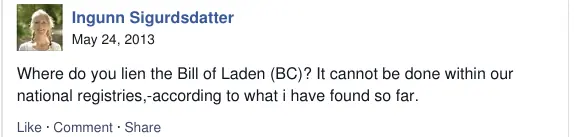
Where do you lien the Bill of Laden (BC)? It cannot be done within our national registries,-according to what i have found so far.
Printed copy · Anthology Volume 1, page 460Printed copy from The Tender For Law Anthology, Volume 1, page 460 (printed 14 June 2014). Added by this site; not part of the Facebook export.Filter by poster
Read Comments 72
Eamonn O Brien
Lien thread, lien thread, lien thread!!! :p
Printed copy · Anthology Volume 1, page 460Printed copy from The Tender For Law Anthology, Volume 1, page 460 (printed 14 June 2014). Added by this site; not part of the Facebook export.
Ingunn Sigurdsdatter
Didn't find it there. Norway is a version of the Soviet Union,-cannot use national registers or file a public claim. And I got the impression you don't file it with UCC? I understood that I should create a common law trust (is that right),- but also that I should lien the birth certificate. Would be happy for answer,-I sorry if I am a slow learner.
Printed copy · Anthology Volume 1, page 460Printed copy from The Tender For Law Anthology, Volume 1, page 460 (printed 14 June 2014). Added by this site; not part of the Facebook export.
Eamonn O Brien
My above post was a suggestion for a lien thread to be started... Sorry for misleading you...
Printed copy · Anthology Volume 1, page 460Printed copy from The Tender For Law Anthology, Volume 1, page 460 (printed 14 June 2014). Added by this site; not part of the Facebook export.
Blake Gardner
Tinglyset
Blake Gardner
Sédan hedder det her i Danmark
Ingunn Sigurdsdatter
Did you make it in Denmark? It doesn't seem to be possible here, - "jTinglysing" is the same as entering judicial information into a registry or public record, and the information then acquires "legal" value within the system. That should be the obvious way of reversing the trust/trustee/beneficiary situation as well as liening the BC, BUT this process has been bound by legislation which prohibits entering anything into the public record except if it is in accordance with very specific terms. Spent all day calling of all the national registries. A lawful way of doing it would be to proclaim it yourself, in writing or in local newspapers, but not so sure about the real-life effect of it.
Printed copy · Anthology Volume 1, page 460Printed copy from The Tender For Law Anthology, Volume 1, page 460 (printed 14 June 2014). Added by this site; not part of the Facebook export.
Blake Gardner
Svar er p” JEK
Pete Daoust
Fuck, I'm not the only token in here :-\
Printed copy · Anthology Volume 1, page 461Printed copy from The Tender For Law Anthology, Volume 1, page 461 (printed 14 June 2014). Added by this site; not part of the Facebook export.
Stuart Stone
You can create a maritime lien, which does not need to be publicly registered.
It is liened into a private trust (which also does not need to be publicly registered because it is private).
You then issue a public notice (newspaper notice, notice to government etc) that the above processes have taken place ie: The BC with details ??? has been liened into a private trust.
Any further details are private, which is the beauty of the process...only parties to the BC and or trust have any standing...anyone else, it's none of their business because it's private...
To paraphrase from a previous thread:
1: Establish a trust
2: Establish a corporation - In the Charter, assign the role of the corporation to HOLD the trust, and establish the "Law" guidelines (You get to make your own up) as regards keeping the trust.
3: Get ANY accountant to manage the books of the corporation. You direct the corporation as FIRST DIRECTOR, and establish roles (President/CEO Vice President, etc) which is how the UNITED STATES was formed.
The accountant EXECUTES YOUR TASKS within the framework. To establish a trust, write it down, and have it witnessed and notarized. The end. Only shareholders of your corporation are recognized by the trust.
run this by Scott Duncan for confirmation/ to clarify details.
Printed copy · Anthology Volume 1, page 461Printed copy from The Tender For Law Anthology, Volume 1, page 461 (printed 14 June 2014). Added by this site; not part of the Facebook export.
David Johansen
dont accountants want those fake fiat dollars? if we dont have spare change to file all this paperwork how can we hire an accountant?
Printed copy · Anthology Volume 1, page 461Printed copy from The Tender For Law Anthology, Volume 1, page 461 (printed 14 June 2014). Added by this site; not part of the Facebook export.
David Johansen
i'm so broke i cant even hire brazillian children to make charcoal briquetts for my bbq grill!
Printed copy · Anthology Volume 1, page 461 · cut by a page breakPrinted copy from The Tender For Law Anthology, Volume 1, page 461 (printed 14 June 2014). Added by this site; not part of the Facebook export. A page break in the printout cut off the end of this comment.
Sirwade Firsbey · Who-are You Frisbey
You can create a maritime lien, which does not need to be publicly registered. How do you do that???
Printed copy · Anthology Volume 1, page 462Printed copy from The Tender For Law Anthology, Volume 1, page 462 (printed 14 June 2014). Added by this site; not part of the Facebook export.
Sirwade Firsbey · Who-are You Frisbey
How do I create a maritime lien?
Printed copy · Anthology Volume 1, page 462Printed copy from The Tender For Law Anthology, Volume 1, page 462 (printed 14 June 2014). Added by this site; not part of the Facebook export.
Pete Daoust
You get a fishing rod, you put a bait on it, and you throw that sucker on the ocean :D
Printed copy · Anthology Volume 1, page 462Printed copy from The Tender For Law Anthology, Volume 1, page 462 (printed 14 June 2014). Added by this site; not part of the Facebook export.
Sirwade Firsbey · Who-are You Frisbey
I did that and all I got was a "token french guy :)
Printed copy · Anthology Volume 1, page 462Printed copy from The Tender For Law Anthology, Volume 1, page 462 (printed 14 June 2014). Added by this site; not part of the Facebook export.
Stuart Stone
Start with a google search on maritime liens...then start a thread to get the details sorted...or, as you are liening it into a private trust & you are the party that gives the BC value, ie: a party, and the government is not a person, thereby not able to act as a party and or rebut your claim/lien, then as I understand it, dotting the 'i's & crossing the 't's becomes less important...after all, who is going to challenge you on it?
Printed copy · Anthology Volume 1, page 462Printed copy from The Tender For Law Anthology, Volume 1, page 462 (printed 14 June 2014). Added by this site; not part of the Facebook export.
Beverly Berta Braakschmack
So Scott, you know how the gov't always seems to access your bank account when they figure you owe them and they just take what they want? Does this lien remove that possibility?Therefore, if you had a functioning business would you also lien that with said Holding Company for the same reasons?
Printed copy · Anthology Volume 1, page 462Printed copy from The Tender For Law Anthology, Volume 1, page 462 (printed 14 June 2014). Added by this site; not part of the Facebook export.
Beverly Berta Braakschmack
Stuart, I think the holding company liens the BC, the Trust would then claim OWNERSHIP of the name... Jinny started a thread on claiming ownership of the name (for yourself) but I think the idea is the TRUST owns it? Scott?
Printed copy · Anthology Volume 1, page 462Printed copy from The Tender For Law Anthology, Volume 1, page 462 (printed 14 June 2014). Added by this site; not part of the Facebook export.
Beverly Berta Braakschmack
A corporation is a PERSON under law, but a TRUST is not?
Printed copy · Anthology Volume 1, page 462Printed copy from The Tender For Law Anthology, Volume 1, page 462 (printed 14 June 2014). Added by this site; not part of the Facebook export.
Blake Gardner
A trust is not a person, thus the oppt scam / ucc claim...re; strawman, it's a benefit unless you reverse your capacity status to trustee and start settling its accounts/public debts with your indorsement...or the less ambiguous method previously mentioned above, of creating a new vessel to operate in commerce with...express trust/private investment fund - corp.
Eamonn O Brien
The PERSON is listed as an asset of the company once it's liened into the TRUST I think...
Printed copy · Anthology Volume 1, page 462 · cut by a page breakPrinted copy from The Tender For Law Anthology, Volume 1, page 462 (printed 14 June 2014). Added by this site; not part of the Facebook export. A page break in the printout cut off the end of this comment.
Blake Gardner
It's a security interest/lien on a certain amount of the names assets...first in time first in line...
Pete Daoust
I think you are ALL FUCKED UP :-D
Printed copy · Anthology Volume 1, page 463 · cut by a page breakPrinted copy from The Tender For Law Anthology, Volume 1, page 463 (printed 14 June 2014). Added by this site; not part of the Facebook export. A page break in the printout swallowed this comment: only its date was printed.
Eamonn O Brien
You CREATE a corporation, then grant ONE SHARE. You are now the SOLE SHAREHOLDER (not an "owner"). You then ORDER (from the corporation, for which you are the CONTROLLING SHAREHOLDER to LIEN your BIRTH CERTIFICATE. The corporation can then hold that asset IN TRUST - Scott
Printed copy · Anthology Volume 1, page 463Printed copy from The Tender For Law Anthology, Volume 1, page 463 (printed 14 June 2014). Added by this site; not part of the Facebook export.
Pete Daoust
Controlling shareholder ? :/
Printed copy · Anthology Volume 1, page 463Printed copy from The Tender For Law Anthology, Volume 1, page 463 (printed 14 June 2014). Added by this site; not part of the Facebook export.
Pete Daoust
besides their shorts, shareholder control fuck all :/
Printed copy · Anthology Volume 1, page 463Printed copy from The Tender For Law Anthology, Volume 1, page 463 (printed 14 June 2014). Added by this site; not part of the Facebook export.
Blake Gardner
So many ways...it is interesting how many are focused on the BC as if it is wealth in and of itself or a definitive answer...it's just a certificate...learning to use what it symbolizes is substance...
Eamonn O Brien
Indeed Blake... As Scott has said, it's evidence that a security exists, not the security itself...
Printed copy · Anthology Volume 1, page 463Printed copy from The Tender For Law Anthology, Volume 1, page 463 (printed 14 June 2014). Added by this site; not part of the Facebook export.
Eamonn O Brien
By being the lawful holder you have control of the security...
Printed copy · Anthology Volume 1, page 463Printed copy from The Tender For Law Anthology, Volume 1, page 463 (printed 14 June 2014). Added by this site; not part of the Facebook export.
Beverly Berta Braakschmack
Blake, my friend just got back from Portland for the last Creditors In Commerce gig... he hasn't explained much to me but Gordon Hall learned everything from Brandon (and is in jail right now with his son for being the PERSON)
Printed copy · Anthology Volume 1, page 463Printed copy from The Tender For Law Anthology, Volume 1, page 463 (printed 14 June 2014). Added by this site; not part of the Facebook export.
Eamonn O Brien
CONTROLLING SHAREHOLDER means a shareholder who owns more than half of the shares or majority of the outstanding shares in a company. A controlling shareholder generally controls the composition of the board of directors and influences the corporation’s activities...
Pete
Printed copy · Anthology Volume 1, page 463Printed copy from The Tender For Law Anthology, Volume 1, page 463 (printed 14 June 2014). Added by this site; not part of the Facebook export.
Pete Daoust
Actionnaires MAJORITAIRE in French, = Majority Shareholder in English ?
I'm just saying that Controlling Shareholders makes no sense to me, but you may be right and I may be wrong....you know, like the song :D
Printed copy · Anthology Volume 1, page 463Printed copy from The Tender For Law Anthology, Volume 1, page 463 (printed 14 June 2014). Added by this site; not part of the Facebook export.
Eamonn O Brien
Majority shareholder yes... They most likely started the business and have control over who the directors are and how they want the business to run...
Printed copy · Anthology Volume 1, page 463 · cut by a page breakPrinted copy from The Tender For Law Anthology, Volume 1, page 463 (printed 14 June 2014). Added by this site; not part of the Facebook export. A page break in the printout cut off the beginning of this comment, with its name.
Pete Daoust
The way I get it, ADMINISTRATORS control a corporation, as I AM the administrator of SFC Inc, and the CEO of SFC Inc, and I'm NOT the Majority shareholder, come and try to move me from my spot :D, you better have your check book ready :D
Printed copy · Anthology Volume 1, page 464Printed copy from The Tender For Law Anthology, Volume 1, page 464 (printed 14 June 2014). Added by this site; not part of the Facebook export.
Blake Gardner
Eamonn O Brien - we are the lawful holder...it's just that most let the public play trustee with account.
Beverly Girl-Brain Braaksma - not quite, he and his son got involved with a scetchy client as trustees for his assets and became implied in the customers prior dealings, plus the Feds were already gunning for an opportunity:-) He's been in this sitch before...should be alright...definitely a prolonged test though...
Eamonn O Brien
Admins are appointed by the shareholders though... I'd imagine they can remove you if they wish...
Printed copy · Anthology Volume 1, page 464Printed copy from The Tender For Law Anthology, Volume 1, page 464 (printed 14 June 2014). Added by this site; not part of the Facebook export.
Beverly Berta Braakschmack
I think when you register a corporation, you set the shareholders right there. Every year they ask if there are any other shareholders.
Printed copy · Anthology Volume 1, page 464Printed copy from The Tender For Law Anthology, Volume 1, page 464 (printed 14 June 2014). Added by this site; not part of the Facebook export.
Eamonn O Brien
Lawful holder in due course I should say... We accepted it in good faith and free of indebtedness
Printed copy · Anthology Volume 1, page 464Printed copy from The Tender For Law Anthology, Volume 1, page 464 (printed 14 June 2014). Added by this site; not part of the Facebook export.
Beverly Berta Braakschmack
So Blake, would you then lien a functioning business the same as your BC? And also hold that name in trust?
Printed copy · Anthology Volume 1, page 464Printed copy from The Tender For Law Anthology, Volume 1, page 464 (printed 14 June 2014). Added by this site; not part of the Facebook export.
Pete Daoust
I DARE any shareholder to come and remove me :D
Printed copy · Anthology Volume 1, page 464Printed copy from The Tender For Law Anthology, Volume 1, page 464 (printed 14 June 2014). Added by this site; not part of the Facebook export.
Pete Daoust
Are we talking about Corp. or OUR person in here ? :/
Printed copy · Anthology Volume 1, page 464Printed copy from The Tender For Law Anthology, Volume 1, page 464 (printed 14 June 2014). Added by this site; not part of the Facebook export.
Blake Gardner
Beverly Girl-Brain Braaksma - you can acquire a corp via contract into a trust.
Eamonn O Brien
A corporation Pierre... A business. Your PERSON is not one... :)
Printed copy · Anthology Volume 1, page 464Printed copy from The Tender For Law Anthology, Volume 1, page 464 (printed 14 June 2014). Added by this site; not part of the Facebook export.
Stuart Stone
'Stuart, I think the holding company liens the BC, the Trust would then claim OWNERSHIP of the name...'...you're right Beverly Girl-Brain Braaksma, my mistake...apologies if I misled anyone.
Printed copy · Anthology Volume 1, page 464Printed copy from The Tender For Law Anthology, Volume 1, page 464 (printed 14 June 2014). Added by this site; not part of the Facebook export.
Blake Gardner
The central trust holds all assets and is generally inactive not ever operating in public. The corp or outer trusts that do operate in public assign/convey their interests to the holding trust creating a buffer.
Scott Duncan
LOOK KIDS! Blake has been doing his homework!
This is how you succeed in this arena... BY ACTUALLY READING WHAT I SAY! :P
Printed copy · Anthology Volume 1, page 464Printed copy from The Tender For Law Anthology, Volume 1, page 464 (printed 14 June 2014). Added by this site; not part of the Facebook export.
Sirwade Firsbey · Who-are You Frisbey
Now I am going to look every word he used to learn all that it means. thanks
Printed copy · Anthology Volume 1, page 465Printed copy from The Tender For Law Anthology, Volume 1, page 465 (printed 14 June 2014). Added by this site; not part of the Facebook export.
Sirwade Firsbey · Who-are You Frisbey
dame it power out losing net.
Printed copy · Anthology Volume 1, page 465Printed copy from The Tender For Law Anthology, Volume 1, page 465 (printed 14 June 2014). Added by this site; not part of the Facebook export.
Beverly Berta Braakschmack
He also learns elsewhere...
Printed copy · Anthology Volume 1, page 465Printed copy from The Tender For Law Anthology, Volume 1, page 465 (printed 14 June 2014). Added by this site; not part of the Facebook export.
Scott Duncan
Oh he does not, either :P
Who's he going to go to? :D
Printed copy · Anthology Volume 1, page 465Printed copy from The Tender For Law Anthology, Volume 1, page 465 (printed 14 June 2014). Added by this site; not part of the Facebook export.
Sirwade Firsbey · Who-are You Frisbey
I am like the bum on the side of the road and I ask for it all Scott I want it all don't hold any thing back tell me all you know. so that I can become free a grow up man please.
Printed copy · Anthology Volume 1, page 465Printed copy from The Tender For Law Anthology, Volume 1, page 465 (printed 14 June 2014). Added by this site; not part of the Facebook export.
Sirwade Firsbey · Who-are You Frisbey
Scott I ask again please. Thank you :)
Printed copy · Anthology Volume 1, page 465Printed copy from The Tender For Law Anthology, Volume 1, page 465 (printed 14 June 2014). Added by this site; not part of the Facebook export.
Scott Duncan
Sirwade Firsbey, go fuck yourself.
...I wish I'd said it back in 2013, but then he'd have "for no reason" as a suffix to "He kicked me out".
Chris Evan
I can't see Frisbey. :D
Chris Evan
I wonder how much Frisbey has in cryptos Ha!
Fucking moron!
Anibal Jose Baez
Has anyone yet found where do you lien the Bin of Laden?
:D
Anibal Jose Baez
Beverly "The Cunt" Berta, Sir-Gay Freeze-Balls, Blake "Belief" Gardener, and Stuart Stone.
Neens Jean
None of these named did the lien?
Neens Jean
I have read many of Stuart, Blake and Beverly's posts and thought they were knowledgeable. Was that wrong of me?
Chris Evan
Stuart Stone, did you lien the name?
Chris Evan
Blake is a Piece of Shit Christian (I know, right?), Beverly is searching, Stuart seems to be thinking right
Neens Jean
So Stuart seemed to understand everything and I watched his posts quite a bit.
Chris Evan
Yes. Stuart Stone, where did you go?
Neens Jean
Okay. Thanks.
Anibal Jose Baez
Beverly is searching... for a brain. Or moisturizer for a dry cunt.
Stuart Stone
Hi Chris Evan, I am still acting as Administrator for the name & finalising a Bill of Exchange (meaning that the other party has been invited to attend to receive payment this Friday, then the matter will be resolved and/or a certificate of protest will be issued).
Then I will complete the process (register the lien/caveat & resign).
Here (Australia), the caveat/lien is registered via the Personal Property Securities Register, the relevant legislation being the Personal Property Securities Act (I think the name is the same for Canada).
Pete Daoust
It's not like Stuart Stone don't want to cooperate or anything like that :/
Stuart Stone
I attempt to be as honourable as you Pete Daoust ;)
But they don't want to play/show up/ attend meetings, so when they don't show, it needs to be recorded so they have no recourse for their dishonour.
Stuart Stone
I'm very cooperative...and I invite them to resolve matters privately :D
Chris Evan
Stuart Stone is a Simu-Drone. :D
Stuart Stone
It's a hat I wear ;)
Anibal Jose Baez
Stuart Stone is a Simu-Drone, just like a mail-order bride is a real wife! :D
Filter by poster
Read Comments 72
Eamonn O Brien
Printed copy · Anthology Volume 1, page 460
Ingunn Sigurdsdatter
Printed copy · Anthology Volume 1, page 460
Eamonn O Brien
Printed copy · Anthology Volume 1, page 460
Blake Gardner
Blake Gardner
Ingunn Sigurdsdatter
Printed copy · Anthology Volume 1, page 460
Blake Gardner
Pete Daoust
Printed copy · Anthology Volume 1, page 461
Stuart Stone
Printed copy · Anthology Volume 1, page 461
David Johansen
Printed copy · Anthology Volume 1, page 461
David Johansen
Printed copy · Anthology Volume 1, page 461 · cut by a page break
Sirwade Firsbey · Who-are You Frisbey
Printed copy · Anthology Volume 1, page 462
Sirwade Firsbey · Who-are You Frisbey
Printed copy · Anthology Volume 1, page 462
Pete Daoust
Printed copy · Anthology Volume 1, page 462
Sirwade Firsbey · Who-are You Frisbey
Printed copy · Anthology Volume 1, page 462
Stuart Stone
Printed copy · Anthology Volume 1, page 462
Beverly Berta Braakschmack
Printed copy · Anthology Volume 1, page 462
Beverly Berta Braakschmack
Printed copy · Anthology Volume 1, page 462
Beverly Berta Braakschmack
Printed copy · Anthology Volume 1, page 462
Blake Gardner
Eamonn O Brien
Printed copy · Anthology Volume 1, page 462 · cut by a page break
Blake Gardner
Pete Daoust
Printed copy · Anthology Volume 1, page 463 · cut by a page break
Eamonn O Brien
Printed copy · Anthology Volume 1, page 463
Pete Daoust
Printed copy · Anthology Volume 1, page 463
Pete Daoust
Printed copy · Anthology Volume 1, page 463
Blake Gardner
Eamonn O Brien
Printed copy · Anthology Volume 1, page 463
Eamonn O Brien
Printed copy · Anthology Volume 1, page 463
Beverly Berta Braakschmack
Printed copy · Anthology Volume 1, page 463
Eamonn O Brien
Printed copy · Anthology Volume 1, page 463
Pete Daoust
Printed copy · Anthology Volume 1, page 463
Eamonn O Brien
Printed copy · Anthology Volume 1, page 463 · cut by a page break
Pete Daoust
Printed copy · Anthology Volume 1, page 464
Blake Gardner
Eamonn O Brien
Printed copy · Anthology Volume 1, page 464
Beverly Berta Braakschmack
Printed copy · Anthology Volume 1, page 464
Eamonn O Brien
Printed copy · Anthology Volume 1, page 464
Beverly Berta Braakschmack
Printed copy · Anthology Volume 1, page 464
Pete Daoust
Printed copy · Anthology Volume 1, page 464
Pete Daoust
Printed copy · Anthology Volume 1, page 464
Blake Gardner
Eamonn O Brien
Printed copy · Anthology Volume 1, page 464
Stuart Stone
Printed copy · Anthology Volume 1, page 464
Blake Gardner
Scott Duncan
Printed copy · Anthology Volume 1, page 464
Sirwade Firsbey · Who-are You Frisbey
Printed copy · Anthology Volume 1, page 465
Sirwade Firsbey · Who-are You Frisbey
Printed copy · Anthology Volume 1, page 465
Beverly Berta Braakschmack
Printed copy · Anthology Volume 1, page 465
Scott Duncan
Printed copy · Anthology Volume 1, page 465
Sirwade Firsbey · Who-are You Frisbey
Printed copy · Anthology Volume 1, page 465
Sirwade Firsbey · Who-are You Frisbey
Printed copy · Anthology Volume 1, page 465
Scott Duncan
Chris Evan
Chris Evan
Anibal Jose Baez
Anibal Jose Baez
Neens Jean
Neens Jean
Chris Evan
Chris Evan
Neens Jean
Chris Evan
Neens Jean
Anibal Jose Baez
Stuart Stone
Pete Daoust
Stuart Stone
Stuart Stone
Chris Evan
Stuart Stone
Anibal Jose Baez