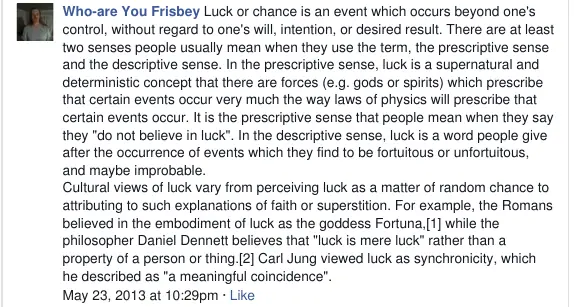
Luck or chance is an event which occurs beyond one's control, without regard to one's will, intention, or desired result. There are at least two senses people usually mean when they use the term, the prescriptive sense and the descriptive sense. In the prescriptive sense, luck is a supernatural and deterministic concept that there are forces (e.g. gods or spirits) which prescribe that certain events occur very much the way laws of physics will prescribe that certain events occur. It is the prescriptive sense that people mean when they say they "do not believe in luck". In the descriptive sense, luck is a word people give after the occurrence of events which they find to be fortuitous or unfortuitous, and maybe improbable.
Cultural views of luck vary from perceiving luck as a matter of random chance to attributing to such explanations of faith or superstition. For example, the Romans believed in the embodiment of luck as the goddess Fortuna,[1] while the philosopher Daniel Dennett believes that "luck is mere luck" rather than a property of a person or thing.[2] Carl Jung viewed luck as synchronicity, which he described as "a meaningful coincidence".
Printed copy · Anthology Volume 4, page 460Printed copy from The Tender For Law Anthology, Volume 4, page 460 (printed 13 June 2014). Added by this site; not part of the Facebook export.