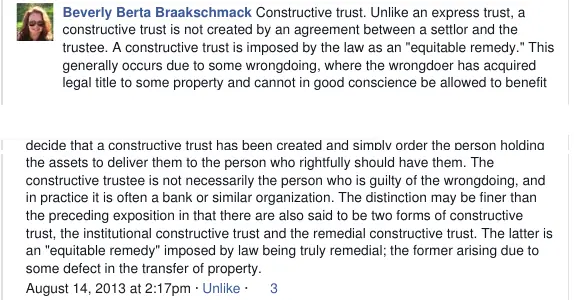
Constructive trust. Unlike an express trust, a constructive trust is not created by an agreement between a settlor and the trustee. A constructive trust is imposed by the law as an "equitable remedy." This generally occurs due to some wrongdoing, where the wrongdoer has acquired legal title to some property and cannot in good conscience be allowed to benefit from it. A constructive trust is, essentially, a legal fiction. For example, a court of equity recognizing a plaintiff's request for the equitable remedy of a constructive trust may decide that a constructive trust has been created and simply order the person holding the assets to deliver them to the person who rightfully should have them. The constructive trustee is not necessarily the person who is guilty of the wrongdoing, and in practice it is often a bank or similar organization. The distinction may be finer than the preceding exposition in that there are also said to be two forms of constructive trust, the institutional constructive trust and the remedial constructive trust. The latter is an "equitable remedy" imposed by law being truly remedial; the former arising due to some defect in the transfer of property.
Printed copy · Anthology Volume 2, page 427Printed copy from The Tender For Law Anthology, Volume 2, page 427 (printed 14 June 2014). Added by this site; not part of the Facebook export.