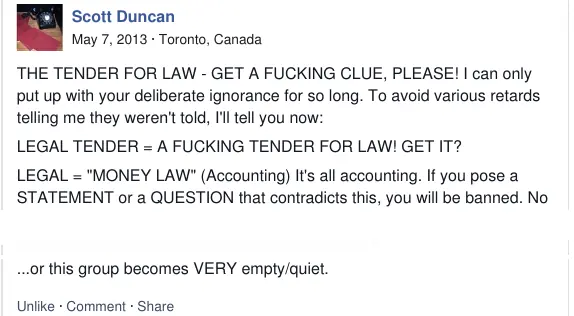
THE TENDER FOR LAW - GET A FUCKING CLUE, PLEASE! I can only put up with your deliberate ignorance for so long. To avoid various retards telling me they weren't told, I'll tell you now:
LEGAL TENDER = A FUCKING TENDER FOR LAW! GET IT?
LEGAL = "MONEY LAW" (Accounting) It's all accounting. If you pose a STATEMENT or a QUESTION that contradicts this, you will be banned. No appeal. No discussion. I'm tired of wasting time with your stupidity. Either you ACTUALLY READ what I write, or you shut up...
...or this group becomes VERY empty/quiet.
Printed copy · Anthology Volume 4, page 574Printed copy from The Tender For Law Anthology, Volume 4, page 574 (printed 13 June 2014). Added by this site; not part of the Facebook export.Filter by poster
Read Comments 28
Pete Daoust
Scott, give me the definition of lawful currency of the day, and WHY is it genius...and don't fucking panic on me or I will jump on you with an axe in my right hand, and a flashlight in the left hand...that term does not fucking clic in my brain....is it because it's too genius ????, or because it does not make sense...
Printed copy · Anthology Volume 4, page 575Printed copy from The Tender For Law Anthology, Volume 4, page 575 (printed 13 June 2014). Added by this site; not part of the Facebook export.
Scott Duncan
Look up LAWFUL.
Printed copy · Anthology Volume 4, page 575Printed copy from The Tender For Law Anthology, Volume 4, page 575 (printed 13 June 2014). Added by this site; not part of the Facebook export.
Scott Duncan
Then look up Currency.
Printed copy · Anthology Volume 4, page 575Printed copy from The Tender For Law Anthology, Volume 4, page 575 (printed 13 June 2014). Added by this site; not part of the Facebook export.
Pete Daoust
Ok, so it is a metal or paper medium of exchange that is in current use in a particular country, established, sanctioned, or recognized by the law....
Printed copy · Anthology Volume 4, page 575Printed copy from The Tender For Law Anthology, Volume 4, page 575 (printed 13 June 2014). Added by this site; not part of the Facebook export.
Pete Daoust
:/
Printed copy · Anthology Volume 4, page 575Printed copy from The Tender For Law Anthology, Volume 4, page 575 (printed 13 June 2014). Added by this site; not part of the Facebook export.
Pete Daoust
WHAT FREAKING LAW ???????...fuck.!!! I don't get it... :(
Printed copy · Anthology Volume 4, page 575Printed copy from The Tender For Law Anthology, Volume 4, page 575 (printed 13 June 2014). Added by this site; not part of the Facebook export.
Pete Daoust
This LAWFUL CURRENCY OF THE DAY thing does not make any sense to me and I can't see where it shall/must/may be genius....I quit, bye !!
Printed copy · Anthology Volume 4, page 575Printed copy from The Tender For Law Anthology, Volume 4, page 575 (printed 13 June 2014). Added by this site; not part of the Facebook export.
Edna Agla
wow, just get to the point, its all terminology. Canadian dictionary terminology defines the word tender as MONEY, there for you advertise as money for law, bank robberies are the ones with the lesser crime. Lawyers for money makes sense, lol im just messing around here, I am learning man, don't be giving up now, we need this tender for law
Printed copy · Anthology Volume 4, page 575Printed copy from The Tender For Law Anthology, Volume 4, page 575 (printed 13 June 2014). Added by this site; not part of the Facebook export.Recovered from The Tender For Law Anthology, Volume 4, page 575 (printed 13 June 2014). Not in the Facebook export; added by this site. A page break in the printout cut off the beginning of this comment, with its name.
Sino General · ChiefRock Sino General
Joseph Pierre Gilles i feel Scott Duncan may have abandoned you :P, no worries thoe, im sure you will get it some day. Law, are you trying to tell me you dont know what law is ? Lawful, Currency... Anyways this is off his topic. :D
Printed copy · Anthology Volume 4, page 576Printed copy from The Tender For Law Anthology, Volume 4, page 576 (printed 13 June 2014). Added by this site; not part of the Facebook export.
Joseph Pierre Gilles, it means you agree by using debt notes as money that their laws have the same value and you accept them.
Printed copy · Anthology Volume 4, page 576Printed copy from The Tender For Law Anthology, Volume 4, page 576 (printed 13 June 2014). Added by this site; not part of the Facebook export.
Adam Thomas
Tender is an OFFER...
Pete Daoust
Definition of 'Lawful Money'
Any form of currency issued by the United States Treasury and not the Federal Reserve System, including gold and silver coins, Treasury notes, and Treasury bonds. Lawful money stands in contrast to fiat money, to which the government assigns value although it has no intrinsic value of its own and is not backed by reserves. Fiat money includes legal tender such as paper money, checks, drafts and bank notes.
Printed copy · Anthology Volume 4, page 576Printed copy from The Tender For Law Anthology, Volume 4, page 576 (printed 13 June 2014). Added by this site; not part of the Facebook export.
Pete Daoust
ChiefRock Sino General, good morning to you....If I send a BILL to my customers and ask to get paid with LAWFUL currency of the day, what should I expect to get from them ?????
Printed copy · Anthology Volume 4, page 576Printed copy from The Tender For Law Anthology, Volume 4, page 576 (printed 13 June 2014). Added by this site; not part of the Facebook export.
Eamonn O Brien
Probably a confused response Pierre
Printed copy · Anthology Volume 4, page 576Printed copy from The Tender For Law Anthology, Volume 4, page 576 (printed 13 June 2014). Added by this site; not part of the Facebook export.
Pete Daoust
Oddly enough, the dollar bills that we carry around in our wallets are not considered lawful money. The notation on the bottom of a U.S. dollar bill reads "Legal Tender for All Debts, Public and Private", and is issued by the U.S. Federal Reserve, not the U.S. Treasury. Legal tender can be exchanged for an equivalent amount of lawful money, but effects such as inflation can change the value of fiat money. Lawful money is said to be the most direct form of ownership, but for purposes of practicality it has little use in direct transactions between parties anymore.
Printed copy · Anthology Volume 4, page 576Printed copy from The Tender For Law Anthology, Volume 4, page 576 (printed 13 June 2014). Added by this site; not part of the Facebook export.
Eamonn O Brien
The Federal Reserve Act 1923 would have legalised the Dollar as we know it today I'd imagine... That's the lawful currency of the day since that act...It actually says it in the first paragraph...
http://en.wikipedia.org/wiki/Federal_Reserve_Act
Printed copy · Anthology Volume 4, page 577Printed copy from The Tender For Law Anthology, Volume 4, page 577 (printed 13 June 2014). Added by this site; not part of the Facebook export.
Pete Daoust
And as far as Scott Duncan abandoned me, well, he never adopted me in the first place....how could he abandoned me ??? :/
Printed copy · Anthology Volume 4, page 577Printed copy from The Tender For Law Anthology, Volume 4, page 577 (printed 13 June 2014). Added by this site; not part of the Facebook export.
Adam Thomas
ABANDON PIERRE, NOT "ED"
NAZI SIEG FAIL !!
Adam Thomas
A Bill of Exchange is Lawful currency.
Pete Daoust
http://freetheplanet.net/images/186.gif
Printed copy · Anthology Volume 4, page 577Printed copy from The Tender For Law Anthology, Volume 4, page 577 (printed 13 June 2014). Added by this site; not part of the Facebook export.
Pete Daoust
A written, unconditional order by one party (the drawer) to another (the drawee) to pay a certain sum, either immediately (a sight bill) or on a fixed date (a term bill), for payment of goods and/or services received. The drawee accepts the bill by signing it, thus converting it into a post-dated check and a binding contract.
A bill of exchange is also called a draft but, while all drafts are negotiable instruments, only "to order" bills of exchange can be negotiated. According to the 1930 Convention Providing A Uniform Law For Bills of Exchange and Promissory Notes held in Geneva (also called Geneva Convention) a bill of exchange contains: (1) The term bill of exchange inserted in the body of the instrument and expressed in the language employed in drawing up the instrument. (2) An unconditional order to pay a determinate sum of money. (3) The name of the person who is to pay (drawee). (4) A statement of the time of payment. (5) A statement of the place where payment is to be made. (6) The name of the person to whom or to whose order payment is to be made. (7) A statement of the date and of the place where the bill is issued. (8) The signature of the person who issues the bill (drawer). A bill of exchange is the most often used form of payment in local and international trade, and has a long history- as long as that of writing.
Printed copy · Anthology Volume 4, page 577Printed copy from The Tender For Law Anthology, Volume 4, page 577 (printed 13 June 2014). Added by this site; not part of the Facebook export.
Adam Thomas
Pay one hundred cents I n the DOLLAR OF THE SUM CERTAIN OWING
Adam Thomas
A Bill of Exchange can also be an INCHOATE INSTRUMENT !!
Adam Thomas
Rubbed stamps are needed as is 5cent postage stamp and a $1 postagd stamp..
Adam Thomas
6 rubber stamps.
Blake Gardner
Law = the agreement between the parties...currency = the authorized medium of exchange/any paper tender...
Filter by poster
Read Comments 28
Pete Daoust
Printed copy · Anthology Volume 4, page 575
Scott Duncan
Printed copy · Anthology Volume 4, page 575
Scott Duncan
Printed copy · Anthology Volume 4, page 575
Pete Daoust
Printed copy · Anthology Volume 4, page 575
Pete Daoust
Printed copy · Anthology Volume 4, page 575
Pete Daoust
Printed copy · Anthology Volume 4, page 575
Pete Daoust
Printed copy · Anthology Volume 4, page 575
Edna Agla
Printed copy · Anthology Volume 4, page 575
Sino General · ChiefRock Sino General
Printed copy · Anthology Volume 4, page 576
Dory Alexander
David Johansen
Printed copy · Anthology Volume 4, page 576
Adam Thomas
Pete Daoust
Printed copy · Anthology Volume 4, page 576
Pete Daoust
Printed copy · Anthology Volume 4, page 576
Eamonn O Brien
Printed copy · Anthology Volume 4, page 576
Pete Daoust
Printed copy · Anthology Volume 4, page 576
Eamonn O Brien
Printed copy · Anthology Volume 4, page 577
Pete Daoust
Printed copy · Anthology Volume 4, page 577
Adam Thomas
Adam Thomas
Pete Daoust
Printed copy · Anthology Volume 4, page 577
Pete Daoust
Printed copy · Anthology Volume 4, page 577
Adam Thomas
Adam Thomas
Adam Thomas
Adam Thomas
Blake Gardner