The Tender For Law

English Only

ENGLISH is the international language of law and commerce. Knowing FRENCH is useful for understanding LEGAL ENGLISH, but FRENCH is not the international language of law and commerce, so we will ignore French speakers who speak to us in the language of a conquered people.

Non.

I understand that you are a proud Québécois, but the people here have nothing but contempt for you because of decades of transfer payments and NONE OF YOU understanding what Quebec sovereignty means. None of you know who Russell Rogers Smith is, and you're too proud and arrogant to teach. Just go away and be Retardier somewhere else.

Volume 1

Mar 29, 2013 9:11 AM

David Johansen

from Corby Weaver's notes: (just a thought to share here) The government states that the Constitution is a grant of power and that is correct, but to perform corporate functions, which is the Office of Profit, everyone misses the Key words in the document like "office of Trust" along with that office of profit. No one seems to see it, as if it is invisible and has no meaning, but IT is the creator. They also miss the words about the jury trial and words of "common law". No one invokes the common law because the laws established under the 14th amendment are not common law, but they cannot be in conflict with it, and they aren't. People do not know who they are and where they came from, why they are here, and where their Rights come from. The Amendments are a restatement of rights but under the 14th amendment they are ONLY a codicil that changes the intentions of the founding fathers. Thus Civil Rights.

To invoke the common law one must ask the administrators which office they represent (office of trust or office of profit), inform them they are trustees of the trust you are a beneficiary/legatee/heir of, tell them where the Trust resides, inform them that Rights do not devolve through an office of profit, that they would be in breach of trust if they continue to follow their proceedings as is, and that as an Heir you are invoking the Common Law of England as it stands in this country.

Under Constitutional Law a court — ANY court, MUST look toward the Trust first and make determinations from that point, not statutory law.

Printed copy · Anthology Volume 1, page 1207
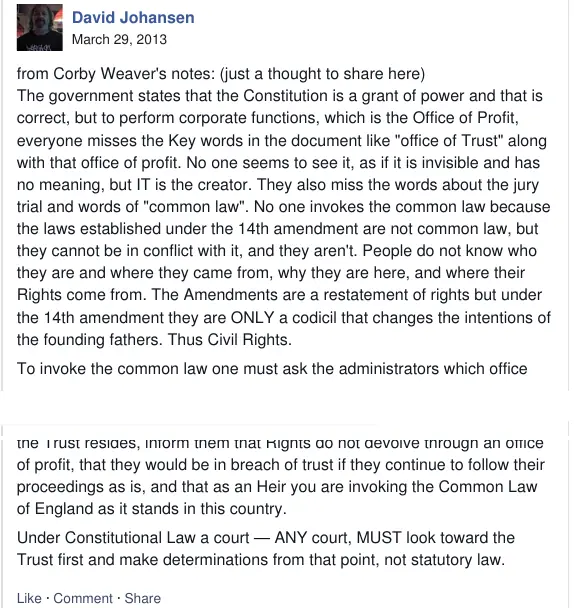
Printed copy of this post
Printed copy from The Tender For Law Anthology, Volume 1, page 1207 (printed 14 June 2014). Added by this site; not part of the Facebook export.

Read Comments 2

James Allan

David, some nice points. But you must be aware of the jurisdiction of the court you are in. If the jurisdiction of the court is solely statutory, no appealing to the administrator will help. His only authority is statutory. He cannot hear anything else. And you most definitely cannot invoke a common law court in a court that is only authorized to hear statutory matters.

Printed copy · Anthology Volume 1, page 1208
Printed copy of this comment
Printed copy from The Tender For Law Anthology, Volume 1, page 1208 (printed 14 June 2014). Added by this site; not part of the Facebook export.

David Johansen

i did not author it, note the first line i cited him. corby BTW is a yale law grad. i only wanted to share it with all of you seeing as it mentions 'trust' i felt it might be important in some way.

Printed copy · Anthology Volume 1, page 1208
Printed copy of this comment
Printed copy from The Tender For Law Anthology, Volume 1, page 1208 (printed 14 June 2014). Added by this site; not part of the Facebook export.
Back to top