The Tender For Law

English Only

ENGLISH is the international language of law and commerce. Knowing FRENCH is useful for understanding LEGAL ENGLISH, but FRENCH is not the international language of law and commerce, so we will ignore French speakers who speak to us in the language of a conquered people.

Non.

I understand that you are a proud Québécois, but the people here have nothing but contempt for you because of decades of transfer payments and NONE OF YOU understanding what Quebec sovereignty means. None of you know who Russell Rogers Smith is, and you're too proud and arrogant to teach. Just go away and be Retardier somewhere else.

Volume 1

Mar 11, 2013 7:31 PM

Derek Moran

The All Things "RECUSAL" -thread..... Black's Law 8th-edition

RECUSABLE: 1. (of an obligation) arising from a party's voluntary act and that can be avoided. 2. (of a judge) capable of being disqualified from sitting on a case. 3. (of a fact) providing a basis for disqualifying a judge from sitting on a case.

RECUSAL: removal of oneself as judge or policy-maker in a particular matter, especially because of a conflict of interest.

RECUSANT: adjective. refusing to submit to an authority or comply with a command <a recusant witness>

RECUSANT: noun. 1. Ecclesiastical law. a person (esp. a Roman Catholic (?)) who refuses to attend the services of the established Church of England. 2. a person who refuses to submit to an authority or comply with a command.

RECUSATIO JUDICIS (latin): Ecclesiastical law. the procedure and grounds by which a judge may be challenged and removed from hearing a case. The grounds for disqualification traditionally include great friendship or enmity with a party, close kinship to a party, acceptance of a bribe, previously giving counsel to a party, or demonstrated ignorance of the law. A panel of three arbiters, chosen by the challenging party and the judge, decides whether the party's complaint has merit.

RECUSATION: 1. Civil law. an objection, exception, or appeal; especially an objection alleging a judge's prejudice or conflict of interest.

RECUSE: 1. to remove (oneself) as a judge in a particular case because of a prejudice or conflict of interest <the judge recused himself from the trial> 2. to challenge or object to (a judge) as being disqualified from hearing a case because of prejudice or a conflict of interest <the defendant filed a motion to recuse the trial judge>

..unrelated, but on the same page and interesting;

RECTUS IN CURIA (latin): "right in the court". free from charge or offence; competent to appear in court and entitled to the BENEFIT OF LAW (hmm, sounds familiar). See LEGALIS HOMO.

REDDITION: an acknowledgment in court that one is not the owner of certain property being demanded, and that it in fact belongs to the demandant. ("Do you, your Honour, take Judicial Notice of the fact that, i as the DEMANDANT, am the Lawful-Holder-In-Due-Course of the SECURITY of my PERSON, and not that of my public-servants meant to serve me?" :)

Printed copy · Anthology Volume 5, page 529
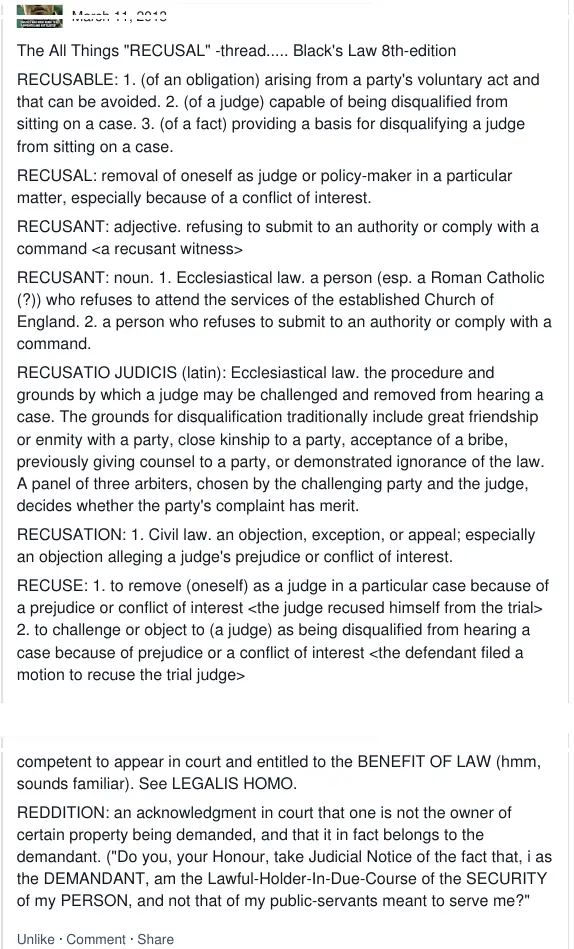
Printed copy of this post
Printed copy from The Tender For Law Anthology, Volume 5, page 529 (printed 13 June 2014). Added by this site; not part of the Facebook export.

Read Comments 87

Derek Moran

Then, they follow that up with THE GROUNDS for the RECUSAL of a judge: "...The GROUNDS for disqualification traditionally include great friendship or enmity with a party, close kinship to a party, acceptance of a bribe, previously giving counsel to a party, or demonstrated ignorance of the law."

Printed copy · Anthology Volume 5, page 530
Printed copy of this comment
Printed copy from The Tender For Law Anthology, Volume 5, page 530 (printed 13 June 2014). Added by this site; not part of the Facebook export.

Derek Moran

On top of that, i see a recurring-theme in these definitions of the words/terms- "...conflict-of-interest...prejudice...(and id assume and/or presume BIAS exhibited, would be acceptable too)..."

Printed copy · Anthology Volume 5, page 530
Printed copy of this comment
Printed copy from The Tender For Law Anthology, Volume 5, page 530 (printed 13 June 2014). Added by this site; not part of the Facebook export.

Derek Moran

What ive learned from you Scott, is that much like comedy- timing is also everything in Law/being-in-court. Goes without saying you would NOT want to RECUSE a Judge who is actually acting IMPARTIAL. But, if he ISNT being IMPARTIAL towards you, how soon/quick/at-which-point, do you pull the "Would you like to recuse yourself"?-trigger...?

Printed copy · Anthology Volume 5, page 531
Printed copy of this comment
Printed copy from The Tender For Law Anthology, Volume 5, page 531 (printed 13 June 2014). Added by this site; not part of the Facebook export.

Scott Duncan

The second you suspect it; "Your Honour your conduct has caused me to reasonably believe that you have formed a biased position as regards this matter, and could serve to damage my interests. Would you please recuse yourself"?

(Note: ending that question with "..you sanctimonious, worthless parasitic bitch"? ...is optional.)

Printed copy · Anthology Volume 5, page 531
Printed copy of this comment
Printed copy from The Tender For Law Anthology, Volume 5, page 531 (printed 13 June 2014). Added by this site; not part of the Facebook export.

Derek Moran

So the more formal way of phrasing this then would be- "Objection...(and then what you wrote a couple posts up)...Your Honour, your conduct has caused me to reasonably believe that you have formed a biased position as regards this matter, and could serve to damage my interests. Would you please recuse yourself?"..... ? "/

Printed copy · Anthology Volume 5, page 531
Printed copy of this comment
Printed copy from The Tender For Law Anthology, Volume 5, page 531 (printed 13 June 2014). Added by this site; not part of the Facebook export.

Derek Moran

at minute 32:00, is where Dean starts explaining how he asked/told the judge to "recuse himself":

http://www.blogtalkradio.com/globalfactradio/2013/03/05/how-to-with-dean-clifford-ep12-dean-tells-all

Printed copy · Anthology Volume 5, page 531
Printed copy of this comment
Printed copy from The Tender For Law Anthology, Volume 5, page 531 (printed 13 June 2014). Added by this site; not part of the Facebook export.

Derek Moran

As i am typing this, i am listening to the portion of the show where Dean describes RECUSING the judge. Was it uneccessary then for Dean, to MOTION for the judge to recuse himself, as in he didnt even need to bother with doing that to begin with? :/

Printed copy · Anthology Volume 5, page 532
Printed copy of this comment
Printed copy from The Tender For Law Anthology, Volume 5, page 532 (printed 13 June 2014). Added by this site; not part of the Facebook export.

Derek Moran

So going into court and right-off-the-bat saying to the judge- "I MOTION for you to Strike/I MOTION for you to Quash this matter" = BAD, because you are consenting to their jurisdiction unwittingly

Printed copy · Anthology Volume 5, page 532
Printed copy of this comment
Printed copy from The Tender For Law Anthology, Volume 5, page 532 (printed 13 June 2014). Added by this site; not part of the Facebook export.

Eamonn O Brien

1. At common law, a writ ordering a defendant to do some act or to explain why inaction is appropriate. - Also termed writ of praecipe. 2. A written motion or request seeking some court action, esp. a trial setting or an entry of judgment...

So praecipe is a request for the court to issue a writ...?

Printed copy · Anthology Volume 5, page 532
Printed copy of this comment
Printed copy from The Tender For Law Anthology, Volume 5, page 532 (printed 13 June 2014). Added by this site; not part of the Facebook export.

Pete Daoust

[Latin, Give an order.] An original writ, one of the forms of legal process used to commence an action. A praecipe was drawn up in the alternative and commanded the defendant to do what was ordered or to appear and show why he or she had not done it. An order that commands the clerk of a court to issue a formal writ of execution directing the enforcement of a judgment already rendered and commanding a public officer to seize the defendant's property in order to satisfy the debt.

Printed copy · Anthology Volume 5, page 533
Printed copy of this comment
Printed copy from The Tender For Law Anthology, Volume 5, page 533 (printed 13 June 2014). Added by this site; not part of the Facebook export.

Derek Moran

The RIGHT WAY would be to say- "Your Honour, i PRAECIPE for you to Strike/ I PRAECIPE for you to Quash this matter"- is the way we SHOULD be phrasing these statements (instead of using the term "MOTION"), but is the way THEY would prefer us NEVER find out about?

Printed copy · Anthology Volume 5, page 533
Printed copy of this comment
Printed copy from The Tender For Law Anthology, Volume 5, page 533 (printed 13 June 2014). Added by this site; not part of the Facebook export.

Scott Duncan

FROM WIKIFUCKINGPEDIA! "In Canada it is used in place of a notice of motion as an application for a desk order that is granted in the court registry without a hearing before a judge".

...oh Derek, you miss the little things...LIKE NOT GOING TO FUCKING COURT!

Printed copy · Anthology Volume 5, page 533 · cut by a page break
Printed copy of this comment
Printed copy from The Tender For Law Anthology, Volume 5, page 533 (printed 13 June 2014). Added by this site; not part of the Facebook export. A page break in the printout cut off the end of this comment.

Derek Moran

"...oh Derek, you miss the little things...LIKE NOT GOING TO FUCKING COURT!"..... no argument here. I just lack experience. Ummm..when will you be showcasing your talents in a courtroom again next? ;)

Printed copy · Anthology Volume 5, page 534
Printed copy of this comment
Printed copy from The Tender For Law Anthology, Volume 5, page 534 (printed 13 June 2014). Added by this site; not part of the Facebook export.

Daniel J Wentz

Oh crap. Scott's makeing a drone army I see.

Oh well. I hear AQUILAE trustees always end up doing pretty well for themselves, so no worries.

Things must be going to shit if `Liz has let you off her leash, Scott Duncan!

Printed copy · Anthology Volume 5, page 534
Printed copy of this comment
Printed copy from The Tender For Law Anthology, Volume 5, page 534 (printed 13 June 2014). Added by this site; not part of the Facebook export.

Pete Daoust

I'm Pete and/or Peter and/or Pierre and/or Babe (I reserve this one for my wife) I'm also Dad (I reserve this one for my children) and/or BELLIGERENT and I'm the LAWFUL HOLDER IN DUE COURSE OF PIERRE DAOUST Social Insurance no. 26X-XXX-XXX, Inscription No.119XXXXXXXX

I’m the SOLE beneficiary of PIERRE DAOUST

I make ALL business decisions for PIERRE DAOUST

And I reserve ALL RIGHTS….all of them—yours as well

Is ANYONE have any objections ?????

Printed copy · Anthology Volume 5, page 534
Printed copy of this comment
Printed copy from The Tender For Law Anthology, Volume 5, page 534 (printed 13 June 2014). Added by this site; not part of the Facebook export.

Scott Duncan

Pierre, when someone addresses you as "SIR" you are being addressed from a subordinate. ALL my trustees in a duty capacity MUST call me "sir".

Ever notice that when a COP doesn't know your name he calls you SIR, and when they HAVE your name they Call you "MISTER Daust"?

Printed copy · Anthology Volume 5, page 534
Printed copy of this comment
Printed copy from The Tender For Law Anthology, Volume 5, page 534 (printed 13 June 2014). Added by this site; not part of the Facebook export.

Derek Moran

Ok, so to review: you would NEVER verbally use the term PRAECIPE in court, in terms of say- "Your Honour, i PRAECIPE for you to Strike/Quash this matter.."..... PRAECIPE, is STRICTLY, to be used, in WRITTEN form ONLY...?

Printed copy · Anthology Volume 5, page 534
Printed copy of this comment
Printed copy from The Tender For Law Anthology, Volume 5, page 534 (printed 13 June 2014). Added by this site; not part of the Facebook export.

Derek Moran

So, to review: it was unneccessary for Dean in court on the audio, to "MOTION" for the judge to recuse himself? He needed only to OBJECT, and ASK the judge to recuse himself, using the phrasing that you wrote earlier, Scott?

Printed copy · Anthology Volume 5, page 535
Printed copy of this comment
Printed copy from The Tender For Law Anthology, Volume 5, page 535 (printed 13 June 2014). Added by this site; not part of the Facebook export.

Daniel J Wentz

If a JUSTICE cautions you about the "dangers" of MOTIONING, he's HELPING you.

Judges are ELECTED, and JUSTICES are APPOINTED. [Scott-like emphisis added]

Since you are in CANADA, then you should not be concerned about JUDGES, because you will never be before one.

Printed copy · Anthology Volume 5, page 535
Printed copy of this comment
Printed copy from The Tender For Law Anthology, Volume 5, page 535 (printed 13 June 2014). Added by this site; not part of the Facebook export.

Derek Moran

..so- i guess thats why then Dean couldnt figure out why the judge was not Recusing himself, because, Dean had MOTIONED for him to Recuse himself, instead of simply OBJECTING and asking the judge to Recuse himself? :/

Printed copy · Anthology Volume 5, page 535
Printed copy of this comment
Printed copy from The Tender For Law Anthology, Volume 5, page 535 (printed 13 June 2014). Added by this site; not part of the Facebook export.

Scott Duncan

Criminal. I would have witnessed FRAUD against the petitioner.

Dean claimed he was not the name, but by MOTIONING he was acting as a PARTY, and was INTERFERING WITH THE LEGAL COMMERCIAL INTERESTS of the petitioner.

You are either a PARTY or you are NOT. You don't get to say you are NOT a party, and than ACT as one. It's FRAUD

Printed copy · Anthology Volume 5, page 536
Printed copy of this comment
Printed copy from The Tender For Law Anthology, Volume 5, page 536 (printed 13 June 2014). Added by this site; not part of the Facebook export.

Derek Moran

"Only public servants can MOTION. Even then, only as a PARTY."...... holy fuck, where does it actually say that somewhere- where is the source-of-reference for this?..id love to see this for myself

Printed copy · Anthology Volume 5, page 536
Printed copy of this comment
Printed copy from The Tender For Law Anthology, Volume 5, page 536 (printed 13 June 2014). Added by this site; not part of the Facebook export.

Derek Moran

So for someone who doesnt know any better, find themselves in court, and are planning on asking the judge to STRIKE or QUASH the charge, what would they use instead of MOTION then, in the wording/phrasing of their delivery...?

Printed copy · Anthology Volume 5, page 536
Printed copy of this comment
Printed copy from The Tender For Law Anthology, Volume 5, page 536 (printed 13 June 2014). Added by this site; not part of the Facebook export.

Pete Daoust

You are either a PARTY or you are NOT. You don't get to say you are NOT a party, and than ACT as one. It's FRAUD: wow...thats solid stuff ???.....is it me or I focus on the wrong stuff..???....

Printed copy · Anthology Volume 5, page 537
Printed copy of this comment
Printed copy from The Tender For Law Anthology, Volume 5, page 537 (printed 13 June 2014). Added by this site; not part of the Facebook export.

Derek Moran

Scott AND/OR Daniel..so what you guys are saying, is nevermind finding a fancy-replacement for the term MOTION, just go ahead and straight-out TELL the judge to STRIKE and QUASH the charge?

Printed copy · Anthology Volume 5, page 537
Printed copy of this comment
Printed copy from The Tender For Law Anthology, Volume 5, page 537 (printed 13 June 2014). Added by this site; not part of the Facebook export.

Chad Brodgesell

""If you are in court RESERVE ALL RIGHTS. State that you wish the "charges" dismissed, and keep QUESTIONING!""

But don't MOTION and then DEMAND their claim if they have one , if not DEMAND the session to be dismissed?

Printed copy · Anthology Volume 5, page 538
Printed copy of this comment
Printed copy from The Tender For Law Anthology, Volume 5, page 538 (printed 13 June 2014). Added by this site; not part of the Facebook export.

Derek Moran

*wait JUST for the moment the Judge begins talking at the start of the proceedings and then state* "Point-of-order...i RESERVE ALL RIGHTS...i WISH for the charges to be dismissed"- then, i start asking questions like this is the first-time ive ever heard about this thing called "The Law," and whatever i do, i dont Understand a FUCKING thing..pretty much, we're just disingenuously playing-dumb with them at this point? :/

Printed copy · Anthology Volume 5, page 539
Printed copy of this comment
Printed copy from The Tender For Law Anthology, Volume 5, page 539 (printed 13 June 2014). Added by this site; not part of the Facebook export.

Pete Daoust

dismiss v. the ruling by a judge that all or a portion (one or more of the causes of action) of the plaintiff's lawsuit is terminated (thrown out) at that point without further evidence or testimony. This judgment may be made before, during, or at the end of a trial, when the judge becomes convinced that the plaintiff has not and cannot prove his/her/its case. This can be based on the complaint not alleging a cause of action, a motion for summary judgment, plaintiff's opening statement of what will be proved, or some development in the evidence by either side which bars judgment for the plaintiff. The judge may dismiss on his own or upon motion by the defendant. The plaintiff may voluntarily dismiss a cause of action before or during trial if the case is settled, if it is not provable, or trial strategy dictates getting rid of a weak claim. A defendant may be "dismissed" from a lawsuit, meaning the suit is dropped against that party. (See: dismissal)

Printed copy · Anthology Volume 5, page 539
Printed copy of this comment
Printed copy from The Tender For Law Anthology, Volume 5, page 539 (printed 13 June 2014). Added by this site; not part of the Facebook export.

Pete Daoust

To liberate or free; to terminate or extinguish. A discharge is the act or instrument by which a contract or agreement is ended. A mortgage is discharged if it has been carried out to the full extent originally contemplated or terminated prior to total execution.

Discharge also means to release, as from legal confinement in prison or the military service, or from some legal obligation such as jury duty, or the payment of debts by a person who is bankrupt. The document that indicates that an individual has been legally released from the military service is called a discharge.

The performance of a duty discharges it. An attorney may speak of discharging a legal obligation

Printed copy · Anthology Volume 5, page 539
Printed copy of this comment
Printed copy from The Tender For Law Anthology, Volume 5, page 539 (printed 13 June 2014). Added by this site; not part of the Facebook export.

Anibal Jose BaezMackximus Minimus

I'm so glad Derek is back. And Chris, while reading this post about RECUSE, I thought of "judges" that consider affidavits as MOTIONS, and ignore MISTAKES ! :D

Printed copy · Anthology Volume 5, page 540
Printed copy of this comment
Printed copy from The Tender For Law Anthology, Volume 5, page 540 (printed 13 June 2014). Added by this site; not part of the Facebook export.

Derek Moran

Scott Duncan "Would you like to recuse yourself"? - This always works

This actually claims your rights, and turfs the Justice.

Scott Duncan The second you suspect it; "Your Honour your conduct has caused me to reasonably believe that you have formed a biased position as regards this matter, and could serve to damage my interests. Would you please recuse yourself"?

(Note: ending that question with "..you sanctimonious, worthless parasitic bitch"? ...is optional.)

Derek Moran Do you have to call-out- "Point-of-Order" first, before you say that?

Scott Duncan No. In fact this would fall under OBJECTION. You OBJECT to a sanctimonious, worthless parasitic bitch ruling on the matter.

POINT OF ORDER serves to POINT out an error and/or MISTAKE.

Derek Moran You have mentioned before NOT to MOTION to/with the court, as you are unwittingly consenting to their jurisdiction, Scott?

Scott Duncan YES! Martin Sutton almost did that. Darren the cop was all for it. If Darren the cop says it, you probably should try figure out why you shouldn't... RIGHT MARTIN?

Eamonn O Brien If a writ is an order of the court on behalf of one party to the other how do you file for the court to issue one? Am I understanding it properly even...?

Scott Duncan Praecipe.

Printed copy · Anthology Volume 5, page 540
Printed copy of this comment
Printed copy from The Tender For Law Anthology, Volume 5, page 540 (printed 13 June 2014). Added by this site; not part of the Facebook export.
Back to top