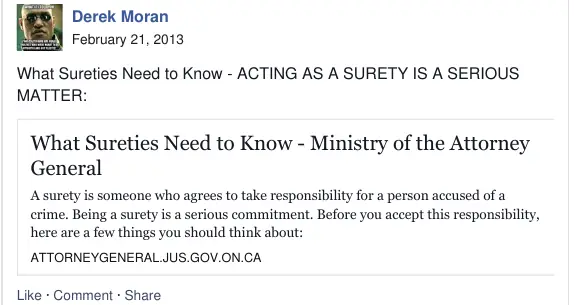
A surety is someone who agrees to take responsibility for a person accused of a crime. Being a surety is a serious commitment. Before you accept this responsibility, here are a few things you should think about:
Printed copy · Anthology Volume 5, page 1296Printed copy from The Tender For Law Anthology, Volume 5, page 1296 (printed 13 June 2014). Added by this site; not part of the Facebook export.Filter by poster
Read Comments 24
Pete Daoust
Accepting a fee or being paid back in return for acting as a surety is against the law...is that apply in every scenario of sureties..???
Printed copy · Anthology Volume 5, page 1296 · cut by a page breakPrinted copy from The Tender For Law Anthology, Volume 5, page 1296 (printed 13 June 2014). Added by this site; not part of the Facebook export. A page break in the printout swallowed this comment: only its date was printed.
Cara Small
i don't believe that is law
Printed copy · Anthology Volume 5, page 1297Printed copy from The Tender For Law Anthology, Volume 5, page 1297 (printed 13 June 2014). Added by this site; not part of the Facebook export.
Cara Small
who's law? only if you agreed to the terms in the first place
Printed copy · Anthology Volume 5, page 1297Printed copy from The Tender For Law Anthology, Volume 5, page 1297 (printed 13 June 2014). Added by this site; not part of the Facebook export.
Pete Daoust
Why..???
Printed copy · Anthology Volume 5, page 1297Printed copy from The Tender For Law Anthology, Volume 5, page 1297 (printed 13 June 2014). Added by this site; not part of the Facebook export.
Cara Small
IF you were to declare surety for some one i certainly wouldn't accept those terms. Paid how?
Printed copy · Anthology Volume 5, page 1297Printed copy from The Tender For Law Anthology, Volume 5, page 1297 (printed 13 June 2014). Added by this site; not part of the Facebook export.
Scott Duncan
Surety talk? OK!
TODAY'S WORD IS...
ESTREAT!
Printed copy · Anthology Volume 5, page 1297Printed copy from The Tender For Law Anthology, Volume 5, page 1297 (printed 13 June 2014). Added by this site; not part of the Facebook export.
Cara Small
that would be u in dean's case?
Printed copy · Anthology Volume 5, page 1297Printed copy from The Tender For Law Anthology, Volume 5, page 1297 (printed 13 June 2014). Added by this site; not part of the Facebook export.
Cara Small
but their laws do not apply
Printed copy · Anthology Volume 5, page 1297Printed copy from The Tender For Law Anthology, Volume 5, page 1297 (printed 13 June 2014). Added by this site; not part of the Facebook export.
Scott N Tara · Roguesupport Nx
Becoming a surety for someone accused of a crime is a lovely way to voluntarily enter into bonded servitude. You consent to the jurisdiction, yourself, having committed no crime, and agree to provide valuable assets, guarantees and unpaid babysitting for the new “ward of the court”.
While it may be tempting to get mom out of jail, after she allegedly robbed the jewelery store and all, you are guaranteeing the “accused” complies with all conditions imposed by the court (to secure their temporary liberty), and accepting full financial responsibility for any action, or inaction, deemed as a default of those undertakings. It's a little like that advertisement for “bits and bites”. You never know what the conditions are going to be when you consent to the process.
If things don't go well, be prepared to say farewell to some, or all, of your assets.
Printed copy · Anthology Volume 5, page 1297Printed copy from The Tender For Law Anthology, Volume 5, page 1297 (printed 13 June 2014). Added by this site; not part of the Facebook export.
Scott Duncan
DOUBLE YOUR IQ OR NO MONEY BACK!
Scott N Tara · Roguesupport Nx
...sorry I can't "like" that more than once :D
Printed copy · Anthology Volume 5, page 1297Printed copy from The Tender For Law Anthology, Volume 5, page 1297 (printed 13 June 2014). Added by this site; not part of the Facebook export.
Scott N Tara · Roguesupport Nx
While we're at it:
Estreat (French estrait, Latin extracta) means, originally, a true copy or duplicate of some original writing or record; since the 1900s used only with reference to the enforcement of a forfeited recognizance.
At one time it was the practice to extract and certify into the exchequer copies of entries in court rolls which contained provision or orders in favor of the treasury, hence the estreating of a recognizance was the taking out from among the other records of the court in which it was filed and sending it to the exchequer to be enforced, or sending it to the sheriff to he levied by him, and then returned by the clerk of the peace to the lords of the treasury.
Printed copy · Anthology Volume 5, page 1298Printed copy from The Tender For Law Anthology, Volume 5, page 1298 (printed 13 June 2014). Added by this site; not part of the Facebook export.
Scott Duncan
NOUNS DON"T HAVE GENDER! MY PENCIL DOES NOT FUCK MY RULER!
Printed copy · Anthology Volume 5, page 1298Printed copy from The Tender For Law Anthology, Volume 5, page 1298 (printed 13 June 2014). Added by this site; not part of the Facebook export.
Scott Duncan
http://www.liveleak.com/view?i=180_1244652735
Printed copy · Anthology Volume 5, page 1298Printed copy from The Tender For Law Anthology, Volume 5, page 1298 (printed 13 June 2014). Added by this site; not part of the Facebook export.
Fiona Munro
Create a Bond for surety it works every time !
Printed copy · Anthology Volume 5, page 1298Printed copy from The Tender For Law Anthology, Volume 5, page 1298 (printed 13 June 2014). Added by this site; not part of the Facebook export.
Derek Moran
The Dictionary of Canadian Law 3rd-edition, RECOGNIZANCE: n. 1. a person's own promise to appear. 2. "The recognizance contemplated by s.22[of the Coroner's Act, R.S.S. 1978, c. C-38] is in the nature of a performance BOND; an acknowledgment from the person from whom it is taken that he is indebted to the Crown in the amount fixed therein, provided always, that if he fulfills the condition of the undertaking and appears as required the debt ceases..." McMillan v. Bassett(19830 [1984] 3. "...a BOND of record testifying the recognizor to owe a certain sum of money to some other..." R. v. Sandhu (1984)
Printed copy · Anthology Volume 5, page 1298Printed copy from The Tender For Law Anthology, Volume 5, page 1298 (printed 13 June 2014). Added by this site; not part of the Facebook export.
Derek Moran
"Create a Bond for surety it works every time"..... CREATING-A-BOND, thats an area that goes right over my head!
Printed copy · Anthology Volume 5, page 1298Printed copy from The Tender For Law Anthology, Volume 5, page 1298 (printed 13 June 2014). Added by this site; not part of the Facebook export.
Printed copy · Anthology Volume 5, page 1298 · cut by a page breakPrinted copy from The Tender For Law Anthology, Volume 5, page 1298 (printed 13 June 2014). Added by this site; not part of the Facebook export. A page break in the printout cut off the beginning of this comment, with its name.
Derek Moran
Scott Duncan: Surety talk? OK!
TODAY'S WORD IS...
ESTREAT!
Printed copy · Anthology Volume 5, page 1299Printed copy from The Tender For Law Anthology, Volume 5, page 1299 (printed 13 June 2014). Added by this site; not part of the Facebook export.
Anibal Jose Baez · Mackximus Minimus
I can SEE what you are doing, Derek! :D
Printed copy · Anthology Volume 5, page 1299Printed copy from The Tender For Law Anthology, Volume 5, page 1299 (printed 13 June 2014). Added by this site; not part of the Facebook export.
David Johansen
as I am NOT surety in this matter, please forgive me for giving YOU that impression.
Printed copy · Anthology Volume 5, page 1299Printed copy from The Tender For Law Anthology, Volume 5, page 1299 (printed 13 June 2014). Added by this site; not part of the Facebook export.
David Johansen
ahh, i see the deception. you are trained to think that some deity will forgive you, and that you have to ask this alleged GOD party rather than who you REALITY need to ask it of... ahh, very clever indeed...
Printed copy · Anthology Volume 5, page 1299Printed copy from The Tender For Law Anthology, Volume 5, page 1299 (printed 13 June 2014). Added by this site; not part of the Facebook export.
David Johansen
court-dorothy is nolonger available on that site nor through the internet wayback archive.
Printed copy · Anthology Volume 5, page 1299Printed copy from The Tender For Law Anthology, Volume 5, page 1299 (printed 13 June 2014). Added by this site; not part of the Facebook export.
Pete Daoust
Acting as ADMINISTRATOR is a serious matter too :P
Printed copy · Anthology Volume 5, page 1299Printed copy from The Tender For Law Anthology, Volume 5, page 1299 (printed 13 June 2014). Added by this site; not part of the Facebook export.
Filter by poster
Read Comments 24
Pete Daoust
Printed copy · Anthology Volume 5, page 1296 · cut by a page break
Cara Small
Printed copy · Anthology Volume 5, page 1297
Cara Small
Printed copy · Anthology Volume 5, page 1297
Pete Daoust
Printed copy · Anthology Volume 5, page 1297
Cara Small
Printed copy · Anthology Volume 5, page 1297
Scott Duncan
Printed copy · Anthology Volume 5, page 1297
Cara Small
Printed copy · Anthology Volume 5, page 1297
Cara Small
Printed copy · Anthology Volume 5, page 1297
Scott N Tara · Roguesupport Nx
Printed copy · Anthology Volume 5, page 1297
Scott Duncan
Scott N Tara · Roguesupport Nx
Printed copy · Anthology Volume 5, page 1297
Scott N Tara · Roguesupport Nx
Printed copy · Anthology Volume 5, page 1298
Scott Duncan
Printed copy · Anthology Volume 5, page 1298
Scott Duncan
Printed copy · Anthology Volume 5, page 1298
Fiona Munro
Printed copy · Anthology Volume 5, page 1298
Derek Moran
Printed copy · Anthology Volume 5, page 1298
Derek Moran
Printed copy · Anthology Volume 5, page 1298
Derek Moran
Printed copy · Anthology Volume 5, page 1298 · cut by a page break
Derek Moran
Printed copy · Anthology Volume 5, page 1299
Anibal Jose Baez · Mackximus Minimus
Printed copy · Anthology Volume 5, page 1299
David Johansen
Printed copy · Anthology Volume 5, page 1299
David Johansen
Printed copy · Anthology Volume 5, page 1299
David Johansen
Printed copy · Anthology Volume 5, page 1299
Pete Daoust
Printed copy · Anthology Volume 5, page 1299