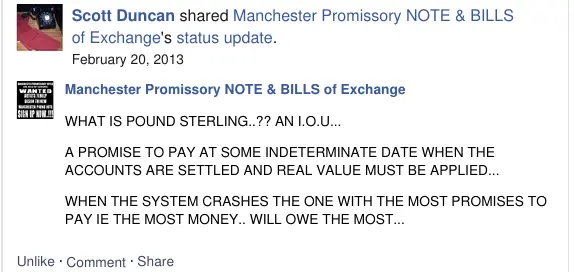
A PROMISE TO PAY AT SOME INDETERMINATE DATE WHEN THE ACCOUNTS ARE SETTLED AND REAL VALUE MUST BE APPLIED...
WHEN THE SYSTEM CRASHES THE ONE WITH THE MOST PROMISES TO PAY IE THE MOST MONEY.. WILL OWE THE MOST...
Printed copy · Anthology Volume 4, page 429Printed copy from The Tender For Law Anthology, Volume 4, page 429 (printed 13 June 2014). Added by this site; not part of the Facebook export.Filter by poster
Read Comments 29
Eamonn O Brien
I dunno if you've seen a EURO note, it only has one signature, it does not say anywhere that it is LEGAL TENDER and it doesn't state that it must be returned to the bearer upon request...
Monopoly money more or less...
Printed copy · Anthology Volume 4, page 429 · cut by a page breakPrinted copy from The Tender For Law Anthology, Volume 4, page 429 (printed 13 June 2014). Added by this site; not part of the Facebook export. A page break in the printout cut off the beginning of this comment, with its name.
Scott Duncan
The EURO is an internal process coupon. The tender was accepted if you are part of the EU.
We have something similar here. It's called "Canadian Tire Money".
Printed copy · Anthology Volume 4, page 430Printed copy from The Tender For Law Anthology, Volume 4, page 430 (printed 13 June 2014). Added by this site; not part of the Facebook export.
Scott Duncan
If you are in Canadian tire, that shit works just like cash.
...and they give you MORE when the transaction is complete!
I take that back, Canadian Tire money is BETTER than the EURO. :P
Printed copy · Anthology Volume 4, page 430Printed copy from The Tender For Law Anthology, Volume 4, page 430 (printed 13 June 2014). Added by this site; not part of the Facebook export.
Eamonn O Brien
So by identifying as a RESIDENT of a STATE within the EU and using the currency within the UNION, we accept the ACT/STATUTE that relates to the country joining the UNION?
Printed copy · Anthology Volume 4, page 430Printed copy from The Tender For Law Anthology, Volume 4, page 430 (printed 13 June 2014). Added by this site; not part of the Facebook export.
Scott Duncan
Pretty much, yes.
Printed copy · Anthology Volume 4, page 430Printed copy from The Tender For Law Anthology, Volume 4, page 430 (printed 13 June 2014). Added by this site; not part of the Facebook export.
Eamonn O Brien
As opposed to our original CENTRAL BANK ACT from early 1900's?
Printed copy · Anthology Volume 4, page 430Printed copy from The Tender For Law Anthology, Volume 4, page 430 (printed 13 June 2014). Added by this site; not part of the Facebook export.
Scott Duncan
Actually I doubt it could be MORE opposed. It's the EXACT OPPOSITE :D
Printed copy · Anthology Volume 4, page 430Printed copy from The Tender For Law Anthology, Volume 4, page 430 (printed 13 June 2014). Added by this site; not part of the Facebook export.
Scott Duncan
With central banks you KNOW who the trustee is...No clue who the trustee for the EURO is.
Printed copy · Anthology Volume 4, page 430Printed copy from The Tender For Law Anthology, Volume 4, page 430 (printed 13 June 2014). Added by this site; not part of the Facebook export.
Scott Duncan
Even Canadian Tire money is pretty obvious from a trustee standpoint. :D
Printed copy · Anthology Volume 4, page 430Printed copy from The Tender For Law Anthology, Volume 4, page 430 (printed 13 June 2014). Added by this site; not part of the Facebook export.
Eamonn O Brien
Now I'm tryin to figure out a central bank's trustee :p
Scott Duncan
Well it's supposed to be the Grantor/Law mechanism. Looks great on paper, but forgets people are assholes.
Printed copy · Anthology Volume 4, page 430Printed copy from The Tender For Law Anthology, Volume 4, page 430 (printed 13 June 2014). Added by this site; not part of the Facebook export.
Eamonn O Brien
So the creator of the CENTRAL BANK ACT would be the SURETY/TRUSTEE... But with regards to the EU being so expansive the liability is a bit "shifty"
Printed copy · Anthology Volume 4, page 431Printed copy from The Tender For Law Anthology, Volume 4, page 431 (printed 13 June 2014). Added by this site; not part of the Facebook export.
Scott Duncan
Those roles ONLY EXIST AFTER the GRANTOR has ratified the LAW behind it (perfected). You won't find the trustees you are looking for, because they don't exist.
Printed copy · Anthology Volume 4, page 431Printed copy from The Tender For Law Anthology, Volume 4, page 431 (printed 13 June 2014). Added by this site; not part of the Facebook export.
Eamonn O Brien
LAWS are ratified by the HEAD OF STATE in Ireland, or THE PRESIDENT as people refer to him/her... So he/she would be grantor, the bank then is established and prints the national currency etc...
Printed copy · Anthology Volume 4, page 431Printed copy from The Tender For Law Anthology, Volume 4, page 431 (printed 13 June 2014). Added by this site; not part of the Facebook export.
Scott Duncan
That is SUPPOSED to be the "Will of the people". They just don't say WHICH people. ;)
Printed copy · Anthology Volume 4, page 431Printed copy from The Tender For Law Anthology, Volume 4, page 431 (printed 13 June 2014). Added by this site; not part of the Facebook export.
Eamonn O Brien
Well the currency was obviously abandoned in 2002 and since then we're trying to pass go :p
Printed copy · Anthology Volume 4, page 431Printed copy from The Tender For Law Anthology, Volume 4, page 431 (printed 13 June 2014). Added by this site; not part of the Facebook export.
Scott Duncan
YUP!
You may now consider yourself "up to speed". :D
Printed copy · Anthology Volume 4, page 431Printed copy from The Tender For Law Anthology, Volume 4, page 431 (printed 13 June 2014). Added by this site; not part of the Facebook export.
Eamonn O Brien
I'm not even close! :) Getting there though... Slow and steady wins the race...
Printed copy · Anthology Volume 4, page 431Printed copy from The Tender For Law Anthology, Volume 4, page 431 (printed 13 June 2014). Added by this site; not part of the Facebook export.
Eamonn O Brien
I'll have a quick read of the ACT relating to IRELAND'S entry to the EU. See what shite it contains...
Printed copy · Anthology Volume 4, page 431Printed copy from The Tender For Law Anthology, Volume 4, page 431 (printed 13 June 2014). Added by this site; not part of the Facebook export.
Fiona Munro
The gold standard began (unofficially) with the introduction of the Guinea in the 17th century..... The guinea under valued gold vs silver... when compared to the pound, which lead to english merchants buying things with silver,.. and selling things for gold... The result was that England was more or less on a gold standard pretty early.
Shortages in gold and silver caused by them being the basis of currency, meant that at many times, tokens were used instead of silver coins..... and the issuing of bank notes.
The gold standard was good, because it meant you could directly compare the value of currencies. It was bad, because it meant countries needed to keep a strategic reserve of gold to make sure they could "honour" their currency.
During the depression, there simply wasn't enough gold to honour the gold standard, and a flat exchange of 1pound to 4 - 5 USD was set up.... In 1949 it was devalued, and all through the 60s, there was pressure that the pound was... "too high" vs the USD. In 1971 the pound floated against the USD which ended a lot of weird inter-currency issues......;)
Officially the pound (and any first world currency) no longer has a fixed promissary value for a resource.
Printed copy · Anthology Volume 4, page 431Printed copy from The Tender For Law Anthology, Volume 4, page 431 (printed 13 June 2014). Added by this site; not part of the Facebook export.
Scott Duncan
You can get a 10 TRILLION DOLLAR bill in Zimbabwe.
Printed copy · Anthology Volume 4, page 432Printed copy from The Tender For Law Anthology, Volume 4, page 432 (printed 13 June 2014). Added by this site; not part of the Facebook export.
Printed copy · Anthology Volume 4, page 432Printed copy from The Tender For Law Anthology, Volume 4, page 432 (printed 13 June 2014). Added by this site; not part of the Facebook export.
Derek Moran
i bought this book last summer, published 1921, explains the purpose for Bills of Exchange were so you didnt have to sail your GOLD across the sea and risk having your BOAT(Scott loves that word) sink, and more convenient than lugging around your GOLD-bars(i suspect safer, too)..
http://books.google.ca/books/about/Promissory_Notes_Bills_of_Exchange_Chequ.html?id=dijVMwEACAAJ&redir_esc=y
Printed copy · Anthology Volume 4, page 432Printed copy from The Tender For Law Anthology, Volume 4, page 432 (printed 13 June 2014). Added by this site; not part of the Facebook export.
Printed copy · Anthology Volume 4, page 432Printed copy from The Tender For Law Anthology, Volume 4, page 432 (printed 13 June 2014). Added by this site; not part of the Facebook export.
Derek Moran
Maximus Legis: We have notes issued by several Banks already. Bank of Scotland, Royal Bank of Scotland and Clydesdale Bank. The real question is would an independent Scotland control it's own money supply and the answer is, WOULD IT FUCK !! As the Chinese say "Meet The New Boss, Same as The Old Boss"
Printed copy · Anthology Volume 4, page 432Printed copy from The Tender For Law Anthology, Volume 4, page 432 (printed 13 June 2014). Added by this site; not part of the Facebook export.
Derek Moran
Scott Duncan: You kids need to learn to make your own...except you'll VERY quickly discover...you have no value.
Printed copy · Anthology Volume 4, page 433Printed copy from The Tender For Law Anthology, Volume 4, page 433 (printed 13 June 2014). Added by this site; not part of the Facebook export.
Derek Moran
Scott Duncan: Money don't lie
Printed copy · Anthology Volume 4, page 433Printed copy from The Tender For Law Anthology, Volume 4, page 433 (printed 13 June 2014). Added by this site; not part of the Facebook export.
Pete Daoust
:D
Printed copy · Anthology Volume 4, page 433Printed copy from The Tender For Law Anthology, Volume 4, page 433 (printed 13 June 2014). Added by this site; not part of the Facebook export.
Pete Daoust
:P
Printed copy · Anthology Volume 4, page 433Printed copy from The Tender For Law Anthology, Volume 4, page 433 (printed 13 June 2014). Added by this site; not part of the Facebook export.
Filter by poster
Read Comments 29
Eamonn O Brien
Printed copy · Anthology Volume 4, page 429 · cut by a page break
Scott Duncan
Printed copy · Anthology Volume 4, page 430
Scott Duncan
Printed copy · Anthology Volume 4, page 430
Eamonn O Brien
Printed copy · Anthology Volume 4, page 430
Scott Duncan
Printed copy · Anthology Volume 4, page 430
Eamonn O Brien
Printed copy · Anthology Volume 4, page 430
Scott Duncan
Printed copy · Anthology Volume 4, page 430
Scott Duncan
Printed copy · Anthology Volume 4, page 430
Scott Duncan
Printed copy · Anthology Volume 4, page 430
Eamonn O Brien
Scott Duncan
Printed copy · Anthology Volume 4, page 430
Eamonn O Brien
Printed copy · Anthology Volume 4, page 431
Scott Duncan
Printed copy · Anthology Volume 4, page 431
Eamonn O Brien
Printed copy · Anthology Volume 4, page 431
Scott Duncan
Printed copy · Anthology Volume 4, page 431
Eamonn O Brien
Printed copy · Anthology Volume 4, page 431
Scott Duncan
Printed copy · Anthology Volume 4, page 431
Eamonn O Brien
Printed copy · Anthology Volume 4, page 431
Eamonn O Brien
Printed copy · Anthology Volume 4, page 431
Fiona Munro
Printed copy · Anthology Volume 4, page 431
Scott Duncan
Printed copy · Anthology Volume 4, page 432
Eamonn O Brien
Printed copy · Anthology Volume 4, page 432
Derek Moran
Printed copy · Anthology Volume 4, page 432
Derek Moran
Printed copy · Anthology Volume 4, page 432
Derek Moran
Printed copy · Anthology Volume 4, page 432
Derek Moran
Printed copy · Anthology Volume 4, page 433
Derek Moran
Printed copy · Anthology Volume 4, page 433
Pete Daoust
Printed copy · Anthology Volume 4, page 433
Pete Daoust
Printed copy · Anthology Volume 4, page 433