Weiss's Concise Trustee Handbook
NACRS, 2005–2008 · 77 pages, with sample forms
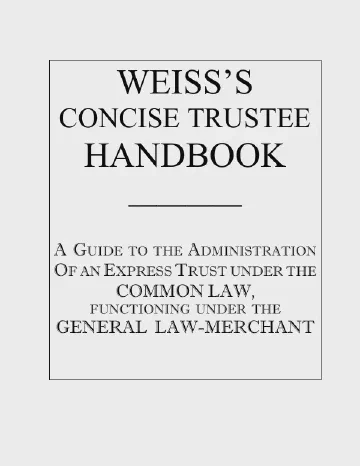
A handbook for the trustee of an express trust: the declaration of trust, the trust corpus and its certificates, the trustee's powers, duties and liabilities, banking, transferring assets, keeping minutes, legal affairs and the I.R.S., with sample forms.
Weiss’s Concise Trustee Handbook, by Carlton Weiss, is a guide for the trustee of an express trust, which it describes as created under the original American common law and working within the general law-merchant. It sets out to give “clearly outlined methods and sample forms” for running the trust’s affairs.
It opens with trust basics: a trust as property held by a trustee at the request of a settlor for the benefit of a beneficiary, and the express trust as one stated fully in words rather than inferred from conduct. It then covers the declaration of trust, the trust corpus, and the certificates of beneficial and capital interest the trustees may issue. The trustee’s powers, duties, privileges and liabilities follow, with authorised representatives, and a comparison of the express trust with the corporation and other bodies that owe their existence to statute.
The second half is practical: commerce and doing business, limiting liability and risk, banking, transferring assets, issuing certificates and bonds, keeping minutes, legal actions for and against the trust, and dealing with the I.R.S. Its conclusion is that the way to thrive is to “own nothing and control everything.” The last thirty pages are sample forms, from an asset sale agreement and assignments to an attorney retainer agreement.
Carlton Weiss also wrote Those Who Mistrust, an article on the mistake of missing the point about express trusts.
Copyright
In copyright. The handbook's licence is its own notice, on its copyright page: "Copyright © 2005-8 by NACRS. All Rights Reserved. For private educational use only." It is shared here on those terms, for education, free and not for profit.
- Held by
- NACRS, as the handbook names it. The handbook names its author only as Weiss: Carlton Weiss.
- Public domain in the United States
- 1 January 2104 if NACRS is the author or the work is anonymous (95 years after publication in 2008); otherwise 70 years after the author's death
- Public domain in Canada
- If the author stays unknown, 1 January after the 75th anniversary of publication (2084); otherwise 70 years after the author's death
The dates are worked out from the publication dates and the authors' deaths. In the United States a book published before 1978 is protected for 95 years after publication, and a later one for 70 years after its author's death; in Canada a book is protected for 70 years after its author's death. Protection runs to the end of the year, so a book enters the public domain on 1 January.