The Life of Apollonius of Tyana
c. 220–238 · translated by F. C. Conybeare · Loeb Classical Library, 1912, both volumes in one PDF
Philostratus' life of Apollonius of Tyana, the first-century Pythagorean sage who travelled from Spain to India, advised Vespasian and stood trial before Domitian. Greek and English, with the Epistles of Apollonius and Eusebius' reply to Hierocles.
My ideal is for each to do what he knows and what he can.
— Apollonius of Tyana, to the people of Smyrna: Book IV, chapter 8. Conybeare gives it, on page 361, as “to me it seems best that each man should do what he understands best and what he best can do.”
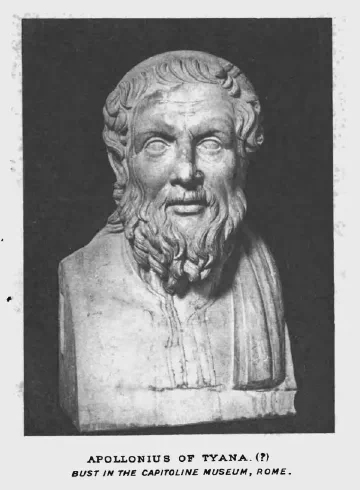
Philostratus wrote this life of Apollonius in the early third century, at the request of the empress Julia Domna, wife of Septimius Severus. F. C. Conybeare (1856–1924), an Oxford scholar of early Christianity and Armenian, translated it for the Loeb Classical Library in 1912, with the Greek on the facing pages. This copy, from the Internet Archive, joins both Loeb volumes in one searchable PDF of 1,252 pages. It also has the Epistles attributed to Apollonius and Eusebius’ treatise against Hierocles, the governor who had set Apollonius beside Christ. The translation is in the public domain. The cover is the book’s frontispiece, a bust in the Capitoline Museum that the editors themselves label Apollonius with a question mark.
The life of Apollonius
Almost everything told of Apollonius comes from this one book, written more than a century after his death by an author who wanted a hero. Philostratus says he worked from the memoirs of Damis of Nineveh, Apollonius’ companion on his travels, which Julia Domna had been given. He also names an account of Apollonius’ youth by Maximus of Aegae, letters and a will by Apollonius himself, and the stories still told in the cities he visited. He sets aside a hostile four-book life by one Moeragenes. No one but Philostratus ever saw the memoirs of Damis, and many historians doubt that they existed. What follows is the life as Philostratus tells it. Where it can be checked, the outline fits the first century: the emperors, the governors and the cities are real, and the dates hang together. The wonders are another matter, and the reader must judge them.
Birth and youth
Apollonius was born at Tyana, a Greek city in Cappadocia, in what is now central Turkey, around the beginning of the Christian era. His family was old and rich. Philostratus surrounds the birth with omens: before it, an Egyptian god, Proteus, appeared to his mother and told her that the child would be the god himself. She gave birth in a meadow where swans gathered and sang around her, and a thunderbolt fell to the ground and rose back into the sky.
At fourteen he was sent to Tarsus to study rhetoric under Euthydemus of Phoenicia. He disliked the city’s luxury and idle talk, and moved with his teacher to Aegae on the coast, where there was a temple of Asclepius. There he heard the teachers of every school, Platonists, Stoics, Peripatetics and Epicureans, and chose Pythagoras. His teacher in it, Euxenus of Heraclea, repeated the doctrine without living it, so at sixteen Apollonius took it up on his own. He gave up meat and wine and wore only linen, nothing made from animals. He went barefoot, let his hair grow, and lived in the temple, where the sick came to him as much as to the god. He stayed unmarried and chaste all his life.
When his father died, he gave most of his share of the estate to his elder brother, whom he talked out of drink and debauchery, and the rest to poorer relatives, keeping very little. He then kept the Pythagorean silence for five years. He travelled through Pamphylia and Cilicia without speaking, and Philostratus says he calmed riots by gesture and look alone.
The journey to India
After the silence he set out for India, to learn from the Brahmans. At Nineveh he met Damis, who became his disciple and companion for the rest of his life. In Babylon he refused to bow to the king’s image. He stayed at the court of the Parthian king Vardanes for a year and eight months, advising him on justice and kingship, and declined almost every gift.
Crossing the Hindu Kush, they reached Taxila, in what is now Pakistan, where King Phraotes received them as a fellow philosopher. He sent them on to the sages, who lived in a fortified hill. Apollonius stayed with them for four months, in conversation with their leader, Iarchas. Philostratus fills these chapters with talk of the soul’s past lives, of the world as a living creature, and with marvels: the sages float in the air and know a stranger’s name and history before he speaks. Apollonius came back, he says, wiser than he went.
Teacher of the cities
Back in the Greek world, Apollonius taught in the cities of Asia Minor and Greece, reforming their temples and their morals. At Ephesus, struck by plague, he picked out a ragged old beggar as the demon of the plague and had the crowd stone him. When the stones were cleared, the body underneath was a huge hound, and the plague ended. At Troy he spent a night at the tomb of Achilles and said he had spoken with the hero’s ghost. At Athens the hierophant of the Eleusinian mysteries refused to initiate him, calling him a wizard. At Corinth he unmasked the bride of his pupil Menippus as a lamia, a spirit that fed on young men. Under his questioning, Philostratus says, her house and its gold vanished like a dream.
Nero, Vespasian and Titus
He reached Rome under Nero, who had banned philosophers from the city. Tigellinus, commander of the Praetorian Guard, had him watched and charged. At the hearing, the writing on the charge sheet was found to have vanished from the page, and he was let go. In Rome he is also said to have raised a young bride of consular family who had died on her wedding day. Philostratus allows that a spark of life may have remained in her. He then left for Spain and the Atlantic at Gades (Cádiz), passed through Sicily and Greece, and came to Egypt.
At Alexandria, in 69, he met Vespasian, who was then making his bid for the empire and asked his advice. The scene is a debate. The Stoic Euphrates and the orator Dio Chrysostom urge Vespasian to restore the republic. Apollonius advises a good monarchy, ruled by law and justice. Euphrates became his enemy for life. Apollonius went on up the Nile to the “naked sages” of Ethiopia, whom he judged inferior to the Indians. Titus, after the fall of Jerusalem, met him at Argos and asked for his counsel. Apollonius warned him, Philostratus says, to beware his own family, a hint at his brother Domitian.
Domitian
Under Domitian, Apollonius spoke openly against tyranny and was accused of conspiring with Nerva, the emperor to come, and of sacrificing a child to read the future. Rather than hide, he sailed to Rome to face the charge. Domitian had his hair and beard shorn and put him in irons. In prison he showed Damis that he could slip his leg out of the fetters at will, and put it back in. At the trial Domitian found nothing on which to convict him and acquitted him, but held him in Rome. Apollonius replied with a line from Homer: the emperor could not kill him, since he was not mortal. Then he vanished from the court. The same afternoon he appeared to Damis and his friend Demetrius at Dicaearchia (Puteoli), far down the coast. Philostratus also gives the long defence Apollonius had prepared and never delivered, a statement of his whole philosophy.
In September 96, lecturing in a grove at Ephesus, he broke off, looked as if he saw something far away, and cried out “Strike the tyrant, strike!” At that moment, it was later learned, Domitian was being stabbed to death in his palace in Rome. Nerva, the new emperor, invited him to court. Apollonius answered by letter and sent Damis in his place.
Death, or no death
Philostratus does not know how he died, and gives three stories. One says he died at Ephesus, attended by two maidservants. Another says he entered the temple of Athena at Lindos, on Rhodes, and disappeared. The third says that in Crete he entered the temple of Dictynna by night, past fierce guard dogs that fawned on him, and was heard to rise into the sky while maidens sang “Go up to heaven.” He would have been very old, by some accounts nearly a hundred. Philostratus adds that afterwards, at Tyana, he appeared in a dream to a young man who doubted that the soul is immortal, and reassured him. No tomb of his was ever found.
Afterwards
His fame outlived him. The emperor Caracalla, Julia Domna’s son, built him a shrine at Tyana. A later biography of Severus Alexander claims the emperor kept his image in his private chapel beside Abraham, Orpheus and Christ. The same collection of lives says Aurelian spared Tyana in 272 after Apollonius appeared to him in a vision. Around 303, Hierocles, a governor and one of the advisers behind Diocletian’s persecution, wrote that Apollonius had done everything Jesus did and was thought no more than a good man. Eusebius of Caesarea answered him, arguing that Philostratus was unreliable and Apollonius a sorcerer at best. That reply is printed in this volume. The comparison with Christ followed the book through the Enlightenment, when the English deist Charles Blount, who translated its first two books in 1680, used it against the Church.
Read as history, the Life tells little that can be relied on beyond the outline. Read as Philostratus meant it, it is a portrait of the wise man as he should be: free of appetite and fear, at home in every country, owing nothing to kings and telling them the truth to their faces.