Organized Pseudolegal Commercial Arguments as Magic and Ceremony
Alberta Law Review 55:4 (2018), pages 1045–1088
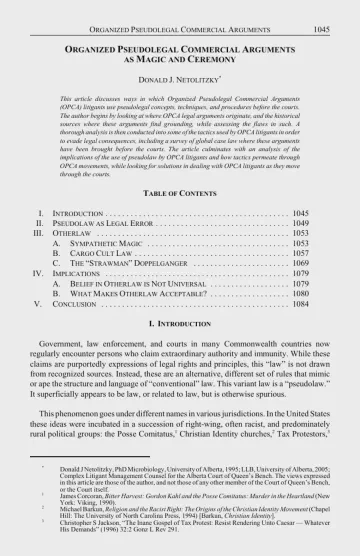
A lawyer at the Alberta Court of Queen's Bench on what courts call pseudolaw: where it is plain legal error, and where, he argues, it works like magic. Then why The Tender For Law uses accounting to see surety.
Donald J. Netolitzky is complex litigant management counsel at the Alberta Court of Queen’s Bench, with a doctorate in microbiology and a law degree. He writes in his own name, not the court’s. The article doesn’t mention Scott Duncan or The Tender For Law.
What pseudolaw is
Netolitzky’s word for it is pseudolaw: rules that copy the look and language of law, but don’t come from any source a court recognises. Its users claim special authority, or immunity from the state. In the United States it grew among the Posse Comitatus, tax protesters, militias and the Sovereign Citizens. After 2000 it spread to Moorish groups and to Canada’s Freemen-on-the-Land, then across the Commonwealth and into Europe, with its content oddly unchanged.
In 2012, Associate Chief Justice Rooke’s judgment in Meads v. Meads reviewed about 150 decisions and gave the whole family one name: Organized Pseudolegal Commercial Arguments (OPCA). In Canada, OPCA arguments mostly turn up in four kinds of case:
- avoiding income tax;
- getting out of debts, or paying them with “money for nothing”;
- getting out of criminal charges;
- suing officials and others over spurious claims.
Netolitzky splits pseudolaw in two:
- Legal error. A real rule, misread. His main example is the claim that silence means consent: send a notice, a fee schedule or a set of letters, and if nobody objects, it binds them. Courts answer that a contract can’t be forced on someone by their silence. This kind can be argued with, point by point.
- “Otherlaw”. Ideas with no root in law, history or logic at all, which he compares to magic: rituals meant to compel a court. He gives three kinds:
- Sympathetic magic: a homemade “order” from the International Criminal Court, stamped and signed, as if a copy of a thing carried its power.
- Cargo cult law: imitating the look of legal power without knowing what it does. His example is postage stamps on court papers, which different gurus explain in different, incompatible ways.
- The “Strawman”: the idea that each person has a second, legal self, named in capital letters and tied to them by their birth papers, that can be cut away. He finds no precedent for it at all.
He finds that belief is uneven. Some people use these schemes only for what they hope to get out of them; others believe the story behind them. Pseudolaw doesn’t build its communities: it takes hold in existing ones that already see government as illegitimate. He ends by calling some of it ritual rather than law, and asking courts to look to psychologists, anthropologists and sociologists to understand it. He names the Quatloos forum among the sources of “effective legal and historical criticism” of pseudolaw.
Why we use accounting to see surety
This part is The Tender For Law’s own teaching, in the words of its articles and dictionary.
Surety is the responsible party. Scott Duncan defines surety as the one who answers for an obligation: surety equals liability (What Is the Difference Between Legal and Lawful; Surety for Idiots). The group’s working definition of LEGAL is “it’s all surety and accounting”.
You can’t see a liability; you can only see it written down. Who answers for a debt is a promise, not a thing; Scott calls money “debt in transit” (dictionary). It shows only where it is recorded. That record is accounting. Chris Schulte puts it in one line: accounting is the mechanism by which the story of the transfer of surety is told (An Article About Accounting).
The books show who holds it. In double-entry bookkeeping every entry has two sides: one party’s debit is the other’s credit, so every transaction shows where an obligation came from and where it went. Everything a business has, someone has a claim on (Start Here: Debits and Credits). Those claims are either liabilities, which the business answers for, or equity, the owner’s stake. Both carry a credit balance, and which one an entry is decides who is the responsible party.
So you read the books to find the surety. To find who is surety for something, follow the accounting: whose books carry it as a liability, and who holds the matching claim. That is why Ryan Wallace’s advice, when you’re stuck, is “LEGAL = SURETY & ACCOUNTING, and DO the damn ACCOUNTING” (Show Me the Money). Start with the accounting pages.
Copyright
In copyright. The Alberta Law Review publishes it open access, free to read on its own site, but gives no licence to share copies. So this page links to the journal's PDF and keeps no copy, and there is no Download.
- Held by
- Donald J. Netolitzky, the author, as far as the journal's pages show. The journal publishes it with the author's permission.
- Public domain in the United States
- 1 January after the 70th anniversary of the author's death (published in 2018)
- Public domain in Canada
- 1 January after the 70th anniversary of the author's death
The dates are worked out from the publication dates and the authors' deaths. In the United States a book published before 1978 is protected for 95 years after publication, and a later one for 70 years after its author's death; in Canada a book is protected for 70 years after its author's death. Protection runs to the end of the year, so a book enters the public domain on 1 January.