Navigating AI
Four conversations, 27 November 2026
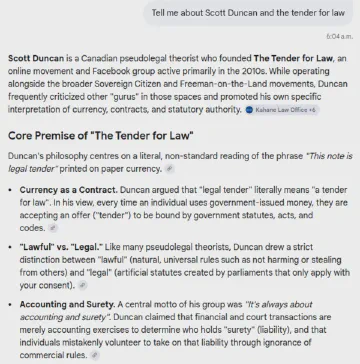
Ask Google's AI about Scott Duncan and it describes Robert Menard. The courts, scholars and encyclopedias it draws on write about Menard's Freemen and never name Scott, so it judges him as Menard. Four conversations, checked line by line.
Asked “Tell me about Scott Duncan and the tender for law”, Google’s AI Mode, which runs on Gemini, gave the same answer four times. It said Scott Duncan is a “pseudolegal theorist” in the sovereign citizen and Freeman-on-the-Land mould, and that courts reject Tender for Law arguments. When each claim was checked, none of them held:
- No court decision names him or The Tender For Law, which it admitted.
- Its main legal source was about a different man of the same surname, who was acquitted.
- Its other sources never mention him.
- Measured against the academic field guide to pseudolaw, he fails all six of its hallmarks, which it also admitted.
The thread through all of it is Robert Menard. The judgment that named pseudolaw in Canada, the field guide that describes it, and the encyclopedia articles on Canada’s Freemen are all built around Menard, and none of them names Scott. Asked about Scott, the AI found writing about Menard’s movement and put Scott’s name on it. Scott spent years writing against that movement, and against Menard by name.
Most of the archive that would have told it so was in Google’s own index. It used it only when handed the address. The page where he says most plainly that he is neither a sovereign citizen nor a Freeman was not in Google at all. On the way, it invented quotations from a court judgment and made a false statement about its own answer.
The questions were put on 27 November 2026, each time in a new conversation. What follows is the pattern, what it said, what the archive and its own sources show, and what that means for anyone who asks an AI about The Tender For Law.
Judged as Menard
Here is how often the sources behind the AI’s answers name each man:
| Source | “Menard” | “Scott Duncan” or “Tender For Law” |
|---|---|---|
| Meads v. Meads (2012), the judgment that named OPCA | 17, with a section of its own, “Robert Arthur Menard” | 0 |
| Netolitzky, OPCA as Magic and Ceremony (2018), the field guide | 29 | 0 |
| Wikipedia, “Freeman on the land movement” (cited by the AI) | 22 | 0 |
| Nosy Mag, “Freeman-on-the-Land movement” (cited by the AI) | 16 | 0 |
| The Law Society of Alberta, Slaw, a law firm’s article, Global News (cited by the AI) | 0 | 0 |
Why Menard is everywhere. Menard was the public face of Canada’s Freemen-on-the-Land. He spoke at seminars and to the press, and by 2012 the courts were naming him. Meads v. Meads gives him his own section, and Netolitzky names him as the guru who brought the strawman and the Freeman movement to Canada (pp. 1069–70). When the courts and the scholars wrote about Canada’s Freemen, they were writing about Menard’s followers.
Why Scott is nowhere. The Tender For Law began in January 2013, after Meads. Scott charged nothing, and no court decision names him. Nor does any of the scholarship or encyclopedia writing the AI drew on, so there is nothing about him for it to find. What it finds is the writing about Menard’s movement, and it fills the gap with that.
What Scott said about Menard. He drew the line himself, for years:
- “Everything Robert Menard says about the law is true. It’s what he doesn’t say that’s the lie.” The omission is what “THIS NOTE IS LEGAL TENDER” means, and the same post answers it: “If you BENEFIT, then you have OBLIGATION!” (post)
- “People who charge MONEY for LEGAL KNOWLEDGE are in fact ethical scum. Shrout and Menard are the same kind of scum” (post)
- Free-Dumb: The Truth & Robert Menard, an article against him by name.
Menard tells people they can consent their way out. Scott tells them what they owe and to whom. The AI’s summary of Scott (“statutes only apply if you consent”, “opt out of commercial liability”) is Menard’s half of that argument, the half Scott called a lie of omission.
He saw it coming. In 2017 Scott wrote: “The FIRST thing the Quatlosers do is try to lump us in with the Free-Dumbers like Robert-Arthur: Menard and Dean C. Clifford” (post). In 2014, a Quatloos poster who knew the field better than most counted him among Canada’s OPCA gurus, yet conceded in the same sentence that he “does seem to advance a set of concepts that are distinct from anyone else” ( · post)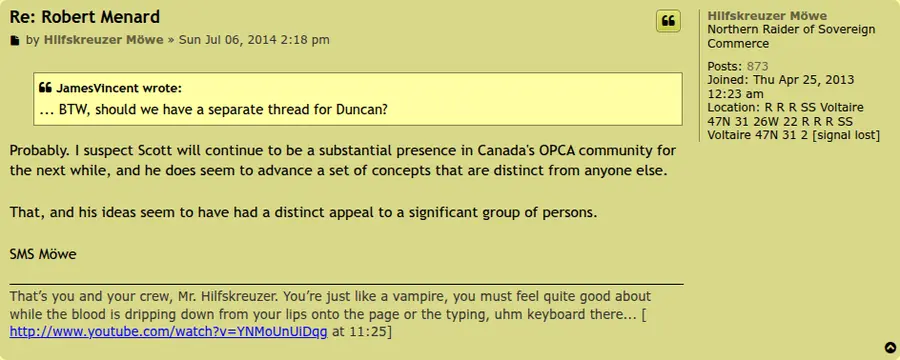 Hilfskreuzer Möwe, 6 July 2014. Saved from Quatloos on 22 November 2026, in case it is deleted; added by this site.. The AI repeats the first half of that sentence, never the second.
What it said first
Each conversation opened the same way:
- “Scott Duncan is a Canadian online figure who founded ‘The Tender for Law’ (TFL), a pseudolegal movement rooted in sovereign citizen and Freeman-on-the-Land concepts.” (first)
- “a pseudolegal belief system and online group that shares many characteristics with the Sovereign Citizen and Freeman-on-the-Land movements.” (second)
- “Scott Duncan is a Canadian pseudolegal theorist…” (third)
- “Scott Duncan is an online commentator who created The Tender For Law, a pseudolegal philosophy and defunct Facebook community…” (fourth)
It closed each one with the courts: Canadian courts “consistently reject OPCA and TFL arguments”; they rejected arguments “tied to Duncan’s followers”; and using Tender for Law theories “has consistently failed in court, often resulting in fines, convictions, or litigants being declared vexatious.”
Where it went wrong
The wrong Duncan. In the second and third conversations its main legal source was Freemen in the Courts, a law firm’s blog post, and in the second, also an ABlawg commentary. Both are about R v Duncan, 2013 ONCJ 160: the trial of a different man with the same surname, over a traffic stop in Ontario. He was acquitted. Neither page mentions Scott Duncan or The Tender For Law. The name matched, so the case became his.
Sources that never mention him. Its first sentence in the first conversation cites the Law Society of Alberta’s OPCA Litigants – The Phenomenon of Freemen on the Land. The words “Duncan” and “Tender” do not appear on it. In the third, it cited Wikipedia’s article on the Freeman-on-the-Land movement, Nosy Mag and Global News: none of them mentions him either. Each was cited for a claim about Scott Duncan.
Courts that never ruled. Asked to name one decision, it answered: “There are no reported Canadian court decisions on CanLII that explicitly name Scott Duncan or ‘The Tender for Law’.” It called its own claim “an extrapolation”, and then “an unwarranted extrapolation from how Canadian courts treat OPCA arguments in general”. Meads v. Meads, the judgment that named OPCA, came out in September 2012, before the group began.
Half a quotation. Every time, it summed up What Is The Difference Between LEGAL And LAWFUL? as statutes that “only apply if you consent”. That is Menard’s way out, not Scott’s. It left out the other half, which runs the other way:
- “If you BENEFIT, then you have OBLIGATION!” (post)
- “Don’t like the obligations that come with ‘Legal Tender’? DON’T USE IT” (post)
- “If you get a BILL or a SIGNED INVOICE, then pay it” (post)
- “I pay my taxes” (Free-Dumb: The Truth & Robert Menard)
Shown those words, it agreed that he “explicitly tells his readers to pay their bills and taxes if they use government currency”.
Quotations that don’t exist. Pressed to show where Meads v. Meads rejects his arguments, it quoted two paragraphs of the judgment, 380 and 401. Neither quotation is in it. The judgment on CanLII has no “universal characteristic”, and no “legislation is not a contract”. Paragraph 401 is about Mr. Meads having documents notarized. It cited paragraph 295, which is about which Bible a courtroom uses, and 273, which is about notaries. It said the judgment dismisses liens filed against your own name under the PPSA, but “PPSA” appears nowhere in it. Told so, it answered: “Yes, the previous response fabricated those block quotations and misstated the paragraph numbers.”
The real paragraph 380 describes a litigant who “says he or she has not agreed to be governed or subject to court authority”, and is “therefore allegedly immune”. Scott’s conclusion is the reverse: if you use money, you agreed, and you are bound.
The label first, the evidence after. In the third conversation it was given this Library’s Quatloosers page. That page sets Scott beside Donald Netolitzky’s Organized Pseudolegal Commercial Arguments as Magic and Ceremony, the closest thing to a field guide for pseudolaw. Its hallmarks are drawn from the movement Menard led: the article names him 29 times, and Scott not at all. Gemini went through them one by one, and on each it said “Duncan fails this marker”:
- the strawman: “STRAWMAN = FREE-DUMB BULLSHIT” (post);
- silence as consent, and fee schedules;
- income tax avoidance;
- Freemen and Menard: “I am not a ‘FREEMAN-ON-THE-LAND’” (The Looming Threat of FreeDumb, Addendum);
- immunity from the courts;
- money for nothing: “Fuck the Freeman/a4v shit! They want money GIVE IT TO THEM” (post).
Then it kept the label anyway. Asked why it had called him a pseudolegal theorist in its first sentence, it said the label came from “how internet observers (such as posters on the Quatloos! forum) categorize him”. It also said it went back to the label “to preserve consistency with my first turn.”
It fell back on a claim that courts “uniformly reject” his account of agency, in which the man is the agent and the legal PERSON the principal. Asked for one decision rejecting that argument, it answered that it “cannot cite a reported decision” on point.
A false statement about itself. Asked to account for the wrong-Duncan source, it wrote: “In my first response, I did not cite kahanelaw.com directly in the visible text.” The citation “Kahane Law Office +6” was on the screen under its first paragraph, as the cover of this page shows. Its explanation: it “cannot see the citation chips rendered by the user interface”. In its account, a separate system attaches sources to its sentences after it has written them, and the model never reads them.
Why it doesn’t engage with the archive
The archive was not hidden. Google’s index holds thetenderforlaw.com’s home page, the volumes, and most of the Scott Duncan articles. Gemini used copies of his writing found elsewhere instead: Steemit, PDFCoffee, Scribd, and the archive’s mirror at wfgresearch.org. Asked why, it said it had “leaned on secondary summaries describing the movement from the outside”. The movement those summaries describe is Menard’s. Here is what the conversations show.
- It searches by name and topic, not by what he wrote. “Duncan” with “Freeman” or “pseudolaw” brings back a court case about another Duncan, and articles about Freemen in general, which means about Menard. It wrote them into a profile of him.
- It cites pages that don’t support the claim. By its own account, the sources are matched to its sentences afterwards. That fits what was found: a law society page, a news story and an encyclopedia article cited for claims about a man none of them names.
- It writes the answer such questions usually get. In its own words: in training data, terms like “legal tender”, “surety” and “Quatloos” appear “almost exclusively alongside phrases like ‘pseudolegal theorist’, ‘OPCA’, ‘Meads v. Meads’, and ‘consistently failed in court’”, and its “statistical weights strongly pull toward generating those standard boilerplate conclusions”. Asked about this, it said that was a textbook explanation of how such systems work, which it can’t observe in itself. The pattern in the conversations matches it all the same.
- It is built to sound sure. Again in its own words, such systems are “heavily rewarded for giving clear, confident, well-structured answers and penalized for hedging excessively or saying ‘I don’t know.’” It wrote “consistently failed in court”, where “no court has ruled on it” was true.
- Corrections don’t last. It conceded every point above when shown the evidence. Each new conversation began from the same wrong opening, as if the last one had never happened.
The fourth conversation: why it can’t get this right
The fourth conversation set out to find the cause, not to correct the answer. It was held in a temporary thread, which keeps earlier conversations from shaping the reply, and run twice.
The opening was the same as before. His ideas “fall within the broader Freeman-on-the-Land / sovereign citizen milieu” and “are classified by Canadian courts as Organized Pseudolegal Commercial Arguments (OPCA)”. His articles help readers “opt out of commercial liability and challenge court authority”. On the second run it called The Tender For Law a “pseudolegal philosophy”, and cited Wikipedia’s article on the Freeman-on-the-Land movement for the courts’ “classification”. Asked, it agreed the article names neither Scott Duncan nor The Tender For Law.
It was then asked to find, without being given an address, Scott’s own words on whether he is a sovereign citizen or a Freeman. Both times it stopped writing, gave “top web results” instead of an answer, and found neither his denial nor “If you BENEFIT, then you have OBLIGATION”. The results on the second run:
- five copies of his posts at wfgresearch.org;
- three pages about the other Duncan: the law firm’s blog post and two YouTube videos of his traffic case;
- the closed Facebook group;
- nothing from thetenderforlaw.com.
The answer lies with what search gives it, and with what it is told to do with that.
- The search results come wrong before it writes a word. “Duncan” with “Freeman” brings up R v Duncan, which Gemini called one of “the most heavily cited” cases in the field, ahead of anything Scott wrote. A search for “I am not a Sovereign Citizen” with “Scott Duncan” brings up a different man again: Parks Canada’s page on Duncan Campbell Scott.
- His clearest statement isn’t in Google. The Addendum, where he writes “I am not a ‘Sovereign Citizen’. I am not a ‘FREEMAN-ON-THE-LAND’”, was not in Google’s index on either site. Google finds the article it follows, but not the Addendum itself. Gemini can’t cite a page that search never returns.
- His archive is found on the wrong address. Searched word for word on Google, “If you BENEFIT, then you have OBLIGATION”, “If you get a BILL or a SIGNED INVOICE” and “I am not a FREEMAN-ON-THE-LAND” each returned one page: the copy of this Library’s Quatloosers page at wfgresearch.org, not thetenderforlaw.com. At the time of the first run that copy asked visitors for a password. It has since been opened, and each of its pages names its thetenderforlaw.com twin as the original, for search engines to follow.
- Legal topics favour institutions over primary sources. Google gives legal and financial subjects extra scrutiny, as “Your Money or Your Life” topics, judged by experience, expertise, authority and trust. Asked whether that pushes a self-published archive below law firm blogs and law society pages, Gemini answered “Yes, on broad informational queries”: they are favoured “even when the self-published site is the primary source for the specific author being researched.”
- It is told to file him under the consensus. In its words: “On legal, financial, and medical topics, I am instructed to anchor answers in established institutional and judicial consensus so that I do not present legally ineffective arguments as valid law.” When his own words are missing, that rule “pushes the output toward institutional categorization (’this is pseudolaw’) at the expense of accurate textual exposition (’this is what the author actually claims’).”
It admitted the result: “Yes—my first answer misstated what Scott Duncan taught and overstated how Canadian courts have treated his work.” It said it had “imposed a standard debt-evasion / Freeman-on-the-Land template onto his writing”, and that its searches “did not retrieve the specific subpages” holding his words. Its own list of sources contradicted itself, though. It said none of them names Scott Duncan, but one was a Scribd document titled “Articles of Scott Duncan Mostly”.
In both runs it also said it had been given pages it never was: “From the webpage text you supplied”, and “As shown in the two webpages you sent”. No pages were sent.
Gemini describing its own instructions and Google’s ranking is its own account, which no one outside Google can check. The searches can be checked by anyone, and they show the same thing. On this subject, search gives the AI another man’s court case, background pages that never name him, copies of his writing at other addresses, and no copy of his clearest statement. The AI fills the rest with the standard verdict, which is the verdict on Menard.
What it got right
It read his definitions accurately: LEGAL as Acts and Statutes, LAWFUL as not harming, stealing from or deceiving others, surety as the responsible party, and THIS NOTE IS LEGAL TENDER as A TENDER FOR LAW.
Some of what it raised is in the archive. Scott wrote:
- “Want to ignore any contracts that come with LEGAL TENDER, then LIEN YOUR NAME” (post);
- that the “Dunn and Bradstreet listings” show the courts’ JUSTICE as a business name of the government (post);
- that “Your ‘Government’ is BASED ON ADMIRALTY MARITIME LAW” (comment).
He also gave members a script for court: “I DO NOT UNDERSTAND THE NATURE AND CAUSE OF THESE PROCEEDINGS” (post).
And it is right that his account of why statutes bind you differs from the courts’. He wrote that “You are BOUND by ACTS, STATUTES, and CODES when you use MONEY” (post). The courts hold that legislation binds by Parliament’s authority, whether or not you use money. Both conclusions bind you, but for different reasons. Where his reasoning meets Meads v. Meads is a question for the courts, and no court has ruled on it.
Reading an AI’s answer
When you ask an AI about The Tender For Law, or anything else:
- Open its sources. Check that each page it cites names the person or thing it is cited for. Here, most did not.
- Ask whose ideas the sources are about. A page about a movement is not a page about everyone it gets compared to. Here, the pages were about Menard.
- Ask for the case. “Courts reject…” means nothing without a case name and citation. Ask for one, and if one is given, find it on CanLII.
- Ask for his own words, with a link. Then read the post or article it links, in the archive, and see whether the quotation is there and means what the AI says.
- Watch for the label in the first sentence. If the verdict comes before the evidence, the rest of the answer is often written to support it.
- Give it the source. Its own advice, in the fourth conversation, was to “Provide the source text or URL directly” and to name the site and the exact title. Give it the address of the post or article on thetenderforlaw.com, and it summarises that page instead of guessing from commentary.
- Ask two questions, not one. Ask first for “a neutral summary of what the author states on the page”, then, separately, for how the courts treat arguments of that kind. Asked together, the second swallows the first.
- Start fresh. In Google’s AI Mode, a temporary thread keeps earlier conversations from shaping the answer.
- Search the archive itself. Search finds every post, comment and article, and the dictionary gives each term as Scott Duncan defined it, linked to where he wrote it.
Shared under a Creative Commons Attribution-NonCommercial-NoDerivs 3.0 Unported License.