Letters Patent Constituting the Office of Governor General and Commander-in-Chief of Canada, 1947
The Canada Gazette, Extra, Vol. 81, No. 12, Ottawa, 1 October 1947 · English and French, 5 pages
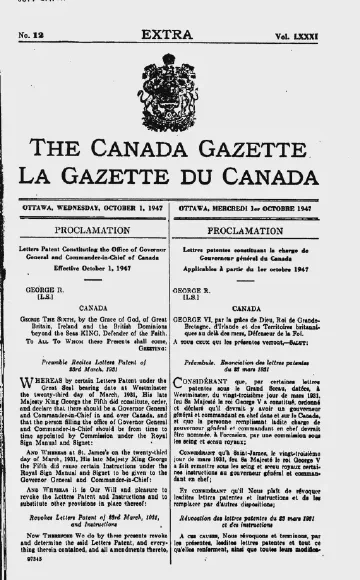
George VI revokes the Letters Patent of 1931 and "authorizes" the Governor General, on the advice of the Privy Council for Canada, to exercise all the powers and authorities lawfully belonging to the King in respect of Canada.
If you are TTFL alumni, you know the weasel words used to lie to you about your heritage, so we are displaying what a quick google search will tell you, along with some discerning notes.
These Letters Patent, “signed [where?] by King George VI on 8 September 1947 and countersigned [where?] by Prime Minister W. L. Mackenzie King”[This is what you were taught], took effect on 1 October 1947. They were published that day [the signatures?] in an extra edition of The Canada Gazette, in English and French side by side.
They revoke the Letters Patent of 23 March 1931 [we can’t find this document] and the Instructions given with them [we can’t read the instructions], and put new provisions in their place. In seventeen articles they:
- constitute the office of Governor General and Commander-in-Chief in and over Canada, filled by commission under the Great Seal of Canada (I);
- authorize the Governor General, with the advice of the Privy Council for Canada or any of its members, to exercise all powers and authorities lawfully belonging to the King in respect of Canada (II);
- give the Governor General the keeping of the Great Seal of Canada (III), and the power to appoint judges, commissioners, justices of the peace, officers and ministers (IV) and to suspend or remove office-holders (V);
- give the power to summon, prorogue or dissolve Parliament (VI), and to appoint deputies (VII);
- provide for an Administrator to act on the Governor General’s death, incapacity or absence;
- reserve to the King the power to revoke, alter or amend the Letters Patent (XV).
The Letters Patent, 1947 are still in force [where are the signatures], amended in 1988 and later, and are the instrument under which every Governor General since has held office.
You should go check out The Myth Is Canada if reading the above didn’t make you sick.
Copyright
Public domain in Canada. A Crown publication of the Government of Canada, published in 1947: Crown copyright lasts 50 years from publication, so it ended in 1997. This copy is the scan from Library and Archives Canada.
- Held by
- None (formerly the Crown in right of Canada)
- Public domain in the United States
- Public domain
- Public domain in Canada
- Public domain since 1 January 1998 (50 years after publication)
The dates are worked out from the publication dates and the authors' deaths. In the United States a book published before 1978 is protected for 95 years after publication, and a later one for 70 years after its author's death; in Canada a book is protected for 70 years after its author's death. Protection runs to the end of the year, so a book enters the public domain on 1 January.