Letter to René Lévesque
Spruce Grove, Alberta, 23 November 1976 · typed transcription, 3 pages
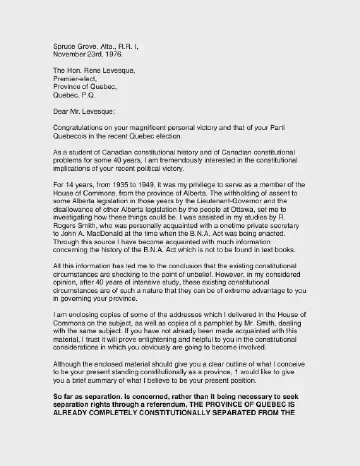
Writing to Quebec's premier-elect after the Parti Québécois victory, the former Alberta MP argues that Quebec, like every province, has been a sovereign state since the Statute of Westminster, 1931: "How can you be divorced if you have never been married?"
Walter Frederick Kuhl (1905–1991) was a teacher and the Member of Parliament for Jasper—Edson, Alberta, from 1935 to 1949.1 Two weeks after the Parti Québécois won the Quebec election of 15 November 1976, he wrote to its leader, René Lévesque, from Spruce Grove, Alberta.2
He tells Lévesque that he was helped in his forty years of study by R. Rogers Smith, the author of Ho, Canada!, and encloses his own House of Commons speeches and a pamphlet by Smith.2 His argument, in ten points, is that the British North America Act made Canada a united colony, not a federal union; that the Statute of Westminster of 11 December 1931 passed sovereignty to the people and, through them, to the provinces; and that, since the provinces have signed no federal union since and the people have ratified no constitution, Quebec has no need of a referendum to separate. Every province is already a sovereign state. He suggests a proper federal constitution instead, in which the provinces would keep the powers they need.
What we could and could not confirm
The copy here is a typed transcription, not a photograph of the signed letter, and we have found no archival original. The Myth is Canada says Lévesque went to Ottawa to ask Pierre Trudeau whether the letter was factual;3 we have found no record of that meeting, or of any reply from Lévesque. His papers at the Bibliothèque et Archives nationales du Québec would be the place to look.
The letter was also printed in Kuhl’s pamphlet Canada: A Country Without a Constitution, with a 1945 Commons speech on Smith’s theories. The Alberta Law Review traces how these were reprinted in 1998 as The Missing Key to Canada’s Future and taken up by “detaxers” as grounds to refuse income tax, and notes that courts have rebutted the argument, for example in Butterfield v LeBlanc, 2007 BCSC 235.4 The pamphlet, Canada: A Country Without a Constitution, is on The Myth is Canada.
The letter (a typed transcription), our copy, from The Myth is Canada. ↩︎ ↩︎
“Walter Kuhl Letter”, The Myth is Canada. ↩︎
Donald J. Netolitzky, “The History of the Organized Pseudolegal Commercial Argument Phenomenon in Canada”, Alberta Law Review, page 609 and note 37: PDF. ↩︎
Copyright
In copyright: an unpublished letter by Walter Kuhl, who died in 1991. No licence or permission is stated by the site it was copied from. This site shares it free and not for profit, for study.
- Held by
- Walter Kuhl's estate
- Public domain in the United States
- 1 January 2062 (70 years after the author's death)
- Public domain in Canada
- 1 January 2062 (70 years after the author's death)
The dates are worked out from the publication dates and the authors' deaths. In the United States a book published before 1978 is protected for 95 years after publication, and a later one for 70 years after its author's death; in Canada a book is protected for 70 years after its author's death. Protection runs to the end of the year, so a book enters the public domain on 1 January.