Man's Search for Meaning
1946 · English translation by Ilse Lasch, 1959 · Beacon Press
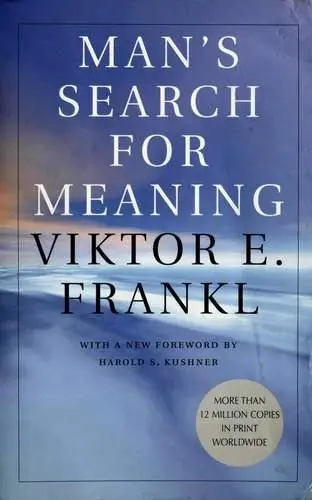
A psychiatrist's account of surviving Auschwitz and Dachau, and the therapy he built on it: that a person can bear almost anything if life still asks something of them.
In copyright, so the PDF is off: see Copyright, below.
Viktor Frankl (1905–1997) was a Viennese psychiatrist and neurologist. In 1942 he was deported with his wife and parents to the Theresienstadt ghetto, and from there to Auschwitz and two subcamps of Dachau, where he was freed in April 1945. His father died at Theresienstadt, his mother and brother at Auschwitz, and his wife at Bergen-Belsen. He wrote this book in nine days the following year.
The first part tells life in the camps from the inside: the shock of arrival, the apathy that followed, and what came after liberation. Frankl watched which prisoners held on and which gave up, and concluded that what kept people alive was less strength or luck than a reason to go on: a person waiting for them, a work to finish, or the way they chose to bear what could not be changed. Everything can be taken from a man, he writes, except the freedom to choose his attitude to his circumstances.
The second part sets out logotherapy, the school of psychotherapy Frankl founded on that observation: that the primary drive in people is not pleasure or power but meaning, found in what we create, in what and whom we love, and in how we face suffering. Later editions add his 1984 postscript, “The Case for a Tragic Optimism.”
Copyright
In copyright. Frankl wrote the book in German in 1946 (… trotzdem Ja zum Leben sagen); Ilse Lasch's English translation appeared in 1959, and Beacon Press publishes it today. Frankl died in 1997. The copy on the Internet Archive was uploaded by one of its users; the archive gives no licence for it, and none is kept here.
- Held by
- The Frankl estate, and Beacon Press for the English edition
- Public domain in the United States
- 1 January 2055 for the 1959 translation, 95 years after publication; the 1946 original, 1 January 2042
- Public domain in Canada
- 1 January 2068, 70 years after Frankl's death in 1997
The dates are worked out from the publication dates and the authors' deaths. In the United States a book published before 1978 is protected for 95 years after publication, and a later one for 70 years after its author's death; in Canada a book is protected for 70 years after its author's death. Protection runs to the end of the year, so a book enters the public domain on 1 January.